
Want to try this solution for the first time?
Get in touch with our team today and request a quote to trial the Klenow Fragment (3'→5' exo–) (low concentration).
Klenow Fragment (3'→5' exo–) (low concentration)
Cat no. / ID. P7010-LC-L
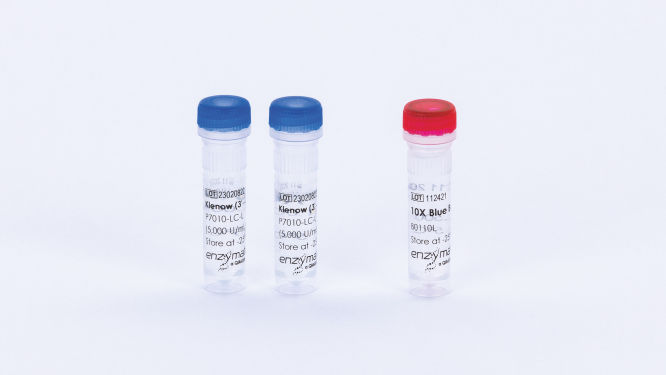
10,000 U of Klenow (3'→5' exo–) (2.0 mL at 5000 U/mL) and 10X Blue Buffer (1 x 1.5 mL)
Log in To see your account pricing.
Enzyme
Klenow Fragment (3'→5' exo–) (low concentration)
Klenow Fragment (3'→5' exo–) (high concentration)
The Klenow Fragment (3'→5' exo–) is intended for molecular biology applications. This product is neither intended for the diagnosis, prevention or treatment of a disease, nor has it been validated for such use either alone or in combination with other products.
Want to try this solution for the first time?
Get in touch with our team today and request a quote to trial the Klenow Fragment (3'→5' exo–) (low concentration).
Features
- DNA polymerase lacking proofreading (3'→5' exonuclease) and nick translation (5'→3' exonuclease) activities
- Retains robust 5'→3' DNA polymerase activity
- Incorporates modified nucleotides including fluorescent labels for microarray
- Best for dA/dT tailing for adapter ligation to DNA fragments for next-generation sequencing
- High purity enzyme tested for absence of contaminating nucleases
Product Details
Klenow Fragment (3'→5' exo-) is the large fragment of DNA polymerase I (Klenow Fragment) that has been rendered deficient in both proofreading (3'→5' exonuclease) and nick translation (5'→3' exonuclease) activities. Klenow Fragment (3'→5' exo-) is a mesophilic DNA polymerase that displays moderate strand displacement activity during DNA synthesis.
Klenow Fragment (3′→5′ exo–) is ideal for dA/dT tailing (also called A-tailing). The enzyme’s terminal transferase activity adds a single adenine (A) or thymine (T) nucleotide to the 3' ends of blunt-ended DNA fragments allowing for the direct ligation of DNA sequencing adapters during next-generation sequencing library preparation. The "exo minus" mutation eliminates the 3′→5 exonuclease activity, preventing the enzyme from removing the added A/T tail. This feature also allows for efficient and stable end-labeling of DNA using Klenow Fragment (3′→5′ exo–) to incorporate labeled nucleotides at the 3’ ends of DNA fragments with 5’ overhangs.
Supplied in:
20 mM Tris-HCl, 1 mM DTT, 0.1 mM EDTA, 50% glycerol; pH 7.5 @ 25⁰C.
Supplied with:
10X Blue Buffer (B0110) containing 500 mM NaCl, 100 mM Tris-HCl, 100 mM MgCl2, 10 mM DTT; pH 7.9 at 25°C.
For applications that require DNA synthesis with proofreading such as cDNA second strand synthesis and blunting 3’ or 5’ overhangs, use Klenow Fragment. This enzyme lacks the holoenzyme’s 5ʹ→3ʹ exonuclease domain while retaining 5'→3' DNA polymerase and 3ʹ→5ʹ exonuclease activity.
Performance
Klenow Fragment (3′→5′ exo–) is tested for purity, activity and the absence of contaminating endonucleases and exonucleases.
| Assay | Specification |
| Purity | >99% |
| Specific activity | 10,000 U/mg |
| Single-stranded exonuclease | 500 U <10% released |
| Double-stranded exonuclease | 500 U <1% released |
| Double-stranded endonuclease | 500 U = No conversion |
| E. coli DNA contamination | 500 U <10 copies |
| UDG activity | <20 U/mL |
Principle
E. coli DNA Polymerase I and its Klenow Fragment variants differ according to which enzymatic domains have been removed or mutated. DNA polymerase I holoenzyme is a single polypeptide chain consisting of ∼930 residues with three activities:
- 5'→3' DNA-dependent DNA polymerase
- 3'→5' exonuclease (proofreading)
- 5'→3' exonuclease (for nick translation)
Enzyme activities of E. coli DNA Polymerase I and its variants
| Enzyme activity | DNA Polymerase I (holoenzyme) | Klenow Fragment | Klenow Fragment (3'→5' exo-) |
| Catalog number | P7050L | P7060L | P7010-LC-L P7010-HC-L |
| 5’→3’ DNA polymerase | Yes | Yes | Yes |
| 3’→5’ exonuclease (proofreading) | Yes | Yes | No |
| 5’→3’ exonuclease (for nick translation) | Yes | No | No |
Nick translation with DNA Polymerase I utilizes its 5'→3' exonuclease to remove nucleotides ahead of a DNA nick, while simultaneously replacing them with tagged nucleotides in the 5' to 3' direction. This 5’→3’ exonuclease activity will also degrade single-stranded and double-stranded DNA from free 5'-ends making the holoenzyme unsuitable for some applications.
Klenow Fragment of E. coli DNA Polymerase I lacks the 5'→3' exonuclease activity but retains the 5'→3' DNA polymerase activity and the 3'→5' exonuclease activity for proofreading and removal of incorrectly incorporated nucleotides. The 3'→5' exonuclease proofreading activity retained by Klenow Fragment can also be undesirable in some circumstances.
Certain specific applications benefit from using non-proofreading DNA polymerases. The 3′→5′ exonuclease proofreading activity retained by Klenow Fragment can also be undesirable in some circumstances because it may excise mismatched or modified nucleotides. A non-proofreading DNA polymerase such as Klenow Fragment (3'→5' exo-) is preferred for labeling DNA with modified nucleotides (e.g., fluorescent bases) as the enzyme cannot excise "mismatched" bases and will efficiently incorporate modified dNTPs.
Procedure
A-tailing or end-labeling of 3‘ termini with Klenow Fragment (3'→5' exo-)
Before A-tailing or end-labeling, ensure DNA fragments are fully blunt-ended by performing an end-repair step if necessary. Clean up with a column-based kit to remove enzymes and unincorporated nucleotides.
- Set up the following reaction mixture in a total volume of 50 µL.
- 1–5 μg purified DNA (template or primer) containing blunt-ends
- 5 µl 10X Blue Buffer
- For A-tailing
- 0.5 μL dATP (10 mM) to a final concentration of 100 µM
- For labeling
- Labeling dNTP Mix: 33 µM each of the unlabeled dNTPs (for 3 of the 4 bases)
- Labeled dNTP: 0.5–2 µL of labeled or fluorescently tagged dNTP
- Add 3 Units Klenow Fragment (3'→5' exo-) per µg DNA
- Add nuclease-free water up to 50 µL
- Add nuclease-free water up to 50 µL
- Clean up the labeled DNA using a spin column-based method (e.g., QIAamp DNA Micro Kit (50), cat. no. 56304).
Instructions for using Klenow Fragment (3'→5' exo-) are provided in the corresponding kit protocol in the resources below.
Quality Control
Klenow Fragment (3'→5' exo-) unit activity was measured using a 2-fold serial dilution method. Dilutions of enzyme were made in a glycerol (50%) containing Klenow (3'→5' exo-) storage solution and added to 50 μL reactions containing Calf Thymus DNA, 1X Blue Buffer, 3H-dTTP and 100 μM dNTPs. Reactions were incubated for 10 minutes at 37°C, plunged on ice, and analyzed using the method of Sambrook and Russell (Molecular Cloning, v3, 2001, pp. A8.25-A8.26).
Protein concentration of Klenow Fragment (3'→5' exo-) (OD280) was determined by OD280 absorbance.
Klenow Fragment (3'→5' exo-) physical purity was evaluated by SDS-PAGE of concentrated and diluted enzyme solutions followed by silver stain detection. Purity was assessed by comparing the aggregate mass of contaminant bands in the concentrated sample to the mass of the protein of interest band in the diluted sample.
Single-stranded exonuclease activity in Klenow Fragment (3'→5' exo-) was determined in a 50 μL reaction containing a radiolabeled single-stranded DNA substrate and 10 μL of enzyme solution incubated for 4 hours at 37°C.
Double-stranded exonuclease activity in Klenow Fragment (3'→5' exo-) was determined in a 50 μL reaction containing a radiolabeled double-stranded DNA substrate and 10 μL of enzyme solution incubated for 4 hours at 37°C.
Double-stranded endonuclease activity in Klenow Fragment (3'→5' exo-) enzyme was determined in a 50 μL reaction containing 0.5 μg of plasmid DNA and 10 μL of enzyme solution incubated for 4 hours at 37°C.
E. coli contamination of Klenow Fragment (3'→5' exo-) was evaluated using 5 μL replicate samples of enzyme solution denatured and screened in a TaqMan qPCR assay for the presence of contaminating E. coli genomic DNA using oligonucleotide primers corresponding to the 16S rRNA locus.
Uracil DNA glycosylase (UDG) contamination of Klenow Fragment (3'→5' exo-) was assessed in a 50 μL reaction containing tritiated uracil DNA and 10 μL enzyme solution incubated for 60 minutes at 37°C under standard UDG unit characterization conditions.
Applications
Klenow Fragment (3′→5′ exo–) is used in a range of DNA labeling and manipulation workflows in molecular biology. Lack of both 5→3' and 3'→5' exonuclease activities ensures that ends of newly synthesized DNA are not digested.
Principal applications
- Proven choice for DNA labeling
- dA/dT-tailing for next-generation sequencing adapter ligation
Other applications
- cDNA second strand synthesis using a defined adapter or sequence tag to initiate polymerization
- Generation of single-stranded DNA probes using random primers
- Sanger DNA sequencing of single- or double-stranded DNA templates
- Site-directed DNA mutagenesis using synthetic oligonucleotides
Resources
Brochures & Guides (1)
Software-related downloads (2)
Safety Data Sheets (1)
Certificates of Analysis (1)