
Want to try this solution for the first time?
Get in touch with our team today and request a quote to trial the Exonuclease I (30,000 U).
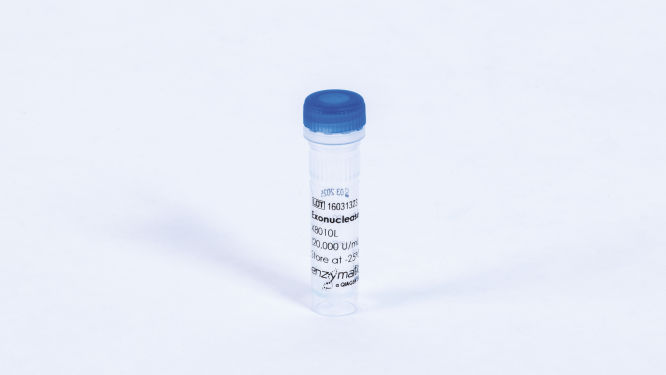
Exonuclease I (30,000 U)
Cat no. / ID. X8010L
30,000 U of Exonuclease I (1.5 mL at 20,000 U/mL)
The Exonuclease I is intended for molecular biology applications. This product is not intended for the diagnosis, prevention, or treatment of a disease.
Want to try this solution for the first time?
Get in touch with our team today and request a quote to trial the Exonuclease I (30,000 U).
Features
- Highly processive 3′→5′ exonuclease activity specific to single-stranded DNA
- Efficiently removes PCR primers and residual ssDNA leaving dsDNA and 5′ termini intact
- Active in PCR and most standard molecular biology buffers
- Heat-inactivatable at 80°C, enabling simple one-tube workflows
- Recombinant enzyme produced in E. coli
- High purity enzyme with no detectable double-stranded endonuclease activity
Product Details
Exonuclease I is a highly processive enzyme that selectively cleaves single-stranded DNA in the 3′→5′ direction, releasing deoxyribonucleoside 5'-monophosphates. Digestion is inhibited where the terminal 3'-OH group is blocked by phosphoryl or acetyl groups. Exonuclease I will preferentially degrade single-stranded oligonucleotide primers in a reaction containing amplification products or other sources of double-stranded DNA, leaving double-stranded molecules intact.
Exonuclease I works well in most molecular biology buffers that contain magnesium over 1.5 mM. The enzyme can be heat inactivated by incubation at 80°C for 15 minutes.
Exonuclease I is purified from a strain of E. coli that expresses the recombinant Exonuclease I gene. Molecular weight is 54.5 kDa.
Supplied in:
10 mM Tris-HCl, 100 mM NaCl, 1 mM DTT, 0.5 mM EDTA and 50% glycerol; pH 7.5 at 25°C. Storage temperature: –25°C to –15°C.
Performance
Exonuclease I is tested for purity, activity and the absence of contaminating dsDNA endonucleases.
| Test | Units tested | Specification |
|---|---|---|
| Purity | n/a | >99% |
| Specific activity | n/a | 185,000 U/mg |
| Double-stranded endonuclease | 200 U | No conversion |
| E. coli DNA contamination | 200 U | <10 copies |
One unit is defined as the amount of enzyme required to produce 10 nmol of acid-soluble total nucleotide in 30 minutes at 37°C.
Principle
Exonuclease I cleaves single-stranded DNA in the 3ʹ→5ʹ direction, releasing 5ʹ mono/di-nucleotides and leaving double-stranded DNA molecules and the 5ʹ terminus intact. The enzyme is processive although digestion is inhibited by a 3ʹ terminal phosphate. Exonuclease I is tolerant of a wide range of buffer conditions and can typically be added to reactions containing magnesium (1–3).
- Lehman IR, Nussbaum AL. J. Biol. Chem. 1964; 239: 2628.
- Kushner SR, et al. Proc. Natl. Acad. Sci. USA 1971; 68: 824.
- Kushner SR, et al. Proc. Natl. Acad. Sci. USA 1972; 69: 366.
Procedure
Removal of single-stranded DNA from PCR products (one-tube cleanup)
- Combine PCR product with Exonuclease I (10 units) in a total volume of 20 µL.
- Incubate at 37°C for 15 minutes.
- Heat inactivate at 80°C for 15 minutes.
Notes
Exonuclease I preferentially degrades ssDNA primers in the presence of dsDNA.
The enzyme is compatible with most buffers containing ≥1.5 mM Mg²⁺.
Quality Control
Unit activity was measured using a twofold serial dilution method.
Dilutions of the enzyme were made in an Exonuclease I storage solution containing glycerol (50%) and added to 50 µL reactions containing a single-stranded tritiated DNA fragment and 67 mM glycine-KOH (pH 9.5), 10mM DTT, 6.7 mM MgCl2. Reactions were incubated for 10 minutes at 37°C, placed on ice, and analyzed using a TCA-precipitation method.
Protein concentration is determined by OD280 absorbance.
Physical purity is evaluated by SDS-PAGE of concentrated and diluted enzyme solutions followed by silver-stain detection. Purity is assessed by comparing the aggregate mass of contaminant bands in the concentrated sample to the band's mass corresponding to the protein of interest in the diluted sample.
Double-stranded endonuclease activity is determined in a 50 µL reaction containing 0.5 µg of plasmid DNA and 10 µL of enzyme solution incubated for 4 hours at 37°C.
E. coli contamination is evaluated using 5 µL replicate samples of enzyme solution that are denatured and screened in a TaqMan qPCR assay for the presence of contaminating E. coli genomic DNA using oligonucleotide primers corresponding to the 16S rRNA locus.
Applications
The specificity of Exonuclease I for ssDNA makes it ideal for workflows requiring removal of residual ssDNA from nucleic acid mixtures.
- PCR cleanup: Exonuclease I degrades leftover single-stranded primers from amplification reactions leaving newly synthesized dsDNA intact.
- Next-generation sequencing (NGS): Exonuclease I treatment will remove excess linear oligonucleotides, improving the yield and quality of 3' cDNA ligation-based libraries.
- Preparation for DNA sequencing or cloning: Use Exonuclease I to purify PCR products before SNP analysis, sequencing or cloning to remove excess primers.
- Nested PCR: Exonuclease I removes unused primers from the first round of PCR to minimize interference with subsequent rounds of nested amplification.
- Cleanup of plasmid preparations: Exonuclease I treatment reduces background contamination by removing linear ssDNA and oligonucleotide primers leaving circular plasmids intact.
Limitations of Exonuclease I
- Does not digest double-stranded DNA or short 3′ overhangs
- Not suitable for removal of 3′ overhangs from dsDNA
- Requires a free 3′-OH terminus for activity
Resources
Brochures & Guides (1)
Software-related downloads (1)
Safety Data Sheets (1)
Certificates of Analysis (1)