
Want to try this solution for the first time?
Get in touch with our team today and request a quote to trial the RNase H (5000 U).
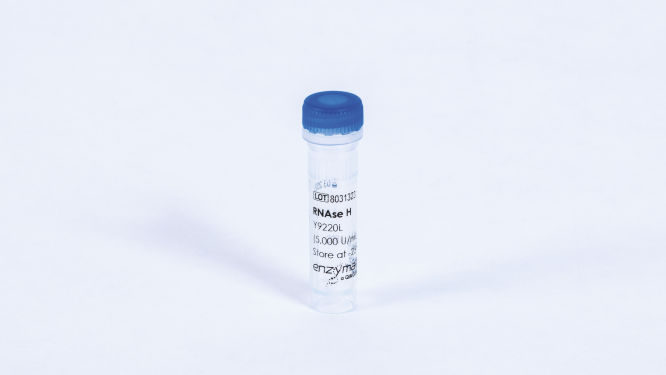
RNase H (5000 U)
Cat no. / ID. Y9220L
RNase H (1 mL at 5000 U/mL) and 10X RNase H Buffer (2 x 1.5 mL)
The RNase H (5000 U) is intended for molecular biology applications. This product is neither intended for the diagnosis, prevention or treatment of a disease, nor has it been validated for such use either alone or in combination with other products.
Kindly note that the delivery takes three to four weeks at the moment. We will keep you posted with any developments. Thank you for choosing us as your molecular biology partner.
Want to try this solution for the first time?
Get in touch with our team today and request a quote to trial the RNase H (5000 U).
Features
- Recombinant RNase H (Ribonuclease H) purified from E. coli carrying the E. coli RNase H (rnh) gene
- Degrades RNA in RNA-DNA hybrids by specifically hydrolyzing RNA phosphodiester bonds
- Does not digest single-stranded DNA, double-stranded DNA or unhybridized RNA
- Supplied with an optimized reaction buffer
- Tested for the absence of contaminating endonucleases, exonucleases and other RNases
- Thermostable RNase H is available for applications requiring higher incubation temperatures
Product Details
Ribonuclease H (RNase H) is an endoribonuclease that selectively hydrolyzes phosophodiester bonds in the RNA strand of RNA-DNA hybrids. The enzyme is highly specific and does not digest single- or double-stranded DNA and does not digest unhybridized RNA. Divalent metal cations (typically (Mg2+) are required to drive catalysis.
QIAGEN RNase H is purified from a recombinant E. coli strain carrying the RNase H (rnh) gene from E. coli.
Supplied in:
20 mM Tris-HCl, 100 mM KCl, 0.1 mM DTT, 10 mM MgCl2, 0.1 mM EDTA, 50% glycerol (pH 7.9 at 25°C)
Supplied with:
10X RNase H Buffer (B9220): 500 mM Tris-HCl, 750 mM KCl, 30 mM MgCl2, 100 mM DTT (pH 8.3 at 25°C)
Use Thermostable RNase H (coming soon) to increase stringency, minimize nonspecific binding, and in applications where higher incubation temperatures are required.
Performance
RNase H is tested for purity, activity and the absence of contaminating endonucleases, exonucleases and other RNases.
- Storage temperature: –25°C to –15°C
- Molecular weight: 18.1 kDa
| Test | Amount tested | Specification |
| Purity | n/a | >99% |
| Specific activity | n/a | 625,000 U/mg |
| Single-stranded exonuclease | 500 U | <5.0 % released |
| Double-stranded exonuclease | 500 U | <1.0 % released |
| Double-stranded endonuclease | 500 U | No conversion |
| E. coli DNA contamination | 500 U | <10 copies |
| Non-specific RNase | 500 U | No detectable non-specific RNase |
One unit is defined as the amount of enzyme that will hydrolyze 1 nmol of RNA from a 3H-labeled DNA-RNA hybrid molecule into acid-soluble material in 20 minutes at 37°C.
Principle
Ribonuclease H is an endoribonuclease that specifically hydrolyzes the RNA strand in RNA-DNA heteroduplexes. Hydrolysis of the RNA phosphodiester bond results in the formation of 3′ hydroxyl and 5′ phosphate groups. The enzyme requires divalent metal cations, typically Mg2+ to drive catalysis. E. coli RNase H belongs to the RNase H1 class of enzymes present in prokaryotes, eukaryotes and the domains of reverse transcriptases.
Ribonuclease H enzymes are required for DNA integrity and are involved in fundamental cellular processes including removing the short stretch of RNA from Okazaki fragments and the long stretch of RNA from R-loops. The strict selectivity of RNase H makes it indispensable to molecular biology workflows where cleavage of RNA in RNA-DNA hybrids is required. The enzyme is widely used in RT-PCR and cDNA synthesis to remove messenger RNA (mRNA) after first-strand cDNA synthesis.
Procedure
Usage Instructions
- Set up the following reaction mixture in a total volume of 100 µL:
Components Final Concentration Volume Nuclease-free water N/A X µL 10X RNase H Buffer (B9220) 1X 10 µL RNA: DNA duplex 2 µg X µL RNase H (Y9220L) 5 U 1 µL Total Volume = 100 µL - Incubate the reaction at 37°C for 20 minutes.
Applications
RNase H is an endoribonuclease specific for degradation of RNA in RNA-DNA heteroduplexes without digestion of the DNA strand. This strict selectivity makes RNase H an indispensable addition to molecular biology workflows for cDNA synthesis, RNA structural analyses and other applications where cleavage of RNA in RNA-DNA hybrids is required.
- cDNA synthesis: RNase H degrades mRNA following first-strand cDNA synthesis to enable synthesis of the second DNA strand
- RT-PCR: RNase H removes RNA templates after reverse transcription to improve downstream DNA amplification
- RT-qPCR: RNase H enhances specificity and performance through controlled degradation of RNA in RNA-DNA hybrids
- Post–reverse transcription cleanup: Selective action of RNase H prepares cDNA for downstream enzymatic reactions
- Site-specific cleavage of RNA within RNA-DNA hybrids: RNase H facilitates mapping of RNA structure or probing specific RNA regions
Resources
Brochures & Guides (1)
Software-related downloads (1)
Safety Data Sheets (1)
Certificates of Analysis (1)