
Want to try this solution for the first time?
Get in touch with our team today and request a quote to trial the RNase Inhibitor Hu (2000 U).
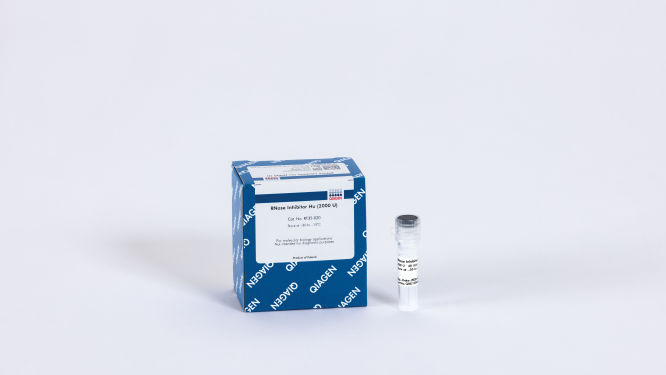
RNase Inhibitor Hu (2000 U)
Cat no. / ID. RT35-020
Supplied at a concentration of 40 U/µL. (Storage temperature: -20°C without a defrost cycle)
Log in To see your account pricing.
Quantity
2000 U
10000 U
20000 U
40000 U
400000 U
1600000 U
The RNase Inhibitor Hu is intended for molecular biology applications. This product is neither intended for the diagnosis, prevention or treatment of a disease, nor has it been validated for such use either alone or in combination with other products.
Want to try this solution for the first time?
Get in touch with our team today and request a quote to trial the RNase Inhibitor Hu (2000 U).
Features
- Heat stable noncompetitive inhibitor of pancreatic-type ribonucleases e.g., RNases A, B and C
- Active at 60°C and retains full stability at 37°C for at least 4 weeks with no loss of activity
- Active in diverse reaction conditions and in various buffers
- Preserves RNA without inhibiting other RNases and modifying enzymes
- Recombinant protein expressed in E.coli carrying the human placental protein gene
Product Details
RNase Inhibitor Hu is a thermally resistant, 50 kDa recombinant human placental protein expressed in Escherichia coli that inhibits RNase activity of common eukaryotic enzymes such as RNase A, RNase B, RNase C.
Native ribonuclease inhibitor is a large (~450 residues, ~50 kDa), acidic (pI ~4.7), leucine-rich repeat protein. Ribonuclease inhibitor shows remarkable affinity for pancreatic-type ribonucleases and acts as a potent noncompetitive inhibitor of these enzymes. The resulting noncovalent complexes are some of the tightest known in biology. Ribonuclease inhibitor does not interfere with the activities of other RNases and modifying enzymes like polymerases and reverse transcriptases.
Ribonuclease inhibitors are essential in molecular biology to minimize the action of ubiquitous ribonucleases that can compromise RNA experiments. The source of RNases within skin, air or labware is primarily microorganisms: bacteria, viruses and fungi.
Benefits of using RNase Inhibitor Human
- Recombinant human enzyme is thermostable and active up to 60°C
- Maximum protection of RNA integrity for intact RNA during handling, storage and assays
- Outperforms alternative supplier products, consistently achieving high RNA integrity
- Suitable for higher temperature applications in RT-PCR, RT-qPCR and RT-LAMP
- Greater resistance to oxidation with more activity at low reducing conditions
- Active over a broad pH range (5.5 to 9.0) and in various buffers
- Improved yields in transcription/translation in in vitro transcription and translation (IVT) systems
RNase Inhibitor Hu is a heat stable recombinant human placental protein expressed in E.coli. RNase Inhibitor Hu retains full stability at 37°C for at least 4 weeks with no loss of activity.
RNase Inhibitor Hu is supplied with 20 mM Hepes-KOH (pH 7.6), 50 mM KCl, 8 mM reducing agent, 50% (v/v) glycerol. The enzyme is active up to 60°C and at a minimum 0.5–1 mM DTT concentration ranges.
One unit is defined as the amount of enzyme required to inhibit the activity of 5 ng RNase A by 50%.
In applications where RNase inhibitor activity at higher temperatures is less critical, RNase Inhibitor Y9240L is stable up to 50°C and is suitable for use at temperatures ≤50°C.
Performance
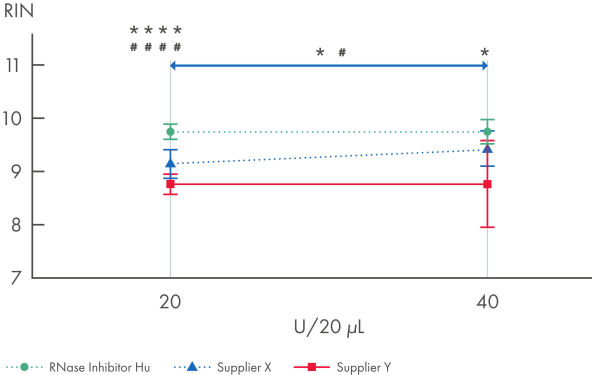
RNase Inhibitor Hu outperforms alternative supplier products, consistently achieving high RNA integrity (see figure “ Summary of RNA integrity number (RIN) results for three RNase Inhibitors”).

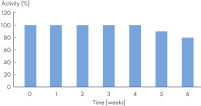
RNase Inhibitor Hu displays full stability at 37°C for at least 4 weeks. High thermostability guarantees high activity even after exposure to increased temperatures e.g., during worktime on the bench or demanding shipping conditions (see figure “ Stability of RNase Inhibitor Hu at 37°C over a 6-week period”).

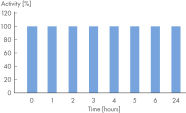
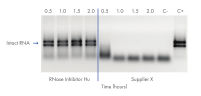
RNase Inhibitor Hu demonstrates stable enzyme activity at 50°C for at least 24 hours. This is applicable for molecular biology applications at elevated temperatures. Enzyme stability at 50°C ensures maximum protection of RNA during reverse transcription or amplification (see figure “ Stability of RNase Inhibitor Hu incubated at 50°C over a 24 hour period”). Stability in stringent thermal conditions is an important requirement for RNA synthesis and reverse transcription. RNase Inhibitor Human remains fully active for two hours at 60°C (see figure “ RNase Inhibitor Hu is thermostable at 60°C”).


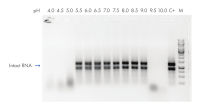
RNase Inhibitor Human retains its activity and RNA protection consistently over a pH range from 5.5 to 9.0 (see figure “ RNase Inhibitor Hu works in a wide pH range, from 5.5 to 9.0”).

| Assay | Specification |
|---|---|
| Purity | >90% |
| RNase contamination | None detected |
| Latent RNase contamination | None detected |
| Exonuclease contamination | None detected |
| Endonuclease contamination | None detected |
Quality Control
Protein purity is determined using assay by SDS-PAGE electrophoresis resulting in >90% purity.
RNase contamination is evaluated by assessing RNase activity through incubation of 1 µg of RNA with a minimum of 200 U of the RNase Inhibitor for 1 hour at 37°C. Results are visualized on an ethidium bromide-stained agarose gel.
Latent RNase contamination is evaluated by assessing latent RNase activity through incubation of 1 µg of RNA with a minimum of 200 U of heat-inactivated RNase Inhibitor for 1 hour at 37°C. Results are visualized on an ethidium bromide-stained agarose gel.
Endonuclease activity is determined by incubating 1 µg of supercoiled plasmid DNA with a minimum of 200 U of the RNase Inhibitor for 2 hours at 37°C. Results are visualized on an ethidium bromide-stained agarose gel.
Exonuclease activity is determined by incubating 1 µg of digested plasmid DNA with a minimum of 200 U of the RNase Inhibitor Lyo-ready for 2 hours at 37°C. Results are visualized on an ethidium bromide-stained agarose gel.
Principle
The protein structure of ribonuclease inhibitor is characterized by 15–17 leucine-rich, tandemly repeated, ~28–29 amino acid residues in a horseshoe-shape consisting of alternating α-helices (outer curve) and β-strands (inner curve) along its backbone. All the 30–32 cysteine residues must remain reduced for the protein to retain activity.
RNase A is a kidney-shaped molecule, and the active site of the enzyme lies in a cleft between two lobes of the protein. Ribonuclease inhibitor inhibits RNase A by blocking the active site. RNase B, C and D are glycosylated forms of RNase A sharing the same protein sequence but differing in their sugar modifications. RNase H is not inhibited by standard commercial ribonuclease inhibitors. The noncovalent binding mechanism that targets RNase A-type enzymes does not recognize the active site of RNase H.
Heat stable Ribonuclease Inhibitor Hu is used in applications where the presence of RNases causes a substantial hazard in receiving good quality, reproducible data, e.g., in RNA isolation, cDNA synthesis, RT-PCR, in vitro transcription and translation, or RNase-free monoclonal antibody preparation. It is compatible with numerous reagents, including DNA polymerases and AMV or M-MuLV Reverse Transcriptase, and its addition into the reaction does not influence the efficiency of other components.
RNase Inhibitor Hu shares many of the features and function of standard RNase Inhibitor Y9240L with important advantages:
- Stable at 37°C for at least 4 weeks without loss of activity
- Retains activity up to 60°C
- Exhibits better resistance to oxidation
Procedure
The optimal final concentration of RNase Inhibitor Hu in a reaction depends on the level of RNase contamination, the incubation time and the compounds present in the reaction mixture. It falls within a range of 1–2 U/μL.
For a standard reverse transcription reaction, use 1 μL (40 U) of RNase Inhibitor Hu for a final sample volume of 20 μL. A final DTT concentration of 0.5–1 mM is essential for optimal activity.
During the reaction assembly, the enzyme should be added before other components that are possible sources of RNase contamination.
Using RNase Inhibitor Hu does not exclude RNase H treatment after amplification of the first strand cDNA.
Instructions for using RNase Inhibitor Hu are provided in the corresponding Quick-Start Protocol in Resources below.
Applications
Ribonuclease Inhibitor Hu is used for maximum protection of RNA integrity in applications where the presence of ribonucleases may pose a risk to RNA quality and experimental results.
RNase Inhibitor Hu has been developed to withstand heat cycles and freeze-thaw events for greater experimental flexibility and logistical convenience (e.g., ambient shipping and storage) for modern, high-throughput workflows like single-cell RNA-seq. RNase Inhibitor Hu is stable at 37°C for at least 4 weeks without loss of activity, remains active up to 60°C and has greater resistance to oxidation for more activity at low reducing conditions.
cDNA synthesis: Protects template RNA during reverse transcription to enhance cDNA yield and prevent degradation that could lead to incomplete or inaccurate cDNA production.
RT-PCR and RT-qPCR: Ensures that the integrity of the RNA template is maintained, critical for accurate detection of low-copy number RNA in one-step or two-step RT-PCR; protects against false-negative results in research and analytical RT-PCR applications.
RNA-Seq library workflows: Ensures success through several stages of the RNA-seq library preparation workflow by maintaining RNA integrity, thereby improving data quality and enhancing reproducibility.
In vitro transcription and translation: Inhibits degradation of synthetic RNA in cell-free systems wherever stable, full-length transcripts are required.
RNase inhibitor works with T7 RNA Polymerase in workflows involving in vitro transcription and RNA sequencing. T7 RNA Polymerase synthesizes high-fidelity RNA from DNA templates; RNase Inhibitor protects the resulting RNA from degradation.
RNA isolation and purification: Inhibits endogenous ribonucleases released during tissue or cell lysis preventing compromise of RNA quality.
RNA Storage: Maintains RNA sample quality over long periods in freezer storage.
Monoclonal antibody production: Protects RNA from degradation during the intermediate steps involving RNA isolation, reverse transcription and gene expression analysis and is essential to producing high-quality, reproducible data for antibody cloning and characterization.
CRISPR guide RNA production: Prevents RNA degradation during in vitro transcription and storage to ensure the integrity of guide RNAs (gRNAs) necessary for CRISPR gene editing and critical for precise gene targeting.
Northern blotting: Protects against degradation of RNA targets during handling; inhibits RNases in reaction mixtures during the reverse transcription step for probe generation.
Unlike PCR-based methods, Northern blotting provides visualization of the RNA molecule's size and can directly detect RNA degradation. Applications of Northern blotting include analyzing gene expression, examining alternative gene splicing and studying mRNA stability and processing.
Enzyme assays: Protects sensitive RNA molecules in applications like RNA degradation studies and RNA-protein interaction analysis.
Ribonuclease characterization: Selectively inhibits specific types of RNases (e.g., pancreatic-type RNases) in experimental setups.
Supporting data and figures
Summary of RNA integrity number (RIN) results for three RNase Inhibitors
Two quantities, 20 and 40 U, of each RNase inhibitor were added per 20 μL reaction. The RIN was determined to establish the RNA protection level. RNase Inhibitor Hu consistently exhibited the highest RIN. Points: mean, whiskers – SD. *, # – determination for statistically significant differences between RNase Inhibitor Hu and RNase inhibitors from Suppliers X and Y, respectively. *, #: p <0.05; ****, ####: p <0.0001: Student‘s t-test.
Resources
Brochures & Guides (2)
Kit Handbooks & Protocols (1)
Safety Data Sheets (1)
Certificates of Analysis (1)
FAQ
Is there an evolutionary relationship between ribonucleases and RNase inhibitor?