
Want to try this solution for the first time?
Get in touch with our team today and request a quote to trial the RNase Inhibitor (20,000 U).
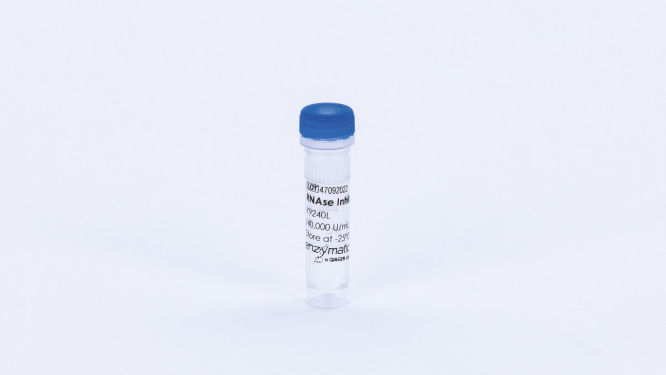
RNase Inhibitor (20,000 U)
Cat no. / ID. Y9240L
20,000 U of RNAse Inhibitor (0.5 mL at 40,000 U/mL). Storage temperature: –25°C to –15°C
Log in To see your account pricing.
The RNase Inhibitor is intended for molecular biology applications. This product is neither intended for the diagnosis, prevention or treatment of a disease, nor has it been validated for such use either alone or in combination with other products.
Want to try this solution for the first time?
Get in touch with our team today and request a quote to trial the RNase Inhibitor (20,000 U).
Features
- Neutralizes pancreatic-type ribonucleases e.g., RNase A, by high affinity noncovalent binding
- Does not inhibit other RNases and modifying enzymes like polymerases and reverse transcriptases
- Minimizes compromise of RNA experiments caused by the presence of RNases
- Recombinant protein expressed in E.coli carrying the porcine RNase Inhibitor gene
- Available in glycerol-free format for lyophilization
Product Details
Native ribonuclease inhibitor is a large (~450 residues, ~50 kDa), acidic (pI ~4.7), leucine-rich repeat protein. Ribonuclease inhibitor shows remarkable affinity for pancreatic-type ribonucleases such as RNase A, RNase B and RNase C and acts as a potent noncompetitive inhibitor of these enzymes. The resulting noncovalent complexes are some of the tightest known in biology. Ribonuclease inhibitor does not interfere with the activities of other RNases and modifying enzymes like polymerases and reverse transcriptases.
Ribonuclease inhibitors are crucial in molecular biology to minimize compromise of RNA experiments by the action of ribonucleases. Ribonucleases are ubiquitous and easily introduced from skin, air or labware. The primary source of RNases within most environments is microorganisms: bacteria, viruses and fungi.
Benefits of using RNase Inhibitor
- Preservation of RNA integrity by preventing degradation during handling, storage and enzymatic assays
- Enhanced experimental accuracy in sensitive applications like qPCR, RT-PCR and RNA-seq
- Improved yields in transcription/translation in in vitro transcription and translation (IVT) systems
RNase Inhibitor is recombinantly expressed in E.coli and is provided as a fusion of the porcine ribonuclease inhibitor gene with a proprietary 22.5 kDa protein tag. RNase Inhibitor is active below 50°C and under nondenaturing conditions.
| Component | Composition | Storage temperature |
|---|---|---|
| RNase Inhibitor (Y9240) | Supplied in 20 mM Hepes-KOH, 50 mM KCl, 8 mM DTT, 50% glycerol, pH 7.5 at 25°C. | –25°C to –15°C |
This product is available in a glycerol-free (lyophilization-ready) format. Contact us for more details.
Many ribonuclease inhibitors have limited stability or activity at high temperatures restricting their use in certain applications. RNase Inhibitor Hu, a recombinant human protein, is stable up to 60°C and is suitable for use in procedures such as reverse transcription at temperatures ≥50°C. RNase Inhibitor Hu is available in pack sizes up to 1,600,000 U.
Performance
Ribonuclease inhibitor is a potent noncompetitive inhibitor of pancreatic-type ribonucleases such as RNase A, RNase B and RNase C. It acts by binding noncovalently in a 1:1 ratio with high affinity. Ribonuclease inhibitor does not interfere with the activities of other RNases or modifying enzymes like polymerases and reverse transcriptases.
Optimal activity of RNase Inhibitor is observed in the range of 25°C to 37°C. Activity significantly decreases, and the inhibitor itself may become denatured and inactivated, at temperatures greater than 50°C. Ribonuclease inhibitor is effective within a pH range of 5.0–8.0.
| Assay | Specification |
| Purity | >99% |
| Specific activity | 53,333 U/mg |
| Single-stranded exonuclease | 2000 U: <5.0% released |
| Double-stranded exonuclease | 2000 U: <1.0% released |
| Double-stranded endonuclease | 2000 U; no conversion |
| E. coli DNA contamination | 2000 U: <10 copies |
| RNase contamination | 2000 U: No detectable non-specific RNase |
Quality control
Details of the following analyses are provided in the corresponding Protocol File in Resources below.
- Unit activity
- Protein concentration
- Physical purity
- Determination of single-stranded exonuclease
- Determination of double-stranded exonuclease
- Determination of double-stranded endonuclease
- E.coli 16S rDNA contamination
- Nonspecific RNase contamination
Principle
The protein structure of ribonuclease inhibitor is characterized by leucine-rich, tandemly repeated amino acid residues in a horseshoe-shape consisting of alternating α-helices (outer curve) and β-strands (inner curve) along its backbone.
RNase A is a kidney-shaped molecule. The active site of this enzyme (and related pancreatic ribonucleases) lies in a cleft between two lobes of the protein. The structure of ribonuclease inhibitor acts as a positively charged framework that binds to and blocks the active site of RNase A, creating one of the tightest known non-covalent protein-protein interactions.
All the 30–32 cysteine residues of ribonuclease inhibitor must remain reduced for the protein to retain activity. DTT (dithiothreitol) or another reducing agent is generally required in molecular biology applications to maintain activity by keeping these cysteine residues reduced.
Procedure
Ribonuclease Inhibitor is used to preserve RNA integrity and prevent degradation by RNase contamination in cDNA synthesis, in vitro transcription/translation reactions and other procedures.
RNase inhibitor is added (final concentration of 1 U/μL) to the reaction mixture before addition of potentially RNase-contaminated components (e.g., enzyme, BSA, template nucleic acids). RNase Inhibitor is active under nondenaturing conditions that ensure essential noncovalent interactions (hydrogen bonds, ionic bonds) holding the 3D structure remain intact.
Optimal activity of ribonuclease inhibitor is observed in the range of 25°C to 37°C. Activity significantly decreases at temperatures greater than 50°C. Inactivation at 65°C for 10 minutes is a common laboratory procedure to remove inhibitor activity if needed.
Instructions for using RNase Inhibitor are provided in the corresponding Protocol File in Resources below.
Applications
Ribonuclease inhibitor is used to protect RNA integrity in applications where the presence of ribonucleases may pose a risk to RNA quality and experimental results.
RNA isolation and purification: Inhibits endogenous ribonucleases released during tissue or cell lysis preventing compromise of RNA quality.
RNA storage: Maintains RNA sample quality over long periods in freezer storage.
cDNA synthesis: Protects template RNA during reverse transcription to enhance cDNA yield and prevent degradation that could lead to incomplete or inaccurate cDNA production.
RT-PCR and RT-qPCR: Ensures that the integrity of the RNA template is maintained, critical for accurate detection of low-copy number RNA in one-step or two-step RT-PCR; protects against false-negative results in research and analytical RT-PCR applications.
In vitro transcription and translation: Inhibits degradation of synthetic RNA in cell-free systems wherever stable, full-length transcripts are required.
RNase Inhibitor works with T7 RNA Polymerase in workflows involving in vitro transcription and RNA sequencing. T7 RNA Polymerase synthesizes high-fidelity RNA from DNA templates; RNase Inhibitor protects the resulting RNA from degradation.
RNA-Seq library workflows: Ensures success through several stages of the RNA-seq library preparation workflow by maintaining RNA integrity, thereby improving data quality and enhancing reproducibility.
Monoclonal antibody production: Protects RNA from degradation during the intermediate steps involving RNA isolation, reverse transcription and gene expression analysis and is essential to producing high-quality, reproducible data for antibody cloning and characterization.
CRISPR guide RNA production: Prevents RNA degradation during in vitro transcription and storage to ensure the integrity of guide RNAs (gRNAs) necessary for CRISPR gene editing and precise gene targeting.
Northern blotting: Protects against degradation of RNA targets during handling; inhibits RNases in reaction mixtures during the reverse transcription step for probe generation.
Unlike PCR-based methods, Northern blotting provides visualization of the RNA molecule's size and can directly detect RNA degradation. Applications of Northern blotting include analyzing gene expression, examining alternative gene splicing and studying mRNA stability and processing.
Enzyme assays: Protects sensitive RNA molecules in applications like RNA degradation studies and RNA-protein interaction analysis.
Ribonuclease characterization: Selectively inhibits specific types of RNases (e.g., pancreatic-type RNases) in experimental setups.
Resources
Brochures & Guides (1)
Software-related downloads (1)
Safety Data Sheets (1)
Certificates of Analysis (1)
FAQ
Is there an evolutionary relationship between ribonucleases and RNase inhibitor?