플라스미드 DNA 추출을 위한 QIAGEN Plasmid Kits

최대 10mg의 트랜스펙션 등급 플라스미드 또는 코스미드 DNA를 정제

S_2406_Qtips

✓ 연중무휴 하루 24시간 자동 온라인 주문 처리

✓ 풍부한 지식과 전문성을 갖춘 제품 및 기술 지원

✓ 신속하고 안정적인 (재)주문

QIAGEN Plasmid Mini Kit (25)

카탈로그 번호 / ID.   12123

QIAGEN-tip 20 25개, 시약, 완충액.
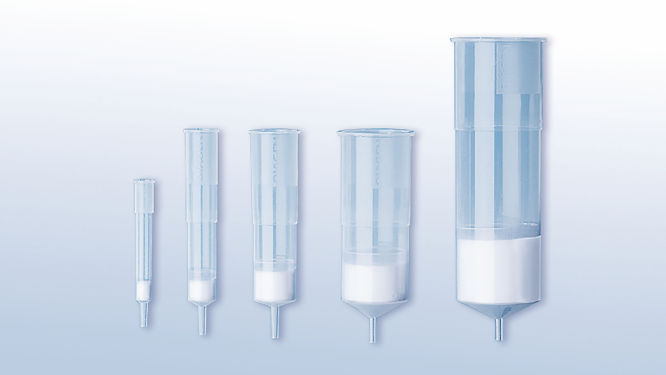
키트완충액컬럼카트리지
Plasmid Kit
Plasmid Buffer Set
QIAGEN-tip
QIAfilter Cartridge
컬럼 유형
Mini
Midi
Maxi
Mega
Giga
준비
25
100
QIAGEN 플라스미드 키트은/는 분자생물학 분야에 사용하기 위한 것입니다. 이 제품들은 질병의 진단, 예방, 또는 치료 목적으로 사용할 수 없습니다.

✓ 연중무휴 하루 24시간 자동 온라인 주문 처리

✓ 풍부한 지식과 전문성을 갖춘 제품 및 기술 지원

✓ 신속하고 안정적인 (재)주문

특징

  • 2회 CsCl 구배 원심분리와 동등한 순도
  • 높은 수율의 플라스미드 DNA
  • 비용 효율적인 프렙
  • 최적의 용해와 최대 DNA 수율을 위한 LyseBlue

제품 세부 정보

QIAGEN 플라스미드 키트는 트랜스펙션 등급 플라스미드 DNA 정제를 위해 중력 흐름(gravity flow) 방식의 음이온 교환 팁을 제공합니다. 용해물 클리어링과 아이소프로판올 침전은 원심분리를 통해 수행됩니다.

QIAGEN Plasmid Mega Kit(카탈로그 번호 12181)와 QIAGEN Plasmid Giga Kit(카탈로그 번호 12191)는 QIAfilter Mega-Giga Cartridges(카탈로그 번호 19781)와 함께 사용할 수 있으며, 이는 원심분리 대신 여과를 통해 박테리아 용해물을 신속하게 클리어링하는 선택적 프로토콜 단계로 활용할 수 있습니다. 아래에서 원리에 대한 더 많은 정보를 확인하세요.

성능

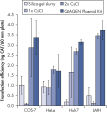
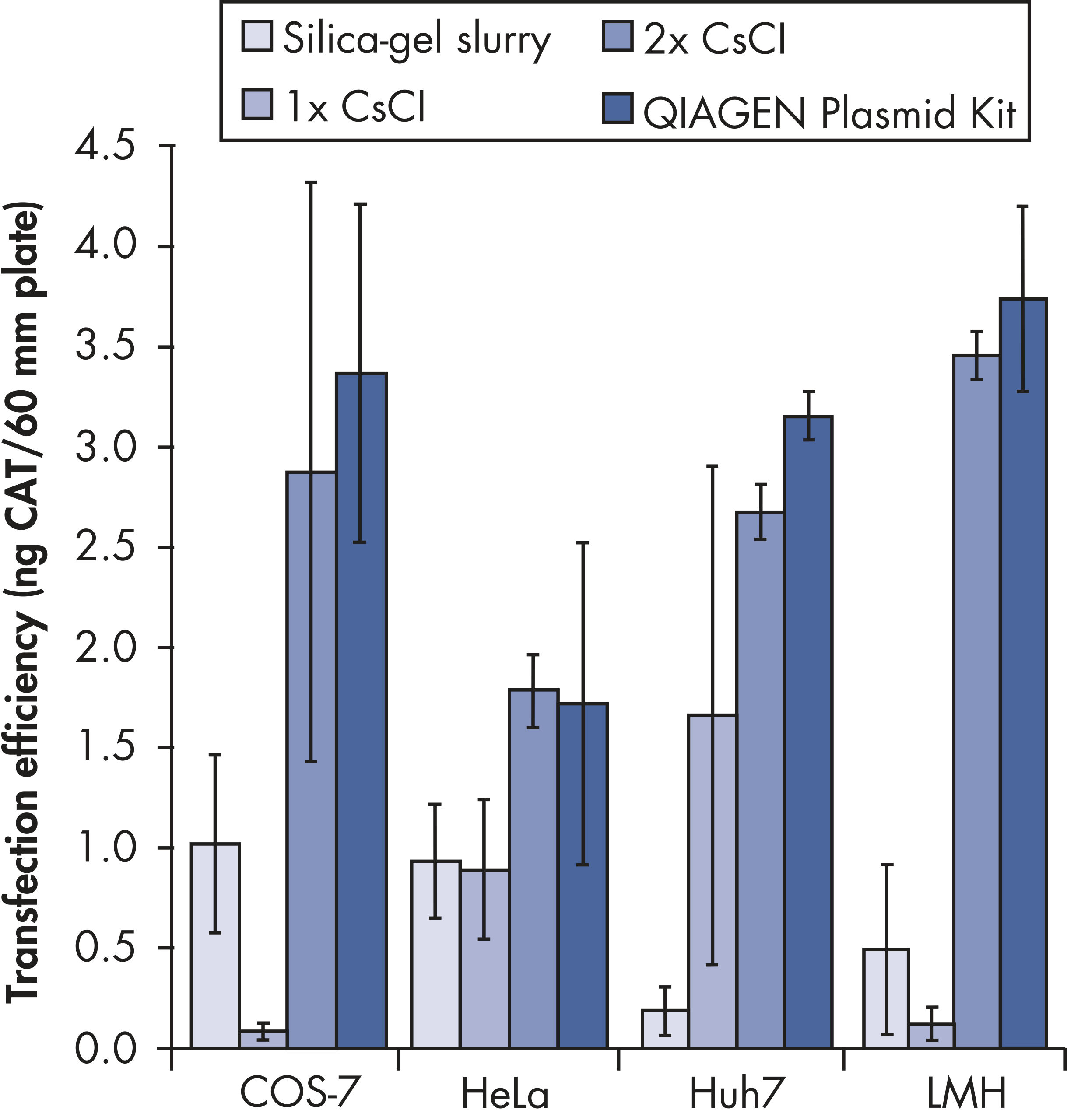
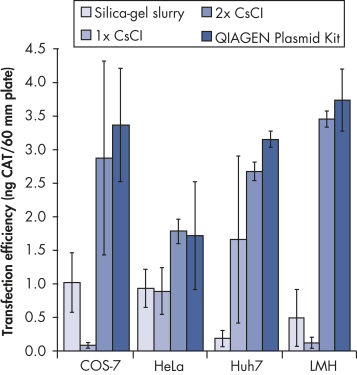
QIAGEN 플라스미드 키트는 플라스미드 DNA의 효율적인 정제를 위해 중력 흐름(gravity flow) QIAGEN 음이온 교환 팁을 사용합니다. 최대 10mg(기가), 2.5mg(메가), 500µg(맥시), 100µg(미디), 20µg(미니)까지의 high-copy 플라스미드 DNA를 배양액에서 정제할 수 있습니다(배양액의 부피는 플라스미드 복제 수, 삽입 유전자 크기, 숙주 균주, 배지 종류에 따라 달라짐). QIAGEN 플라스미드 키트로 정제한 플라스미드 DNA는 트랜스펙션(그림 ‘ 트랜스펙션 효율 대비 플라스미드 정제 방법’ 참고), 클로닝, 시험관 내 전사와 같은 다양한 응용 분야에 매우 적합합니다.

원리

QIAGEN-tips에 사용된 독자적인 음이온 교환 수지는 핵산 정제를 위해 특별히 개발되었습니다. 탁월한 분리 특성 덕분에 이 방법으로 얻은 DNA의 순도는 두 번 연속 CsCl 구배 원심분리로 얻은 것과 같거나 이보다 더 우수합니다. 미리 채워진 QIAGEN-tips는 중력의 힘으로 작동하며 건조해지지 않아 플라스미드 준비에 필요한 수작업 시간이 최소화됩니다. QIAGEN의 전체 플라스미드 정제 시스템은 페놀, 클로로포름, 브롬화 에티듐(ethidium bromide), CsCl과 같은 유해 물질을 사용하지 않아 실험자와 환경에 미치는 위험을 최소화했습니다.

원심분리 대신 여과를 통해 박테리아 용해물을 빠르게 클리어링하는 선택적 프로토콜 단계로 QIAfilter Mega-Giga Cartridges(카탈로그 번호 19781)를 사용할 수 있습니다. 이 카트리지는 실험실 진공 장치를 통해 대용량의 박테리아 용해물도 최소한의 노력으로 효율적으로 정제할 수 있습니다. 프로토콜은 안내서에서 확인하실 수 있습니다.

사양

특징
Plasmid
Mini Kit
Plasmid
Midi Kit
Plasmid
Maxi Kit
Plasmid
Mega Kit
Plasmid
Giga Kit
응용 분야 트랜스펙션, 클로닝, 염기서열 분석, 모세관 염기서열 분석(capillary sequencing) 등 트랜스펙션, 클로닝, 염기서열 분석, 모세관 염기서열 분석(capillary sequencing) 등 트랜스펙션, 클로닝, 염기서열 분석, 모세관 염기서열 분석(capillary sequencing) 등 트랜스펙션, 클로닝, 염기서열 분석, 모세관 염기서열 분석(capillary sequencing) 등 트랜스펙션, 클로닝, 염기서열 분석, 모세관 염기서열 분석(capillary sequencing) 등
배양액 부피/출발 물질 배양액 부피 3~10mL 배양액 부피 25~100mL 배양액 부피 100~500mL 배양액 부피 500mL~2.5L 배양액 부피 2.5~5L
용출량 변수 변수 변수 변수 변수
플라스미드 유형 High-copy, low-copy, 코스미드 DNA High-copy, low-copy, 코스미드 DNA High-copy, low-copy, 코스미드 DNA High-copy, low-copy, 코스미드 DNA High-copy, low-copy, 코스미드 DNA
처리 수동(중력 흐름(gravity flow)) 수동(중력 흐름(gravity flow)) 수동(중력 흐름(gravity flow)) 수동(중력 흐름(gravity flow)) 수동(중력 흐름(gravity flow))
실험당 샘플 실험당 샘플 1개 실험당 샘플 1개 실험당 샘플 1개 실험당 샘플 1개 실험당 샘플 1개
기술 음이온 교환 기술 음이온 교환 기술 음이온 교환 기술 음이온 교환 기술 음이온 교환 기술
실험당 소요 시간 80분 150분 160분 220분 320분
수율 <20µg 최대 100µg <500µg <2.5mg <10mg

절차

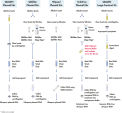
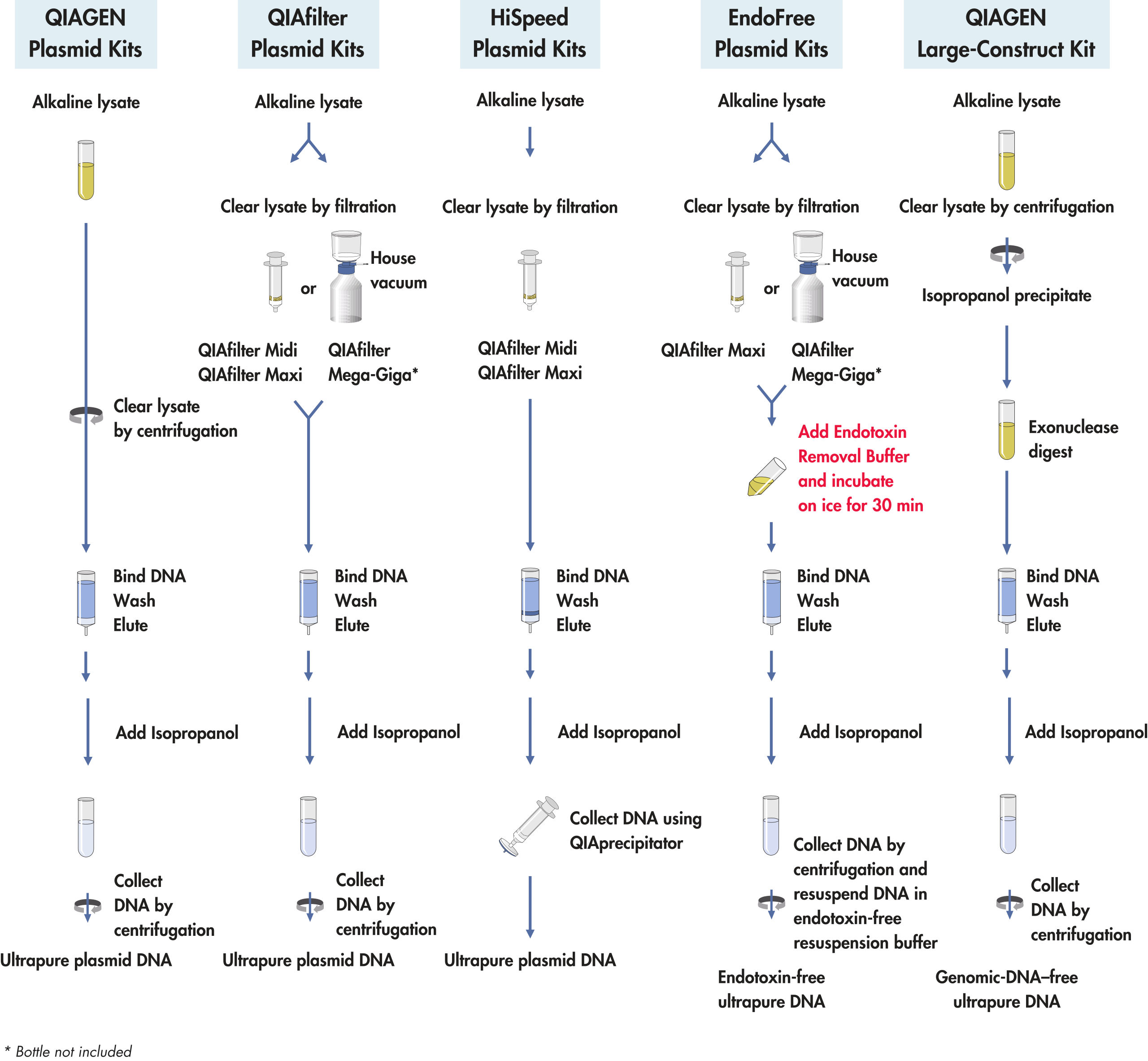
QIAGEN 플라스미드 키트를 사용하면 박테리아 용해물이 원심분리를 통해 클리어링됩니다. 그 후 클리어링된 용해물을 음이온 교환 팁에 로드하여 적절한 저염 및 pH 조건에서 플라스미드 DNA가 선택적으로 결합되도록 합니다. RNA, 단백질, 대사산물, 기타 저분자량 불순물은 중간 농도의 염 용액으로 세척되어 제거되고, 순수 플라스미드 DNA는 고농도 염 용액에서 용출됩니다(순서도 ‘ QIAGEN 플라스미드 키트 절차’ 참고). DNA는 아이소프로판올 침전법으로 농축 및 탈염되고, 원심분리로 회수됩니다.

응용 분야

QIAGEN 플라스미드 키트로 정제한 플라스미드 DNA는 다음과 같은 응용 분야에 사용하기에 매우 적합합니다.
  • 트랜스펙션
  • 클로닝
  • PCR
  • 시험관 내 전사

지원되는 데이터 및 수치

사양

특징사양
Technology음이온 교환 기술
Culture volume/starting material배양액 부피 3mL~5L
Yield<20µg~<10mg
Processing수동(중력 흐름(gravity flow))
Samples per run (throughput)실험당 샘플 1개
Time per run or prep per run80~320분
Applications트랜스펙션, 클로닝, 염기서열 분석, 모세관 염기서열 분석(capillary sequencing) 등
Plasmid typeHigh-copy, low-copy, 코스미드 DNA

리소스

보충 프로토콜 (8)
This protocol is designed for the rapid, easy, and non-toxic preparation of up to 2 mg genomic DNA from not more than 2 g of tissue using QIAGEN-tip 2500. QIAGEN® Genomic-tips 20/G, 100/G, and 500/G can also be used with this protocol by reducing the amount of starting material according to the table on page 2. The purified genomic DNA ranges in size from 50-150 kb.
This protocol is designed for isolation of up to 200 μg RNA from 150 mg plant tissue or up to 1 mg RNA from 600 mg plant tissue and is for use with QIAGEN-tip 100 or QIAGEN-tip 500, respectively.
This protocol is for purification of up to 100 µg endotoxin-free plasmid DNA using QIAGEN-tip 100.
This protocol is designed to provide up to 150 μg BAC/PAC/P1 DNA or up to 400 μg cosmid DNA.
Endotoxin-free DNA is essential for gene therapy research and will improve transfection into sensitive eukaryotic cells.
사용자 개발 프로토콜 (12)
The procedure has been used successfully for isolation of different medium-copy-number plasmids carrying pHM1519 or pBL1 origins of replication from Corynebacterium glutamicum ATCC 13032. Yield of plasmid DNA was typically 0.4-1.5 µg per ml LB culture, although yield was dependent on the vector, the insert, and the size of the plasmid.
The procedure has been used successfully for isolation of high- and low-copy-number plasmids from various Bacillus subtilis strains. Yield of plasmid DNA was typically 10-20 µg plasmid DNA from 100 ml culture.
The procedure has been used successfully for isolation of 110 kb P1 DNA (pAdsacBII with an 80 kb insert) from Escherichia coli strain NS3529. Yield of P1 DNA was typically 10-50 µg from 500 ml culture.
The procedure has been used successfully for isolation of a variety of medium-copy-number shuttle vectors from S. xylosus, S. carnosus, S. epidermidis, and S. aureus. Yield of plasmid DNA was typically 2-10 µg from 50 ml culture.
The procedure has been used successfully for isolation of cryptic plasmids (pLC2-based) from mesophilic Lactobacillus strains such as L. sake and L. curvatus. Yield of plasmid DNA was typically 10-20 µg plasmid DNA from 100 ml culture.
This procedure has been used successfully for isolation of 150-250 kb BAC DNA from a mouse-BAC library cloned in pBeloBAC11 from Escherichia coli strain HB101/r. The yield of BAC DNA from 100 ml culture was typically 20-40 μg.
The procedure has been used successfully for isolation of high-copy-number plasmids from Proteus vulgaris and Proteus mirabilis. Yield of plasmid DNA was typically 3-8 µg DNA per ml culture.
The procedure has been used successfully for isolation of plasmids SCP2 and SCP2* as well as the plasmids listed in Table 1 (see next page) from S. coelciolor and S. lividans strains.
The procedure has been used successfully for isolation of the large (128 kb), very-low-copynumber (1-2 copies per cell) plasmid pHCG3 and its derivatives from Oligotropha carboxidovorans. Yield of plasmid DNA was typically 3-6 µg plasmid DNA from 200 ml culture.
The procedure has been used successfully for isolation of linear plasmids from Borrelia burgdorferi sensu lato species, which include Borrelia burgdorferi sensu stricto, Borrelia afzelli, and Borrelia garinii.
The procedure has been used successfully for isolation of high-copy-number plasmids from Citrobacter freundii. Yield of plasmid DNA was typically 3-8 µg DNA per ml culture.
안전보건자료 (2)
Download Safety Data Sheets for QIAGEN product components.
Safety Data Sheets (1)
Certificates of Analysis (1)

출판물

Oncocytic change in pleomorphic adenoma: molecular evidence in support of an origin in neoplastic cells.
Di Palma S; Lambros MB; Savage K; Jones C; Mackay A; Dexter T; Iravani M; Fenwick K; Ashworth A; Reis-Filho JS;
J Clin Pathol; 2006; 60 (5):492-9 2006 Feb 7 PMID:16467165
Haploinsufficiency of C2GnT-I glycosyltransferase renders T lymphoma cells resistant to cell death.
Cabrera PV; Amano M; Mitoma J; Chan J; Said J; Fukuda M; Baum LG;
Blood; 2006; 108 (7):2399-406 2006 Jun 15 PMID:16778138
RepAM of the Amycolatopsis methanolica integrative element pMEA300 belongs to a novel class of replication initiator proteins.
Te Poele EM; Kloosterman H; Hessels GI; Bolhuis H; Dijkhuizen L;
Microbiology (Reading); 2006; 152 (Pt 10):2943-2950 2006 Oct PMID:17005975
Involvement of Bcl-X(L) deamidation in E1A-mediated cisplatin sensitization of ovarian cancer cells.
Chang CY; Lin YM; Lee WP; Hsu HH; Chen EI;
Oncogene; 2006; 25 (18):2656-65 2006 Apr 27 PMID:16331250

FAQ

Is plasmid DNA purified with QIAGEN Plasmid Purification Kits suitable for in vitro transcription?

Plasmid preparations are free of any detectable proteins or other contaminants when purified using QIAGEN's anion-exchange kits according to the recommended protocols. DNA purified using QIAGEN Plasmid Kits, QIAfilter Plasmid Kits, or EndoFree Plasmid Kits gives excellent results with in-vitro transcription experiments.

Although a high level of RNase A is employed at the beginning of the procedure, it is removed efficiently by potassium dodecyl sulfate precipitation and subsequent washing with Buffer QC. It is possible, although not necessary, to omit RNase A from the procedure when purifying DNA for in vitro transcription. In this case, increasing the volume of Wash Buffer QC is recommended (e.g., for a Midi preparation on a QIAGEN-tip 100, use at least 2x 30 ml of Buffer QC instead of 2x 10 ml).

FAQ-1
Where can I find a protocol for cleanup of already purified plasmid DNA?

When using the silica-based QIAprep Spin Miniprep Kit, a protocol is contained in the QIAprep Miniprep Handbook, in Appendix C: Special Applications. The protocol is called: 'Purification of plasmid DNA prepared by other methods'.

For our anion-exchange based Plasmid Purification Kits, a protocol can be accessed online at our Plasmid Resource Center, and is called 'Re-Purification of Plasmid DNA Prepared by Methods other than QIAGEN Tips'.


FAQ-1031
I am seeing a precipitate after adding LyseBlue reagent to Buffer P1. What should I do about that?

A precipitate forming upon adding LyseBlue reagent to Buffer P1 is a normal observation. This precipitate will completely dissolve after addition of Buffer P2. Please be sure to shake Buffer P1 vigorously before use to completely resuspend LyseBlue particles.

FAQ-1045
What are the additional plasmid bands I see on my gel?

Open circular plasmid, resulting from single strand nicks, usually migrates slower in agarose gels and forms (faint) bands above the supercoiled plasmid DNA band. Sometimes an additional band of denatured supercoiled DNA migrates just below the supercoiled form. This form may result from prolonged alkaline lysis with Buffer P2 and is resistant to restriction digestion.

For a detailed description on how to run and interpret an analytical gel, please see Appendix A in the QIAGEN Plasmid Purification Handbook: "Agarose Gel Analysis of the Purification Procedure", or visit this link.

FAQ-1059
What are the maximum culture volumes to use with the QIAGEN Plasmid Midi or Maxi Kit?

Maximum recommended culture volumes for standard Luria Bertani (LB) medium*:


QIAGEN-tip 100

(QIAGEN Plasmid Midi Kit)

QIAGEN-tip 500

(QIAGEN Plasmid Maxi Kit)

High-copy plasmids

25 ml 100 ml

Low-copy plasmids

100 ml 500 ml


* For the QIAGEN-tip 100, the expected yields are 75–100 µg for high-copy plasmids and 20–100 µg for low-copy plasmids. For the QIAGEN-tip 500, the expected yields are 300–500 µg for high-copy plasmids and 100–500 µg for low-copy plasmids.


It is not recommended to use super rich growth media such as TB (terrific broth) or 2x YT for most commonly used high-copy plasmids. Although TB or 2x YT have the obvious advantage of producing more bacteria (2–5 times), this does not necessarily lead to greater yields or higher-quality DNA. Please visit the QIAGEN Plasmid Resource Center for further information on the growth of bacterial cultures.

FAQ-167
What are the recommended culture and buffer volumes for a very low-copy plasmid?

Very low-copy plasmids and cosmids of less than 10 copies per cell often require large culture volumes to yield significant amounts of DNA. The recommended conditions below are suitable for QIAGEN-tip 100 or QIAGEN-tip 500, and use centrifugation to clear lysates rather than QIAfilter Cartridges, due to the large culture volumes. After alkaline lysis, there is an additional isopropanol precipitation step to decrease the amount of lysate before DNA is bound to the QIAGEN-tip. Please follow the protocol for 'Very Low-Copy Plasmid/Cosmid Purification Using QIAGEN-tip 100 or QIAGEN-tip 500' in the QIAGEN Plasmid Purification Handbook. Culture volumes and tip sizes are selected to match the quantity of expected DNA with the capacity of the QIAGEN-tip.


Parameters for purification of very low-copy plasmids and cosmids of less than 10 copies per cell


Required DNA yield* Up to 100 ug Up to 500 ug

Culture volume

500 ml 2.5 liters
Buffer P1 20 ml 125 ml
Buffer P2 20 ml 125 ml
Buffer P3 20 ml 125 ml

QIAGEN-tip

QIAGEN-tip 100

QIAGEN-tip 500

Buffer QBT (for equilibrating) 4 ml 10 ml
Buffer QC (for washing) 2x 10 ml 2x 30 ml
Buffer QF (for elution) 5 ml 15 ml

* For very low-copy plasmids, expected yields are 20–100 µg for the QIAGEN-tip 100, and 100–500 µg for the QIAGEN-tip 500.

† Volumes of lysis Buffers P1, P2, and P3 are higher than in the standard protocols in order to efficiently lyse the large number of cells required for purification of very low-copy plasmids and cosmids.

FAQ-168
How should QIAGEN Plasmid Purification Kits be stored and for how long?
QIAGEN-tips and QIAfilter Cartridges should be stored dry and at room temperature (15–25°). They can be stored for at least two years without showing any reduction in performance, capacity, or quality of separation.

QIAGEN, QIAfilter, EndoFree, HiSpeed and Large-Construct Plasmid Kits should be stored at room temperature (15–25°). After adding RNase A, Buffer P1 should be stored at 2–8°C and is stable for six months. All other buffers and RNase A stock solution can be stored for two years at room temperature (15–25°).
FAQ-192
What is the RNase A concentration and composition of Buffer P1?

The composition of Buffer P1 is:

  • 50 mM Tris·Cl, pH 8.0
  • 10 mM EDTA
  • 100 µg/ml RNase A

After RNase A addition, the buffer should be stored at 2–8°C.

Buffer P1 is the resuspension buffer used in a variety of QIAGEN kits for plasmid DNA purification. Details on buffer preparation and storage are presented in Appendix B of the QIAGEN Plasmid Purification Handbook.

FAQ-198
What is the composition of Buffer P2?

The composition of Buffer P2 is:

  • 200 mM NaOH
  • 1% SDS (w/v)

It should be stored at room temperature. Buffer P2 is the lysis buffer used in a variety of QIAGEN kits for plasmid DNA purification. Details on buffer preparation and storage are presented in Appendix B of the QIAGEN Plasmid Purification Handbook.

FAQ-203
What is the recipe for LB?
Preparation of LB medium: Dissolve 10 g tryptone, 5 g yeast extract, and 10 g NaCl in 800 ml dH2O. Adjust the pH to 7.0 with 1 N NaOH. Adjust the volume to 1 liter with dH2O. Sterilize by autoclaving.
FAQ-212
What is the recipe for 2x YT?
2x YT medium, per liter 16 g tryptone 10 g yeast extract 5 g NaCl Media Preparation and Bacteriological Tools. Edited by: Fred M. Ausubel, Roger Brent, Robert E. Kingston, David D. Moore, J.G. Seidman, John A. Smith, Kevin Struhl Current Protocols in Molecular Biology (1994), Section 1.1.3.
FAQ-213
When is chloramphenicol amplification of plasmids performed?

When low-copy-number plasmids containing the pMB1 or ColE1 origin of replication are prepared using QIAGEN Plasmid Purification Kits, plasmid DNA yields can be improved by adding chloramphenicol to the culture medium (170 mg/liter) to amplify copy numbers. For details and precautions on the use of chloramphenicol when culturing plasmids, please refer to standard manuals for cloning procedures (e.g., Molecular cloning : A laboratory manual / T. Maniatis, E.F. Fritsch, J. Sambrook).

Cultures of bacteria containing low-copy-number plasmids amplified in the presence of chloramphenicol should be treated as if they contain high-copy-number plasmids when choosing the appropriate culture volumes for the QIAGEN-tip to be used.

Note that copy numbers of the current generation of plasmids are so high that selective amplification in the presence of chloramphenicol is not necessary to achieve high yields. Please see FAQ 350 for origins of replication and copy numbers of various plasmids.

FAQ-3
How do I perform a DNA precipitation to concentrate my sample?
  • Add 1/10 volume of 3 M Na-Acetate pH 5.2, and 2 to 2.5 volumes of ice-cold 100% ethanol to the DNA sample
  • Mix, and store at –20°C for at least 1 h to precipitate the DNA
  • Recover the precipitated DNA by centrifugation at full speed in a microcentrifuge for 15–20 min
  • Pour off the ethanol and wash the pellet twice with room-temperature 70% ethanol
  • Allow the DNA pellet to air-dry
  • resuspend the DNA in a suitable volume of sterile TE buffer or distilled water
FAQ-305
What is the expected level of endotoxins in plasmid DNA purified with QIAGEN Plasmid kits, QIAfilter Plasmid kits and HiSpeed Plasmid purification kits?

Average endotoxin level in plasmid DNA purified with QIAGEN Plasmid kits, QIAfilter Plasmid kits and HiSpeed Plasmid purification kits is around 10 EU/µg DNA.

FAQ-3082
Can Buffers N3 and P3 be used interchangeably?
No. Although both Buffers N3 of the QIAprep Spin Miniprep and P3 of the QIAGEN Plasmid Kits perform the neutralization step in an alkaline lysis procedure, they are completely different. Buffer N3 contains a proprietary formula that sets up binding conditions for the QIAprep Miniprep column's silica-gel-membrane. Buffer P3 sets up binding conditions for QIAGEN anion-exchange columns. Our website explains QIAGEN's nucleic acid purification technologies in more detail.
FAQ-310
How do I know if my plasmid is a high- or low copy number type?

Find out which origin of replication your plasmid contains, and look at the table below for classification into high-copy or low-copy types. This table can also be found online at the QIAGEN Plasmid Resource Center in the section 'Growth of bacterial cultures; Plasmid Copy Number' . A way to determine experimentally if the copy number of your plasmid is high or low is to perform a miniprep. A high-copy plasmid should yield between 3-5 ug DNA per 1 ml LB culture, while a low-copy plasmid will yield between 0.2-1 ug DNA per ml of LB culture.


Origins of replication and copy numbers of various plasmids and cosmids

DNA construct Origin of Replication Copy number Classification
Plasmids      
pUC vectors pMB1* 500–700 high copy
pBluescript® vectors ColE1 300–500 high copy
pGEM® vectors pMB1* 300–400 high copy
pTZ vectors pMB1* >1000 high copy
pBR322 and derivatives pMB1* 15–20 low copy
pACYC and derivatives p15A 10–12 low copy
pSC101 and derivatives pSC101 ~5 very low copy
Cosmids      
SuperCos pMB1* 10-20 low copy
pWE15 ColE1 10-20 low copy

* The pMB1 origin of replication is closely related to that of ColE1 and falls in the same incompatibility group. The high-copy plasmids listed here contain mutated versions of this origin.

FAQ-350
What is the white insoluble precipitate in my resuspended plasmid DNA pellet?

White insoluble material in the resuspended plasmid DNA pellet indicates carry-over of salts and/or carbohydrates. Ensure that isopropanol is used at room temperature for precipitation. Some bacterial strains, such as TG1 and JM100, naturally produce a high level of carbohydrates. However, carbohydrate contamination may also be observed when using other strains. The most common cause of this problem is over-growth of bacterial cultures. To avoid this, closely follow the guidelines for Plasmid DNA Preparation in the Handbook that was provided with the respective QIAGEN Plasmid Kit.

Useful hints and information on optimizing plasmid preparations can be found at the QIAGEN Plasmid Resource Center.

FAQ-352
Why do I get genomic DNA contamination in my plasmid prep?

Too vigorous mixing of the bacterial lysate causes genomic DNA to appear in the eluate. The lysate must be handled gently after addition of buffers P2 and P3 to prevent shearing of chromosomal DNA. The culture volume needs to be reduced if the lysate is too viscous for gentle mixing.

Use of LyseBlue Reagent enables visualization of efficient bacterial cell resuspension as a prerequisite for complete lysis, thereby helping to avoid overloading of the columns and additional difficulties related to highly viscous lysates.

Additional information for successful plasmid preparations using QIAGEN's broad selection of Plasmid Kits can be found at our Plasmid Resource Center.

FAQ-353
Can I eliminate RNase A from buffer P1 for my plasmid preparation to obtain RNase-free DNA for in-vitro transcription?
No, RNase A should not be omitted from buffer P1. It is required to prevent RNA contamination of the purified plasmid DNA. RNase A will not interfere with downstream in-vitro transcription experiments, since it will be efficiently removed during the plasmid purification procedures using QIAGEN Plasmid Kits.
FAQ-366
What is the composition of buffer QBT?

Buffer QBT is the equilibration buffer used in QIAGEN Plasmid Kits for plasmid purification and in QIAGEN Blood & Cell culture kits.

The composition of Buffer QBT is:

  • 750mM NaCl • 50 mM MOPS, pH 7.0
  • 15% isopropanol (v/v)
  • 0.15 % Triton® X-100 (v/v)

To make 1 liter of solution, dissolve 43.83 g NaCl, 10.46 g MOPS (free acid) in 800 ml distilled water. Adjust the pH to 7.0 with NaOH. Add 150 ml pure isopropanol and 15 ml 10% Triton X-100 solution (v/v). Adjust the volume to 1 liter with distilled water. Store at 15–25°C

FAQ-411
What is the composition of buffer QC?

Buffer QC is the wash buffer used in QIAGEN Plasmid Kits for plasmid purification and in QIAGEN Blood & Cell Culture kits.

The composition of Buffer QC is:

  • 1.0 M NaCl
  • 50 mM MOPS, pH 7.0
  • 15% isopropanol (v/v)


To make 1 liter of solution, dissolve 58.44 g NaCl, 10.46 g MOPS (free acid) in 800 ml distilled water. Adjust the pH to 7.0 with NaOH. Add 150 ml pure isopropanol. Adjust the volume to 1 liter with distilled water. Store at 15–25°C.

FAQ-412
What is the composition of buffer QF?

Buffer QF is the elution buffer used in QIAGEN Plasmid Kits for plasmid purification and in QIAGEN Blood & Cell culture kits.

The composition of Buffer QF is:

  • 1.25 M NaCl
  • 50 mM Tris-Cl, pH 8.5
  • 15% isopropanol (v/v)


To make 1 liter of solution, dissolve 73.05 g NaCl and 6.06 g Tris base in 800 ml distilled water. Adjust the pH to 8.5 with HCl. Add 150 ml pure isopropanol. Adjust the volume to 1 liter with distilled water. Store at 15–25°C

FAQ-413
What is the composition of buffer STE?

The composition of Buffer STE is:

  • 100 mM NaCl
  • 10 mM Tris-Cl, pH 8.0
  • 1 mM EDTA

Buffer STE is a DNA resuspension and storage buffer used in QIAGEN Plasmid Kits for plasmid purification and in some plasmid supplementary protocols. Details on buffer preparation and storage are presented in Appendix B of the QIAGEN Plasmid Purification Handbook.

FAQ-415
What is the composition of buffer TE?

The composition of Buffer TE is:

  • 10 mM Tris·Cl, pH 8.0
  • 1 mM EDTA

Buffer TE is a commonly used DNA resuspension and storage buffer. It is supplied in QIAGEN's Endofree Plasmid Kits, and used for plasmid DNA resuspension in combination with other QIAGEN Plasmid Kits. Details on buffer preparation and storage are presented in Appendix B of the QIAGEN Plasmid Purification Handbook.

FAQ-416
What is the composition of buffer P3?

The composition of Buffer P3 is:

  • 3.0 M potassium acetate, pH 5.5

Buffer P3 is the neutralization buffer used in QIAGEN's anion-exchange based Kits for plasmid preparation. Details of buffer preparation and storage are presented in Appendix B of the QIAGEN Plasmid Purification Handbook.

FAQ-418
Do you have a protocol for the removal of endotoxins from already purified plasmid DNA?

Yes. Endotoxins can be removed from purified plasmid preparations by following the Supplementary Protocol 'Removal of endotoxins from purified plasmid DNA using the EndoFree Plasmid Maxi Kit' (QP12).

This protocol requires the EndoFree Plasmid Buffer Set, which can be purchased separately. Alternatively, the EndoFree Plasmid Maxi Kit, containing all necessary components, can be used.

The plasmid DNA is first treated with endotoxin removal buffer ER, and then applied to QIAGEN's anion-exchange tip. After performing a wash step, the plasmid DNA is eluted from the tip, followed by isopropanol precipitation and redissolving the DNA in a suitable volume of endotoxin-free buffer TE.

FAQ-500
What can I do when the DNA pellet prepared with QIAGEN Plasmid Kits has been overdried?
Redissolve the DNA by warming the solution slightly, e.g. incubate it at 37°C, and allow more time for redissolving.
FAQ-572
Why is my plasmid DNA yield low?

Low yields of plasmid DNA can be caused by a number of different factors. The most common causes for low yield are poor culturing conditions and plasmid propagation, excessive amounts of starting material resulting in insufficient bacterial cell lysis and column overloading. When working with the anion-exchange based QIAGEN Plasmid Purification Kits, extra care is required during the isopropanol precipitation step, as the glassy DNA pellet may be difficult to see, and tends to be only loosely attached to the side of the tube.

We strongly recommend to review the information provided on our Plasmid Resource Page in the section 'Optimal results with QIAGEN plasmid kits', as it provides useful background information on growing bacterial cultures and general considerations for optimal results. It is also necessary to follow the instructions in the relevant protocols precisely to ensure the best plasmid yield and quality.

To determine at what stage of the procedure any problem occurred, save fractions from different steps of the purification procedure, and analyze by agarose gel electrophoresis. For a detailed description on how to run and interpret an analytical gel, please see Appendix A in the QIAGEN Plasmid Purification Handbook: "Agarose Gel Analysis of the Purification Procedure", or visit the QIAGEN Plasmid Resource Center.


FAQ-768
What is the advantage of running an analytical gel with fractions of my plasmid preparation?

Running fractions saved from each step in the plasmid preparation procedure on an agarose gel enables monitoring the performance of each crucial step in the protocol. If the plasmid DNA is of low yield or quality, the samples can be analyzed to determine at what stage of the purification procedure the difficulty occurred.

Aliquots can be taken from the cleared lysate and the flow-throughs as indicated in the relevant protocols, precipitated with isopropanol and resuspended in a small volume of TE buffer.

Please see the Troubleshooting Section of the QIAprep Miniprep Handbook and Appendix A of the QIAGEN Plasmid Purification Handbook for instructions, and a picture and legend explaining the typical results you may see. You can also access this information on our Plasmid Resource Pages.

FAQ-769
Do you have a protocol for the isolation of plasmid DNA from yeast?

Yes, please follow the User-Developed Protocol:

FAQ-853
I left Buffer P1 at room temperature after addition of RNase A, what shall I do?

Buffer P1 with RNase A used in QIAGEN Plasmid Purification Kits should be fine at room temperature for a few days. We would expect the enzyme to have some residual activity. However, optimal results cannot be guaranteed after storage at room temperature. If you notice that RNase A activity is substantially reduced, you can add fresh RNase A to your buffer.

We recommend that Buffer P1 with RNase A be stored in the refrigerator (2–8°C). RNase A will be stable for 6 months under this condition.

FAQ-859
What to do if cell clumps are present after Buffer P2 addition when using LyseBlue Reagent?

If cell clumps are present after adding Buffer P2 to your samples when using a QIAGEN Plasmid Purification Kit in combination with LyseBlue Reagent, you have two options:

  • pipet the cell clumps up and down for resuspension
  • transfer any clumps to a separate tube, add Buffer P1 and mix vigorously for resuspension, add Buffer P2 for lysis, and subsequently transfer the lysed material back to combine it with the rest of the original solution

Note: Avoid incubation times longer than 5 minutes in Buffer P2 as this will irreversibly denature plasmid DNA. In the scenario above, Buffer P3 may need to be added to portions of the sample, which can be subsequently combined once resuspension, lysis and neutralization of all fractions is complete.

FAQ-861
Why would clumps occur following the addition of Buffer P2 when using LyseBlue Reagent in a plasmid preparation?

Clumps that occur after addition of Buffer P2 in a bacterial lysate containing LyseBlue reagent indicate poor resuspension of the bacterial cell pellet in Buffer P1. This handling error leads to inefficient cell lysis, and incomplete precipitation of SDS, cell debris, and genomic DNA. When resuspending the cell pellet, vortexing longer or resuspending the pellet by pipetting up and down can help.

If cells have been resuspended properly in P1, “brownish areas” after P2 addition just indicate poor mixing of P1 and P2. To overcome this, continue mixing the solution by inverting it gently until a homogeneous blue suspension is achieved.

FAQ-862
With LyseBlue reagent for lysis control, can I now process more bacterial culture and overload the columns?

No. The maximum culture volumes recommended for QIAGEN's plasmid preparation kits still apply, and should be strictly followed. LyseBlue reagent now allows the user to monitor potential problems (insufficient bacterial cell resuspension and lysis as a consequence of overloading) early in the plasmid preparation process.

FAQ-864
Which QIAGEN plasmid preparation kits will contain LyseBlue Reagent?

LyseBlue reagent is provided in the following QIAGEN plasmid kits:

FAQ-865
Do you have a protocol for the isolation of BAC DNA using the QIAGEN Plasmid Midi Kit?

Yes, please follow the User-Developed Protocol 'Isolation of BAC DNA using the QIAGEN Plasmid Midi Kit' (QP01).  However, we recommend that the QIAGEN Large-Construct Kit be used for the purification of BAC DNA as it contains an exonuclease buffer for the removal of gDNA.

FAQ-881
Do you have a protocol for the isolation of bacteriophage P1 derived constructs with any of your plasmid kits?

Yes, please follow the User-Developed Protocol 'Isolation of bacteriophage P1 derived constructs using the QIAGEN Plasmid Midi Kit' (QP03).

FAQ-883
Do you have a protocol for the isolation of plasmid DNA from Borrelia spp.?

Yes, please follow the User-Developed Protocol 'Isolation of plasmid DNA from Borrelia spp. using the QIAGEN Plasmid Midi Kit' (QP04).

FAQ-884
Do you have a protocol for the isolation of plasmid DNA from Citrobacter freundii?

Yes, please follow the User-Developed Protocol 'Isolation of plasmid DNA from Citrobacter freundii using the QIAGEN Plasmid Midi Kit' (QP05).

FAQ-885
Do you have a protocol for the isolation of plasmid DNA from Corynebacterium glutamicum?
FAQ-886
Do you have a protocol for the isolation of plasmid DNA from Lactobacillus spp.?

Yes, please follow the User-Developed Protocol 'Isolation of plasmid DNA from Lactobacillus spp. using the QIAGEN Plasmid Midi Kit' (QP07).

FAQ-887
Do you have a protocol for the isolation of plasmid DNA from Oligotropha carboxidovorans?

Yes, please follow the User-Developed Protocol 'Isolation of plasmid from Oligotropha carboxidovorans using the QIAGEN Plasmid Midi Kit' (QP08).

FAQ-888
Do you have a protocol for the isolation of plasmid DNA from Proteus spp.?

Yes, please follow the User-Developed Protocol 'Isolation of plasmid DNA from Proteus spp. using the QIAGEN Plasmid Midi Kit' (QP09).

FAQ-889
Do you have a protocol for the isolation of plasmid DNA from Staphylococcus spp.?

Yes, please follow the User-Developed Protocol 'Isolation of plasmid DNA from Staphylococcus spp. using the QIAGEN Plasmid Midi Kit' (QP10).

FAQ-890
Do you have a protocol for the isolation of very low-copy plasmids from Streptomyces spp.?
FAQ-893
Do you have a protocol for the isolation of single-stranded DNA from M13 phage using QIAGEN Plasmid Kits?

Yes, please follow the Supplementary Protocol 'Isolation of single-stranded DNA from M13 phage using QIAGEN Plasmid Kits' (QP14).

FAQ-894
895 - Do you have a protocol for the isolation of endotoxin-free plasmid DNA using the QIAGEN Plasmid Midi Kit?

Yes, please follow the Supplementary Protocol 'Isolation of endotoxin-free plasmid DNA using the QIAGEN Plasmid Midi Kit' (QP15).

FAQ-895
Do you have a protocol for the isolation of plasmid DNA from Bacillus subtilis?
Do you have protocols for the isolation of genomic DNA from tissue using QIAGEN-tips 2500 (Mega) and 10000 (Giga)?
Do you have a protocol for the isolation of total RNA from plant tissue using QIAGEN-tips?
Yes, please follow the Supplementary Protocol 'Isolation of total RNA from plant tissue using the QIAGEN-tip' (QR01).
FAQ-949