Blood & Cell Culture DNA Kits

혈액이나 배양 세포에서 최대 20µg, 100µg 또는 500µg의 고분자량 DNA 분리용

S_1084_5_GEN_V2

✓ 연중무휴 하루 24시간 자동 온라인 주문 처리

✓ 풍부한 지식과 전문성을 갖춘 제품 및 기술 지원

✓ 신속하고 안정적인 (재)주문

Blood & Cell Culture DNA Mini Kit (25)

카탈로그 번호 / ID.   13323

25 QIAGEN Genomic-tip 20/G, QIAGEN 프로테아제, 완충액
키트완충액
Blood & Cell Culture DNA Kit
Genomic DNA Buffer Set
컬럼 유형
20/G
100/G
500/G
Blood & Cell Culture DNA Kits은/는 분자생물학 분야에 사용하기 위한 것입니다. 이 제품들은 질병의 진단, 예방, 또는 치료 목적으로 사용할 수 없습니다.

✓ 연중무휴 하루 24시간 자동 온라인 주문 처리

✓ 풍부한 지식과 전문성을 갖춘 제품 및 기술 지원

✓ 신속하고 안정적인 (재)주문

특징

  • 최대 150kb 크기의 고분자량 DNA를 안정적으로 분리
  • 페놀이나 클로로포름 무사용 추출
  • 여러 샘플을 편리하게 병행 처리

제품 세부 정보

혈액 및 세포 배양 DNA 키트는 광범위한 생물학적 샘플에서 유전체 DNA를 효율적으로 분리하기 위한 중력류, 음이온 교환 팁 및 완충액을 제공합니다. 정제된 DNA의 크기는 최대 150kb이며 평균 크기는 50~100kb입니다.

효모와 박테리아 샘플의 경우 유전체 DNA 완충액 세트(카탈로그 번호 19060)를 구입해야 합니다.

성능

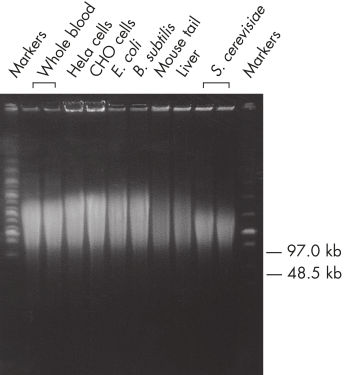
QIAGEN Genomic-tip 절차는 매우 섬세하여 DNA 단편화가 거의 발생하지 않습니다. QIAGEN Genomic-tips로 정제된 DNA는 크기가 최대 150kb이며, 평균 길이는 50~100kb입니다(그림 '최대 150kb의 유전체 DNA' 참조). 이 DNA에는 RNA, 단백질, 대사산물 등 오염 물질이 전혀 없으며 A260 / A280 비율은 1.7~1.9입니다.

획득된 DNA 크기가 매우 크므로 다양한 플랫폼에서 차세대 염기서열 분석(Next-Generation Sequencing, NGS)을 하기 위한 고품질 라이브러리를 준비하는 데 특히 적합하며 여러 핵심 시설의 추천을 받고 있습니다.

원리

혈액 및 세포 배양 DNA 키트에 포함된 QIAGEN Genomic-tips는 페놀이나 클로로포름을 사용하지 않고도 다양한 생물학적 샘플에서 고분자량 DNA를 정제하기 위해 독자적인 QIAGEN 음이온 교환 기술을 사용합니다. 용해 완충액은 다양한 샘플 유형에 맞게 최적화되어 있으며, 핵산 분해 효소, 히스톤, DNA 결합 단백질과 같은 단백질은 물론, 감염성이 있는 바이러스 입자도 즉각 변성시킵니다. 완충액의 pH 및 저염 조건 하에서 DNA는 칼럼 내 QIAGEN 레진에 결합하게 됩니다. 동시에 단백질, 탄수화물, 대사산물 등 다른 세포 구성 요소도 통과해 흐릅니다. 정제 DNA는 고염도 완충액에서 용출됩니다. Genomic-tips는 중력류로 작동하며, 방치해도 마르지 않습니다. 따라서 실제 작업에 필요한 시간이 최소화되고 여러 샘플을 동시에 처리하는 데 이상적인 절차입니다.

절차

우선 샘플을 용해하고(조직 샘플을 기계적으로 파쇄) 적절한 용해 완충액에서 단백질을 동시에 변성시킵니다(흐름도 'QIAGEN Genomic-tip 절차' 참조). 그런 후 QIAGEN Protease 또는 Proteinase K를 첨가하고 적절한 배양 기간이 경과한 후 용해물을 QIAGEN Genomic-tip에 로드합니다. DNA는 컬럼에 결합하지만 다른 세포 성분은 컬럼을 통과합니다. 잔류 오염 물질을 제거하기 위한 세척 단계 후에 분자량이 큰 순수 DNA가 용출되어 이소프로판올로 침전됩니다. 혈액과 배양 세포의 경우 전체 절차에 걸리는 시간이 단 30분입니다.

Blood & Cell Culture DNA Kits는 혈액과 배양 세포에서 고분자량 DNA를 정제하는 데 필요한 모든 구성 요소가 갖춰진 바로 사용 가능한 키트입니다.

응용 분야

Blood & Cell Culture DNA Kits로 정제된 DNA는 다음과 같은 용도에 사용하기에 적합합니다.

  • 염기서열 분석 및 차세대 염기서열 분석
  • Long-read sequencing
  • RFLP 분석
  • 유전자 표적화 분석
  • 형질전환 동물 스크리닝
  • DNA 지문법 연구
  • PCR 증폭

특징 Blood & Cell Culture DNA Mini Kit Blood & Cell Culture DNA Midi Kit Blood & Cell Culture DNA Maxi Kit
응용 분야 PCR, RFLP, 블로팅, 스크리닝 PCR, RFLP, 블로팅, 스크리닝 PCR, RFLP, 블로팅, 스크리닝
용출량 0.1~2ml 0.1~2ml 0.1~2ml
형식 Genomic-tip Genomic-tip Genomic-tip
주 샘플 유형 혈액, 세포 혈액, 세포 혈액, 세포
처리 수동 수동 수동
총RNA, miRNA, poly A+ mRNA, DNA 또는 단백질 정제 DNA DNA DNA
샘플양 1 ml/5 x 106 5 ml/2 x 107 20 ml/1 x 108
기술 음이온 교환 기술 음이온 교환 기술 음이온 교환 기술
수율 15~20µg 80~100µg 350~400µg

지원되는 데이터 및 수치

리소스

빠른 시작 프로토콜 (1)
안전보건자료 (2)
Download Safety Data Sheets for QIAGEN product components.
키트 안내서 (1)
Safety Data Sheets (1)
Certificates of Analysis (1)

출판물

Lack of telomerase RNA gene hTERC expression in alternative lengthening of telomeres cells is associated with methylation of the hTERC promoter.
Hoare SF; Bryce LA; Wisman GB; Burns S; Going JJ; van der Zee AG; Keith WN;
Cancer Res; 2001; 61 (1):27-32 2001 Jan 1 PMID:11196173
GATA-3 is an important transcription factor for regulating human NKG2A gene expression.
Marusina AI; Kim DK; Lieto LD; Borrego F; Coligan JE;
J Immunol; 2005; 174 (4):2152-9 2005 Feb 15 PMID:15699146

FAQ

How do I safely inactivate biohazardous flow-through material?

Always dispose of potentially biohazardous solutions according to your institution’s waste-disposal guidelines. Although the lysis and binding buffers in QIAamp, DNeasy, and RNeasy kits contain chaotropic agents that can inactivate some biohazardous material, local regulations dictate the proper way to dispose of biohazards. DO NOT add bleach or acidic solutions directly to the sample-preparation waste. Guanidine hydrochloride in the sample-preparation waste can form highly reactive compounds when combined with bleach.
Please access our Material Safety Data Sheets (MSDS) online for detailed information on the reagents for each respective kit.

FAQ-12
Does the Epitect Bisulfite Kit also work on DNA extracted from plants?

Bisulfite conversion of unmethylated cytosines into uracils with the EpiTect Bisulfite Kit works on DNA irrespective of the source organism. The DNA template needs to be of high purity for efficient conversion. We recommend to use genomic DNA extracted with our DNA isolation kits for clinical or animal and plant samples as a template for the EpiTect Bisulfite Kit.

FAQ-1209
What is the size of genomic DNA that is obtained with QIAGEN Genomic-tips?
Genomic DNA purified using QIAGEN Genomic-tips ranges in size from 20–150 kb, with an average length of 50–100 kb. Vortexing the lysate for about 20 seconds may reduce the size of the genomic DNA slightly to 20–130 kb, but can help to improve flow rates.
FAQ-142
Do you have a protocol for the purification of DNA from fruit flies?

Using Gentra Puregene Cell kit:


• Purification of archive-quality DNA from up to 30 Drosophila melanogaster using the Gentra Puregene Cell Kit (PG20)

• Purification of archive-quality DNA from 100 Drosophila melanogaster using the Gentra Puregene Cell Kit (PG21)

• Purification of archive-quality DNA from 300–700 Drosophila melanogaster using the Gentra Puregene Cell Kit (PG22)


Using the QIAGEN Genomic tips:

• Isolation of genomic DNA from flies using the QIAGEN Genomic-tip 100/G (QG05)

FAQ-1970
What is the composition of Buffer G2?

Buffer G2 is a component of QIAGEN Blood & Cell Culture DNA Kits, but is also provided with several other kits (e.g., for automation on the EZ1 Advanced instrument). Usually Buffer G2 is used in combination with Proteinase K or QIAGEN Protease for efficient lysis.

Buffer G2 (General Lysis Buffer ) consists of: 800 mM guanidine hydrochloride; 30 mM Tris•Cl, pH 8.0; 30 mM EDTA, pH 8.0; 5% Tween 20; 0.5% Triton X-100.

How to prepare Buffer G2: Dissolve 76.42 g guanidine hydrochloride, 11.17g Na2EDTA•2H2O, and 3.63 g Tris base in 600 ml distilled water. Add 250 ml 20% Tween 20 solution and 50 ml 10% Triton X-100 solution. Adjust the pH to 8.0 with NaOH. Adjust the volume to 1 liter with distilled water.

FAQ-2943
What is the composition of Buffer B1?

Buffer B1 is used in combination with lysozyme or lysostaphin and proteinase K for the efficient lysis of bacteria prior to DNA purification using QIAGEN Genomic-tips. Please note this buffer is not recommended for any purification procedures using QIAGEN’s silica-membrane-based spin columns.

Buffer B1 (Bacterial Lysis Buffer 1) consists of 50 mM Tris•Cl pH 8.0; 50 mM EDTA pH 8.0; 0.5% Tween 20; 0.5% Triton-X100.

How to prepare Buffer B1: Dissolve 18.61 g Na2EDTA•2H2O and 6.06 g Tris base in 800 ml distilled water. Add 50 ml 10% Tween 20 solution and 50 ml 10% Triton X-100 solution. Adjust the pH to 8.0 with HCl. Adjust the volume to 1 liter with distilled water.

FAQ-2944
What is the composition of Buffer B2?

Buffer B2 is used in combination with Buffer B1, lysozyme or lysostaphin and Proteinase K for efficient lysis of bacteria prior to DNA purification using QIAGEN Genomic-tips. Genomic-tips are gravity-flow, anion-exchange columns. Please note this buffer is not recommended for any purification procedures using QIAGEN’s silica-membrane-based spin columns.

Buffer B2 (Bacterial Lysis Buffer 2) consists of 3 M guanidine hydrochloride, 20% Tween 20.

How to prepare Buffer B2: Dissolve 286.59 g guanidine hydrochloride in 700 ml distilled water. Add 200 ml 100% Tween 20. Adjust the volume to 1 liter with distilled water. pH does not need to be adjusted.

FAQ-2945
How do I perform a DNA precipitation to concentrate my sample?
  • Add 1/10 volume of 3 M Na-Acetate pH 5.2, and 2 to 2.5 volumes of ice-cold 100% ethanol to the DNA sample
  • Mix, and store at –20°C for at least 1 h to precipitate the DNA
  • Recover the precipitated DNA by centrifugation at full speed in a microcentrifuge for 15–20 min
  • Pour off the ethanol and wash the pellet twice with room-temperature 70% ethanol
  • Allow the DNA pellet to air-dry
  • resuspend the DNA in a suitable volume of sterile TE buffer or distilled water
FAQ-305
What do you recommend for the cleanup of genomic DNA (gDNA)?

Using QIAGEN Genomic-tips

Protocol for DNA cleanup using Genomic-tips can be found in the 'Special Applications' section of the QIAGEN Genomic DNA Handbook.


Using QIAamp DNA Micro kit

Up to 10ug of gDNA can be cleaned using the cleanup protocol in the QIAamp DNA Micro Handbook.


Using Gentra Puregene Reagents

Gentra Puregene Handbook has protocols for removal of proteins and RNA from purified gDNA in Appendix C and Appendix D respectively.

FAQ-618
What can be used as an alternative to the A260 measurement for quantification of small amounts of RNA and DNA?

Small amounts of RNA and DNA may be difficult to measure spectrophotometrically. Fluorometric measurements, or quantitative RT-PCR and PCR are more sensitive and accurate methods to quantify low amounts of RNA or DNA.

Fluorometric measurements are carried out using nucleic acid binding dyes, such as RiboGreen® RNA Quantitation Reagent for RNA, and PicoGreen® DNA Quantitation Reagent for DNA (Molecular Probes, Inc.).

FAQ-728
Do you have a protocol for the isolation of genomic DNA from frozen clotted blood?

Yes, we have the following protocols:

  • Isolation of genomic DNA from frozen clotted whole blood using the QIAGEN Genomic-tip 100/G (QG02). TEST

You will need to prepare the required buffers according to the recipes in Appendix A of the QIAGEN Genomic DNA Handbook, or you can purchase the Genomic DNA Buffer Set containing pre-made solutions. Alternatively, the QIAGEN Blood & Cell Culture Midi Kit, containing Genomic-tips 100/G and buffers, can be used.

  • Purification of archive-quality DNA from clotted whole blood using Clotspin Baskets and the Gentra Puregene Blood Kit (PG03).
  • Purification of archive-quality DNA from clotted whole blood using the Gentra Puregene Tissue Kit or Gentra Puregene Mouse Tail Kit (PG04).
  • Purification of DNA from clotted blood using the FlexiGene DNA Kit (FG01).
FAQ-900
Do you have a protocol for isolation of genomic DNA from insects?

Yes, we have the following protocols:

  • Isolation of genomic DNA from mosquitoes or other insects using the QIAGEN Genomic tip (QG06).
  • Purification of total DNA from insects using the DNeasy Blood & Tissue Kit (DY14).
FAQ-904
Do you have a protocol for the isolation of genomic DNA from fungi?

Yes, we have the following protocols:

  • Isolation of genomic DNA from fungi (culture and blood) using the QIAamp DNA Mini Kit (QA09).
  • Isolation of genomic DNA from plants and filamentous fungi using the QIAGEN Genomic-tip (QG08).
FAQ-911