
✓ 24/7 automatic processing of online orders
✓ Knowledgeable and professional Product & Technical Support
✓ Fast and reliable (re)-ordering
QIAsprint Plasmid BOPP PrepSet
Cat no. / ID. 588909
Buffer P1, P2 and P3, Buffer QBB, Buffer ETR2 and RNAse A
Log in To see your account pricing.
Kit
PrepSet
Essential Kit
Add on
QIAsprint Consumables
The QIAsprint Plasmid BOPP PrepSet is intended for molecular biology applications. This product is not intended for the diagnosis, prevention, or treatment of a disease.
QIAsprint modular system: Automated plasmid DNA purification are intended for molecular biology applications. These products are not intended for the diagnosis, prevention, or treatment of a disease.
✓ 24/7 automatic processing of online orders
✓ Knowledgeable and professional Product & Technical Support
✓ Fast and reliable (re)-ordering
Features
- Automate 96-well plasmid prep directly from 1 mL bacterial cultures or up to 5 mL pellets.
- Perform centrifugation-free magnetic clearing for fully automated runs on the QIAsprint Connect.
- Configure modular PrepSets and Essential Kits for flexible, sample-specific purification workflows.
- Recover transfection-grade plasmid DNA for restriction enzyme digestion, cloning, PCR, sequencing, etc.
- Eliminate dry ice requirements with ambient temperature shipping for all modular sets.
Product Details
The QIAsprint workflow for plasmid DNA isolation from bacteria is a modular magnetic bead system enabling high-throughput plasmid preps with minimal manual interaction. After pretreatment, samples are loaded onto the QIAsprint Connect instrument for automated purification. The system combines modular flexibility with proven magnetic bead technology to support scalable processing of transfection-grade plasmid DNA.
The workflow consists of dedicated modules that can be flexibly combined. You can start directly from bacterial culture using a walk-away protocol or from pelleted bacteria. In both cases, BOPP technology eliminates the need for lysate clearing by centrifugation or buffer pipetting steps.
QIAsprint Plasmid BOPP PrepSet (384)
This module is tailored for extraction pretreatment and enables the “beads-only” plasmid workflow. The patent-pending BOPP technology allows lysate clearing without centrifugation. The PrepSet includes Buffer P1, P2 and P3, Buffer QBB, Buffer ETR2 and RNase A.
QIAsprint Essential Kit D (384)
Used in combination with the QIAsprint Plasmid BOPP PrepSet, this module is recommended for purification of plasmid DNA from bacteria. The Essential Kit provides the magnetic beads and wash buffers required for high-yield, reproducible purification of high-quality, transfection-grade plasmid DNA. The kit includes Buffer PE, EB and MagAttract Suspension G.
QIApHish Beads (384)
QIApHish Beads enable direct capture of bacterial cells from liquid culture. Combined with the QIAsprint Plasmid BOPP PrepSet and Essential Kit D, they support automated plasmid DNA purification with consistent yield and reproducibility.
All modules are optimized for automated processing of up to 384 samples on the QIAsprint Connect, ensuring minimal hands-on time and reproducible performance at high throughput.
Performance
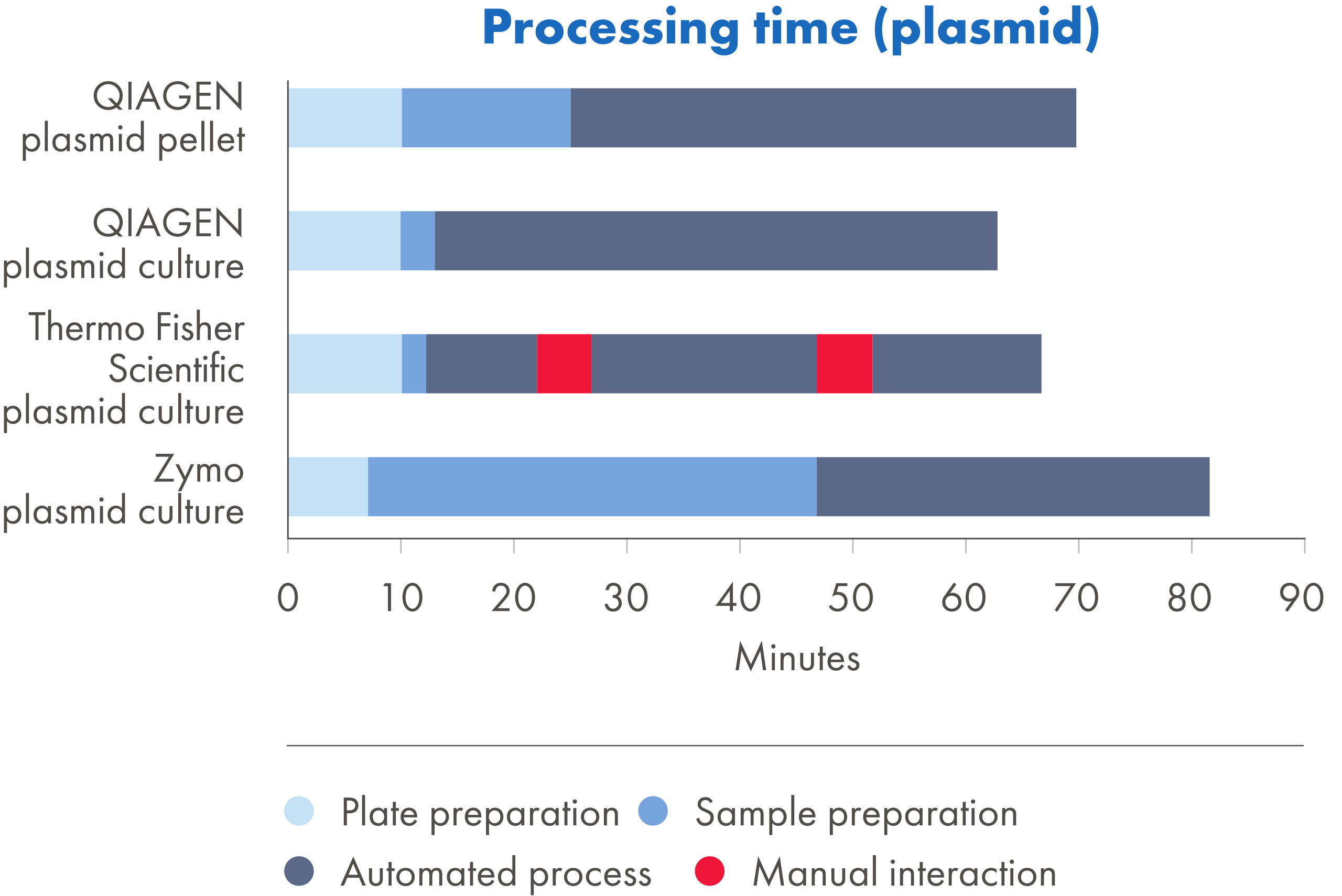
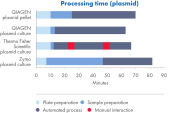
The QIAsprint Plasmid BOPP PrepSet workflow for plasmid DNA isolation from bacteria delivers exceptional speed and high processing performance, enabling automated nucleic acid extraction with minimal manual intervention (see Processing time).
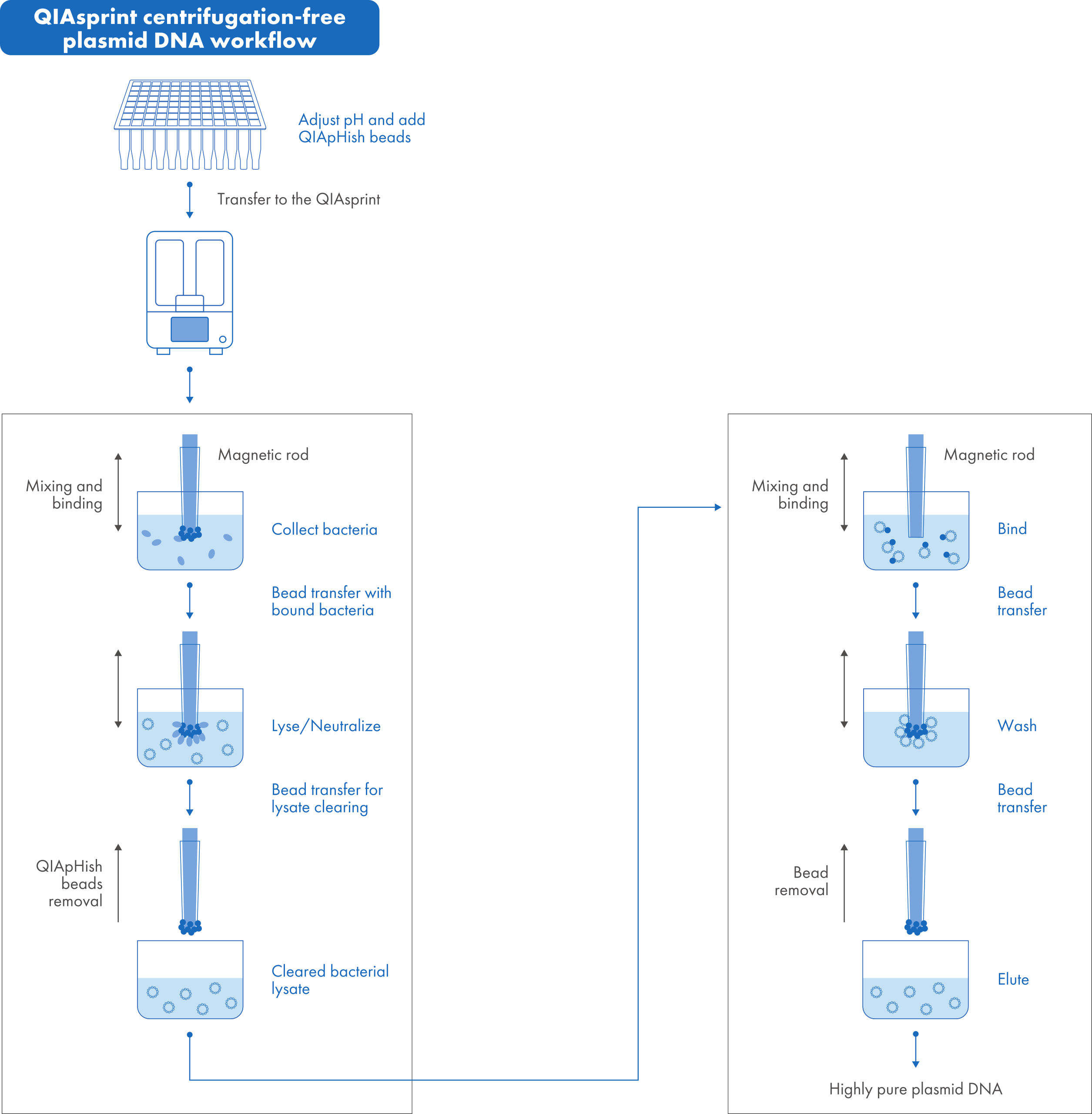
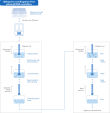
Flexible workflow options allow either direct processing from bacterial cultures using a true walk-away protocol or starting from pelleted bacteria. In both cases, BOPP technology eliminates the need for lysate clearing by centrifugation (see QIAsprint plasmid DNA workflow).
Principle
The QIAsprint workflow for plasmid DNA isolation from bacterial cells uses a modular approach that enables an efficient culture-to-eluate protocol. The procedure supports automated processing directly from bacterial cultures or from pelleted bacteria. When starting from culture, QIApHish Beads capture bacterial cells directly, eliminating the need for centrifugation-based harvesting (see QIAsprint plasmid DNA workflow).
During pretreatment, the QIAsprint Plasmid BOPP PrepSet applies the BOPP technology to clear lysates without centrifugation or manual transfer steps. This streamlined pretreatment integrates directly with the automated purification workflow, significantly reducing hands-on time while maintaining consistent performance.
The workflow recovers ready-to-use, transfection-grade plasmid DNA from up to 1 mL bacterial cultures when using the Culture protocol or from up to 5 mL bacterial cultures when using the Pellet protocol. The approach is suitable for both high-copy and low-copy plasmids.
In addition, most buffers and reagents used within the workflow are available as standalone components, enabling further customization for specialized applications (see QIAsprint sets and consumables finder).
See QIAsprint Connect Protocol Guide for support on finding or customizing according to your application’s needs.
Procedure
Workflow A: Plasmid purification directly from bacterial cultures
This workflow includes capture of bacterial cells, lysis, binding, washing and elution. The pH of the bacterial culture is adjusted and QIApHish Beads are added to capture bacterial cells. The bead-bound cells are transferred to perform lysis, neutralization and lysate clearing. MagAttract Suspension is then added to bind plasmid DNA from the cleared lysate, followed by wash and elution steps to yield ready-to-use plasmid DNA (see QIAsprint Plasmid Workflow).
Workflow B: Plasmid purification from pelleted bacterial cultures
This workflow includes lysis, binding, washing and elution. Bacterial cultures are pelleted and resuspended before lysis, neutralization and lysate clearing are performed on the QIAsprint Connect. MagAttract Suspension binds plasmid DNA from the cleared lysate, followed by wash and elution steps to yield ready-to-use plasmid DNA (see QIAsprint Plasmid Workflow).
Applications
Plasmid DNA extracted using QIAsprint workflows delivers high-quality DNA with full downstream compatibility. Applications include restriction enzyme digestion, PCR analysis, Sanger sequencing, cloning and transfection of robust cells.
Supporting data and figures
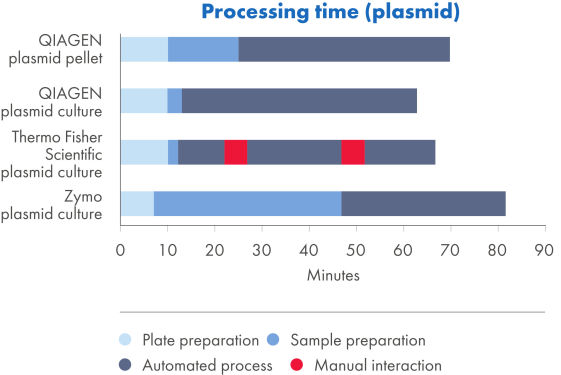
Comparison of plasmid purification workflows using QIAGEN, Thermo Fisher Scientific and Zymo magnetic bead–based kits
Plasmid DNA was purified using QIAGEN workflows consisting of the QIAsprint BOPP Plasmid PrepSet and Essential Kit D for pellet-based processing, or in combination with QIApHish beads, PrepSet and Essential Kit D for centrifugation-free purification directly from bacterial culture. The Thermo Fisher Scientific workflow requires manual user intervention steps. In contrast, the QIAGEN workflows enable true walk-away automation without manual intervention while maintaining competitive processing times. The Zymo protocol includes extensive manual sample preparation steps.
Specifications
| Features | Specifications |
|---|---|
| Elution volume | Variable, depending on sample: 50 µL and 100 µL recommended |
| Main sample type | Plasmid carrying E. coli grown in LB medium |
| Processing | Automated on QIAsprint |
| Analyte | Plasmid DNA |
| Sample amount | Up to 1 mL bacterial culture (culture protocol),up to 5 mL bacterial culture (pellet protocol) |
| Technology | Magnetic-particle technology |
Sets & Consumables
QIAsprint Sets
Add ons
Consumables & Accessories
Resources
Brochures & Guides (3)
Kit Handbooks & Protocols (2)
Safety Data Sheets (1)
Certificates of Analysis (1)
Specialized Protocols (2)
Operating software (1)
User Manuals (1)
FAQ
What is the composition of Buffer PE?
What is the composition of Buffer EB?
3314-What is the concentration of RNase A sold separately?
Can I use other plastics than the QIAsprint Connect plastics on the instrument?
What is the maximum plasmid size I can isolate with the QIAsprint Plasmid chemistry?
How important is the pH adjustment in the QIAsprint Plasmid Culture Protocol?
Can I use more than 1 mL culture in the QIAsprint Plasmid Culture Protocol?
Can E. coli cells be grown in other media than LB?
What is the processing volume of the QIAsprint Connect?
What about isolation of plasmids from other types of bacteria?
What is the typical endotoxin content of the isolated plasmids?