
Want to try this solution for the first time?
Get in touch with our team today and request a quote to trial the T4 DNA Ligase (Rapid).
T4 DNA Ligase (Rapid)
Cat no. / ID. L6030-HC-L
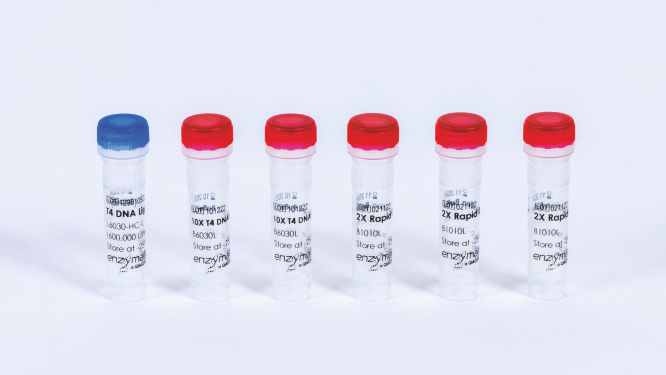
240,000 U of T4 DNA Ligase (600,000 U/mL) 2x Rapid Ligation Buffer and 10x T4 DNA Ligase Buffer
Log in To see your account pricing.
Enzyme
T4 DNA Ligase (Rapid)
T4 DNA Ligase (Standard)
WGS Ligase
The T4 DNA Ligase is intended for molecular biology applications. This product is neither intended for the diagnosis, prevention or treatment of a disease, nor has it been validated for such use either alone or in combination with other products.
Want to try this solution for the first time?
Get in touch with our team today and request a quote to trial the T4 DNA Ligase (Rapid).
Features
- Versatile enzyme widely used for high-precision NGS library prep and DNA cloning
- Efficiently joins both complementary cohesive (sticky) ends and blunt ends
- Repairs single-stranded nicks in duplex DNA for high-efficiency DNA ligation
- High-concentration rapid formulation increases efficiency and decreases ligation times
- Quality tested for the absence of DNase contamination
Product Details
T4 DNA Ligase enzyme is a recombinant protein (55,292 Daltons) produced by an E. coli strain carrying the cloned bacteriophage T4 DNA ligase gene.
T4 DNA Ligase is an ATP-dependent enzyme that catalyzes the formation of a phosphodiester bond between the terminal 5ʹ phosphate and a 3' hydroxyl group of duplex DNA or RNA. The enzyme efficiently joins blunt and cohesive ends and repairs single-stranded nicks in duplex DNA, RNA or DNA:RNA hybrids (1). T4 DNA Ligase is effective for joining blunt or cohesive ends in double-stranded RNA with a complementary "splint" strand (DNA or RNA) holding the RNA ends together. T4 DNA Ligase cannot join single-stranded nucleic acids.
Available Configurations:
| Feature | T4 DNA Ligase (Standard) | T4 DNA Ligase (Rapid) | WGS Ligase |
|---|---|---|---|
| Catalog number | L6030-LC-L | L6030-HC-L | L6030-W-L |
| Best for | Routine cloning and ligation of cohesive or blunt DNA ends | Fast ligation and improved blunt-end efficiency | Whole genome sequencing (WGS) library construction and adapter ligation |
| Ligase concentration | 120,000 U/mL | 600,000 U/mL | 600,000 U/mL |
| Buffers included (PEG concentration) |
10x T4 DNA Ligase Buffer | 10x T4 DNA Ligase Buffer 2x Rapid Ligation Buffer (15% PEG 6000) |
5x Rapid Ligation Buffer (30% PEG 6000) |
| Ligation time | 30 minutes at 25°C | 10 minutes at 25°C | 15 minutes at 20°C |
Product Composition:
| Component | Composition | Storage temperature |
|---|---|---|
| T4 DNA Ligase (L6030) | Supplied in 10 mM Tris-HCl, 50 mM KCl, 1 mM DTT, 0.1 mM EDTA and 50% glycerol; pH 7.5 at 25°C. | –25°C to –15°C |
| 10x T4 DNA Ligase Buffer (B6030) | 500 mM Tris-HCI, 100 mM MgCl2, 50 mM DTT and 10 mM ATP; pH 7.6 at 25°C. | –25°C to –15°C |
| 2x Rapid Ligation Buffer (B1010) | 132 mM Tris-HCl, 20 mM MgCl2, 2 mM DTT, 2 mM ATP and 15% PEG 6000; pH 7.6 at 25°C. | –25°C to –15°C |
| 5x Rapid Ligation Buffer (B9020) | 330 mM Tris-HCl, 50mM MgCl2 , 5 mM DTT, 5 mM ATP and 30% PEG 6000; pH 7.6 @ 25°C | –25°C to –15°C |
Performance
One unit of enzyme is defined as the amount of T4 DNA Ligase required to join 50% of 100 ng of DNA fragments with cohesive termini in 50 µL 1x T4 DNA Ligase Buffer following a 30 minute incubation at 23°C.
One T4 DNA Ligase cohesive end unit (CEU) is equivalent to approximately 3 cohesive end units as measured with a Lambda-Hind III DNA fragment substrate in 1x T4 DNA Ligase reaction buffer.
One Weiss Unit is approximately equivalent to 22 T4 DNA Ligase cohesive end units.
Quality Control:
Each lot of T4 DNA Ligase is manufactured under stringent quality standards and tested to ensure consistent performance, purity and freedom from contaminating nuclease activities. For detailed assay methodologies, please refer to the product manual.
| Test | Units tested | Specification |
|---|---|---|
| Purity | n/a | >99% |
| Specific activity | n/a | 300,000 U/mg |
| Single-stranded exonuclease | 6000 U | <1% released |
| Double-stranded exonuclease | 6000 U | <1% released |
| Double-stranded endonuclease | 6000 U | No conversion |
| E. coli DNA contamination | 6000 U | <10 copies |
Principle
T4 DNA ligase DNA ligation mechanism:
DNA ligases are critical DNA replication and repair enzymes and are widely used in molecular biology and biotechnology applications. The core enzyme function for ligation or sealing, either in vivo (replication/repair) or in vitro (cloning/molecular biology), is the covalent joining of the 3′-hydroxyl end of one nucleotide to the 5′-phosphate end of another.
DNA ligases share a high degree of structural similarity and a common mechanism with other members of the nucleotidyltransferase superfamily, including RNA ligases and RNA-capping enzymes.
- DNA ligases in this superfamily utilize an ATP molecule to activate the enzyme.
- DNA ligases do not require dNTPs as substrates for their function.
- All DNA ligation reactions entail sequential nucleotidyltransfer steps.
The T4 DNA ligase DNA ligation mechanism can be divided into three distinct catalytic events. All three chemical steps depend on a divalent cation (Mg2+).
- Step 1 is activation of the enzyme through the covalent addition of AMP to the conserved catalytic lysine of the ligase, accompanied by the release of PPi from the ATP cofactor.
- Step 2 is binding of the ligase-adenylate to the substrate DNA and the transfer of AMP from the ligase to the 5’-phosphoryl group of the nick on the DNA.
- Step 3 is formation of the phosphodiester-bond with the concomitant release of free AMP from the DNA-adenylate intermediate.
Procedure
Single-insert ligations are optimal with a ratio of target-insert-to-vector between 2:1 and 6:1. A ratio above 6:1 promotes the insertion of multiple fragments, whereas a ratio below 2:1 reduces ligation efficiency. It may be necessary to vary ratios and run multiple ligations for problematic ligations or if the DNA concentration is unknown.
A 3–10 molar excess of insert DNA over vector DNA is recommended.
Use the following equation to calculate the optimal amount of insert DNA in a ligation reaction:
ng of insert = [ ng of vector x kb size of insert x molar ratio insert:vector ] / [ kb size of vector ]
Note: T4 DNA Ligase is ATP-dependent. We recommend discarding reaction buffers after one year of –20°C storage and replacing them with fresh buffer to ensure maximum performance.
T4 DNA Ligase (Standard) ligation protocol
Reaction setup (Standard)
| Reagent | Amount | Final Concentration |
|---|---|---|
| 10x T4 DNA Ligation Buffer | 2 µL | 1x |
| Vector | 1–10 ng/µL | Variable |
| Insert | 1–10 ng/µL | Variable |
| T4 DNA Ligase (120 U/ µL) | 1 µL | 6 U/µL |
| Nuclease-free water | Variable | n/a |
| Total volume | 20 µL | n/a |
1. Transfer all components to a clean reaction vessel and mix well by pipetting.
2. Incubate at 25°C for 30 minutes.
3. Immediately purify DNA using PCR clean-up columns and elute in approximately 50 µL.
4. Alternatively, dilute immediately in TE or water (at least 1:10, but ensure that 0.1–10 ng ligation product is available for transformation).
5. Transform 0.1–10 ng ligation product into a chemically or electrocompetent cell line compatible with the vector.
T4 DNA Ligase (Rapid) high concentration ligation protocol
High-concentration T4 DNA Ligase (600,000 U/mL) is designed for rapid ligation of sticky-end (10 minutes) or blunt-end (10–30 minutes) DNA, using 2x Rapid Ligation Buffer containing PEG. For best results, use a 1:3 vector-to-insert ratio at 25°C.
Reaction setup (Rapid)
| Reagent | Amount | Final Concentration |
|---|---|---|
| 2x Rapid Ligation Buffer | 10 µL | 1x |
| Vector | 1–10 ng/µL | Variable |
| Insert | 1–10 ng/µL | Variable |
| T4 DNA Ligase (600 U/µL) | 1 µL | 30 units/µL |
| Nuclease-free water | Variable | n/a |
| Total volume | 20 µL | n/a |
1. Transfer all components to a clean reaction vessel and mix well by pipetting.
2. Incubate at 25°C for 10 minutes.
3. Immediately purify DNA using PCR clean-up columns and elute in approximately 50 µL.
4. Alternatively, dilute immediately in TE or water to reduce PEG concentration (at least 1:10, but ensure that 0.1–10 ng ligation product is available for transformation).
5. Transform 0.1–10 ng ligation product into a chemically or electrocompetent cell line compatible with the vector.
WGS Ligase ligation protocol:
1. Transfer Y μL of DNA adapter* into a PCR tube with 50 μL of A-tailed DNA from a 5X WGS Fragmentation reaction. Mix gently by pipetting and cool on ice.
*Note: DNA adapters are not included. Follow supplier’s recommendation for adapter concentration and usage condition. We recommend an adapter to insert molar ratio from 25:1 to 200:1.
2. Prepare the following ligation reaction master mix (per DNA sample) in a separate tube on ice and mix well by pipetting. The master mix can be scaled as needed for the desired number of samples.
Master mix for one reaction
| Reagent | Amount |
|---|---|
| 5x Rapid Ligation Buffer | 20 µL |
| WGS DNA Ligase | 10 µL |
| Nuclease-free water | (20 – Y) µL |
| Total | (50 – Y) µL |
3. Add (50 – Y) μL of the ligation master mix to the sample from step 1 and mix well by pipetting. Incubate the ligation reaction at 20°C for 15 minutes.
IMPORTANT: Do not use a thermocycler with a heated lid.
4. Proceed immediately to adapter ligation cleanup using 0.8X (80 μL) AMPure® XP beads or an alternative method.
5. If no size selection is required, perform a second purification using 1X (50 μL) AMPure XP beads. Elute DNA in 28 μL of 10mM Tris-HCl, pH 8.0.
6. If size selection is required, use your choice of method and follow the corresponding manufacturer’s protocols.
7. If library amplification is not intended, elute DNA in 12.5 μL of 10mM Tris-HCl, pH 8.0 after second 1X AMPure XP beads purification. Collect 10 μL of purified DNA sample. This sample can be stored at –20°C.
Applications
T4 DNA Ligase applications in DNA:
- Cloning: Joins restriction fragments or PCR products into vectors (cohesive or blunt-ended), including TA cloning.
- Next-generation sequencing (NGS): Attaches adapters to DNA fragments for library construction.
- Site-directed mutagenesis: Following PCR amplification with mutation-containing primers, seals the nicked/linearized plasmid vector to form a complete circle necessary for transformation.
- Gene synthesis: Joins synthesized oligonucleotides to form larger gene fragments or full-length genes.
- Self-circularization of linear DNA: Facilitates self-circularization of linear DNA (both blunt and cohesive ends) essential for producing plasmids.
- Nick repair in double-stranded DNA: Acts as a molecular "repair kit" to seal nicks, or small gaps (1–5 nucleotides).
- Ligation-mediated PCR (LM-PCR): Facilitates the ligation of linkers/adaptors to unknown, digested DNA sequences; essential for subsequent PCR amplification using primers specific to the adapter.
T4 DNA Ligase applications in RNA:
- Adapter ligation in RNA-seq library prep: Enables attachment of sequencing adapters (specifically for dsDNA/RNA hybrids or cDNA) especially for small RNA sequencing.
- Splint ligation/RNA joining: Joins blunt or cohesive ends in double-stranded RNA with a complementary "splint" oligonucleotide (DNA or RNA) holding the RNA ends together to synthesize long, structured or modified RNAs or to produce circular RNA/DNA chimeric oligonucleotides.
- Ligase-mediated RNA detection: Joins two adjacent DNA probes (a "splint ligation") that are hybridized to a target RNA template to directly detect, differentiate and quantify RNA sequence variants, including microRNAs.
- Nick repair in RNA: Repairs nicks in duplex RNA or DNA/RNA hybrids.
- RNA 5′-adenylation: Facilitates the 5′-adenylation of RNA for applications such as 5'-end labeling of RNA and producing 5'-adenylated RNA/DNA adapters for library construction, particularly in small RNA and miRNA studies.
Resources
Kit Handbooks & Protocols (2)
Software-related downloads (2)
Safety Data Sheets (1)
Certificates of Analysis (1)
Brochures & Guides (2)