HiSpeed Plasmid Kits

最大750 μgのトランスフェクショングレードのプラスミドまたはコスミドDNAの超高速な精製用

S_1376_DNA_PLS0763

✓ オンライン注文による24時間年中無休の自動処理システム

✓ 知識豊富で専門的な製品&テクニカルサポート

✓ 迅速で信頼性の高い(再)注文

HiSpeed Plasmid Midi Kit (25)

カタログ番号 / ID.   12643

25 x HiSpeed Midi Tips、25 x QIAfilter Midi Cartridges、25 x QIAprecipitator Midi Modules plus Syringes、試薬、バッファー。
¥49,000
カートリッジタイプ
Midi
Maxi
HiSpeed Plasmid Kitsは分子生物学的アプリケーション用であり、疾病の診断、予防、あるいは治療に使用することはできません。

✓ オンライン注文による24時間年中無休の自動処理システム

✓ 知識豊富で専門的な製品&テクニカルサポート

✓ 迅速で信頼性の高い(再)注文

特徴

  • 60分未満の調製時間
  • 遠心分離なしで溶解物の不純物除去およびイソプロパノール沈殿を実現
  • 沈殿操作中にDNAを失うリスクなし
  • 最大750 µgの高コピープラスミドDNA収量
  • LyseBlueで最適な溶解と最大のDNA収量を実現
  • 吸引マニフォールドなしでラージスケールのプラスミド調製

製品詳細

HiSpeed Plasmid Kitsは遠心分離を必要とせず、陰イオン交換法を用いた迅速でラージスケールのプラスミドDNA調製を実現します。精製されたDNAは、CsCl密度勾配遠心法を2回行なって得られる精製グレードに匹敵し、トランスフェクショングレードのアプリケーションに適しています。

パフォーマンス

HiSpeed Plasmid Kitsは、吸入マニホールドを使用しない高速の大量プラスミド調製用にQIAfilter Cartridges、HiSpeed TipsおよびQIAprecipitatorモジュールを備えています。シリンジフォーマットのQIAfilterとQIAprecipitatorモジュールにより、従来の陰イオン交換調製法における遠心操作の必要がなくなり、プラスミド精製がより迅速で簡単になりました。150~250 ml の培養液から最高750 µg(Maxi)、または50~150 ml の培養液から最高200 µg(Midi)の高コピープラスミドDNAを精製することができます(培養液の容量はプラスミドのコピー数、添加サイズ、宿主株、培養媒体に依存)。HiSpeed Tipでは、流速が早くなり、プラスミド精製のためのDNA結合、洗浄および溶出ステップをより迅速に行なえます。

HiSpeed Tipsの独自の陰イオン交換樹脂は核酸の精製専用に開発されています。本製品の優れた核酸分離能力により、CsCl密度勾配遠心分離法を2回行なって得たDNAの純度に匹敵、あるいはそれ以上の純度のDNAが精製されます。

原理

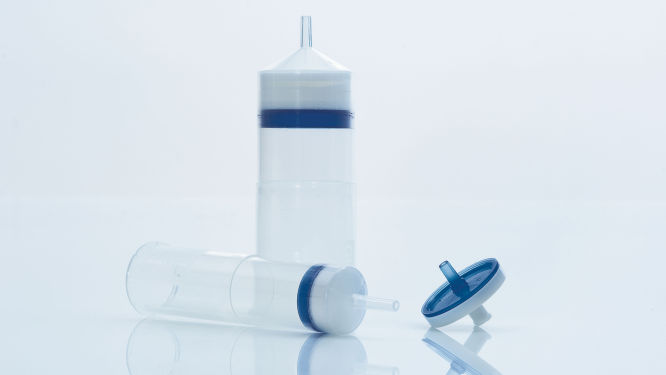
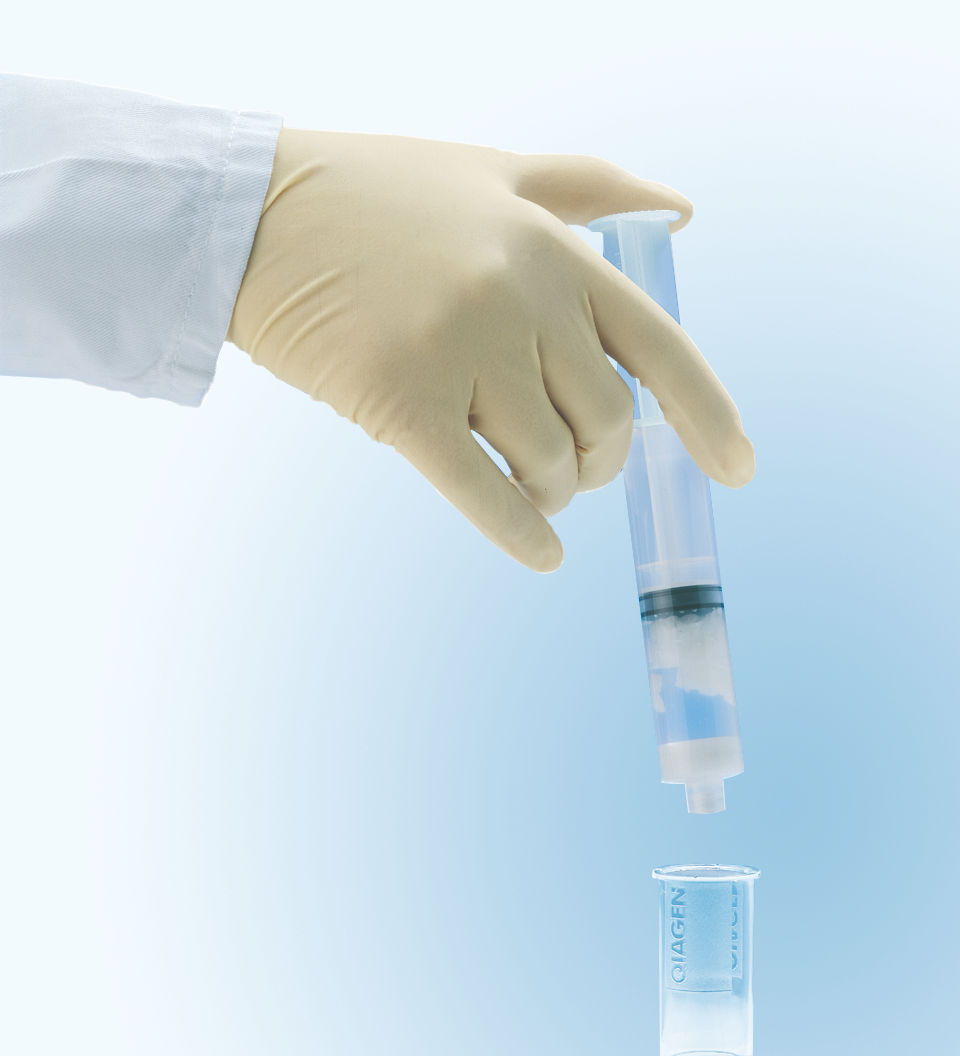
QIAfilter Cartridges(図「 QIAfilter Cartridge」を参照)は、バクテリア細胞のアルカリ溶解に続く遠心分離ステップを代替するために設計された特別なフィルターユニットです。遠心分離で要する時間に比べわずかな時間で、SDS沈殿物を完全に除去し、バクテリア溶解物の不純物を除去します。充填済みのHiSpeed Tipsは、自然落下で作動し乾燥することがなく、プラスミド調製に要する直接の作業時間を短縮できます。
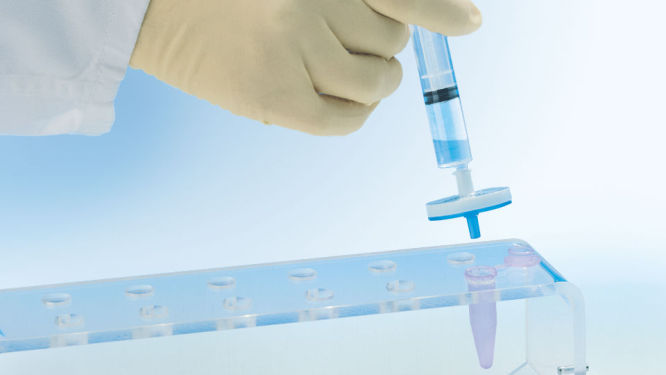
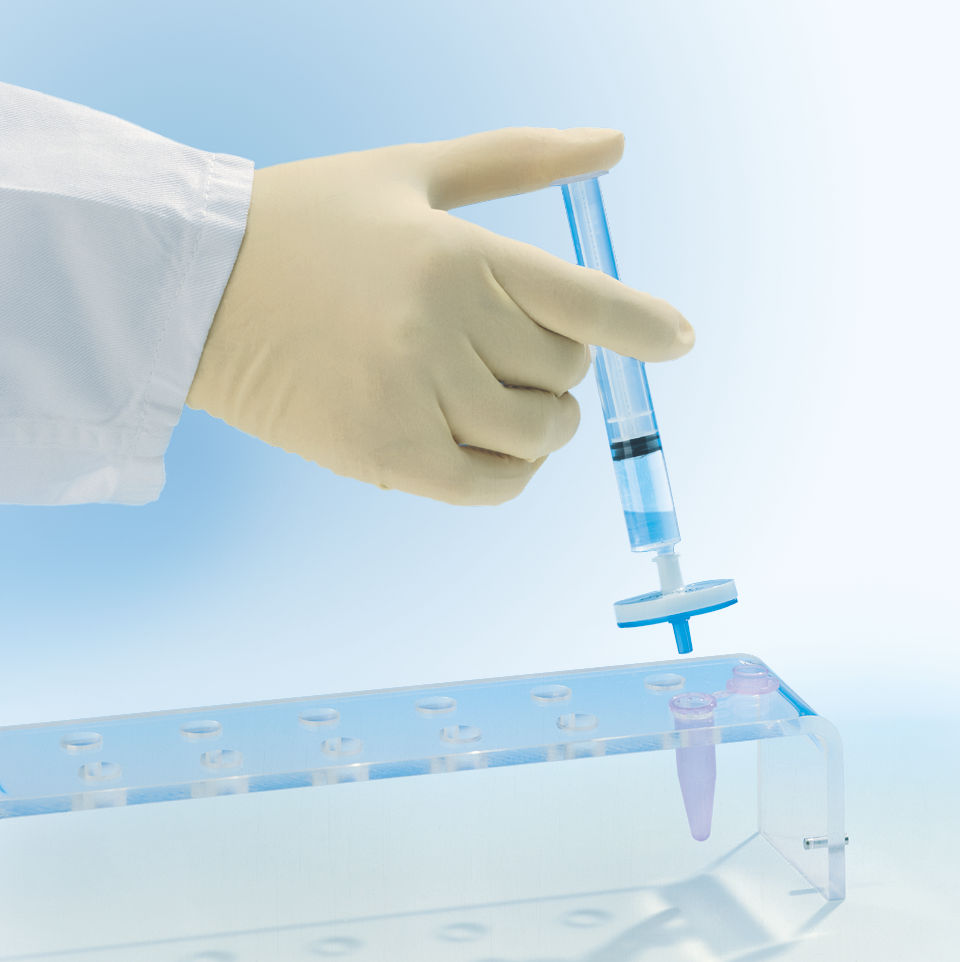
独自のQIAprecipitatorモジュール(図「 QIAprecipitatorモジュール」を参照)により、イソプロパノールで沈殿させたDNAを収集するために従来の遠心操作の必要がなくなりました。沈殿したDNAは、QIAprecipitatorモジュールで捕獲され、イソプロパノールやバッファーは流出します。このDNAはTEバッファーあるいは水により、QIAprecipitatorからマイクロ遠心チューブに簡単に溶出されます。また、この独自のモジュールにより、遠心操作後に上清を除去する際に起こり得るペレットを失うリスクもなくなりました。
仕様
特徴 HiSpeed Plasmid Midi Kit HiSpeed Plasmid Maxi Kit
アプリケーション トランスフェクション、クローニングシークエンシング、遺伝子サイレンシング トランスフェクション、クローニングシークエンシング、遺伝子サイレンシング
培養液量/出発物質 培養液量50 µl~150 ml 培養液量150 µl~250 ml
プラスミドタイプ 高コピー、コスミドDNA 高コピー、コスミドDNA
処理 手動(濾過) 手動(濾過)
ランあたりのサンプル ランあたり1サンプル ランあたり1サンプル
技術 陰イオン交換テクノロジー 陰イオン交換テクノロジー
ラン1回あたりの時間 45分 60分
収量 <200 µg <750 µg

操作手順

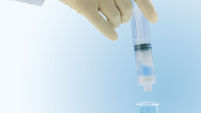
中和したバクテリア溶解物をQIAfilter Cartridgeでインキュベートし、濾過によりすぐに不純物を除去します。濾過物をHiSpeed tipにアプライしてプラスミドDNAを精製します(フローチャート「QIAGEN Plasmid Kit操作手順」を参照)。溶出したDNAをイソプロパノールで混和し、付属のシリンジでQIAprecipitatorモジュールにアプライします。次に、濃縮され脱塩したDNAは、QIAprecipitatorから直接、TEバッファーまたは水の入ったマイクロ遠心チューブに溶出します。

アプリケーション

HiSpeed Plasmid Kitsを用いて精製したDNAは、クローニングやシークエンシングから、トランスフェクション、プラスミド媒介の遺伝子サイレンシングに至るまで、あらゆるアプリケーションで卓越した結果をもたらします。

裏付けデータと数値

リソース

クイックスタートプロトコール (2)
安全データシート (1)
Download Safety Data Sheets for QIAGEN product components.
Safety Data Sheets (1)
Certificates of Analysis (1)

出版物

Characterization of Helicobacter pylori lytic transglycosylases Slt and MltD.
Chaput C; Labigne A; Boneca IG;
J Bacteriol; 2006; 189 (2):422-9 2006 Nov 3 PMID:17085576
Identification of a lipase-linked cell membrane receptor for pigment epithelium-derived factor.
Notari L; Baladron V; Aroca-Aguilar JD; Balko N; Heredia R; Meyer C; Notario PM; Saravanamuthu S; Nueda ML; Sanchez-Sanchez F; Escribano J; Laborda J; Becerra SP;
J Biol Chem; 2006; 281 (49):38022-37 2006 Oct 10 PMID:17032652
Role of parathyroid hormone in the downregulation of liver cytochrome P450 in chronic renal failure.
Michaud J; Naud J; Chouinard J; Désy F; Leblond FA; Desbiens K; Bonnardeaux A; Pichette V;
J Am Soc Nephrol; 2006; 17 (11):3041-8 2006 Oct 4 PMID:17021269
A rapid functional assay for the human trace amine-associated receptor 1 based on the mobilization of internal calcium.
Navarro HA; Gilmour BP; Lewin AH;
J Biomol Screen; 2006; 11 (6):688-93 2006 Jul 10 PMID:16831861
Engineering of a xylose metabolic pathway in Corynebacterium glutamicum.
Kawaguchi H; Vertès AA; Okino S; Inui M; Yukawa H;
Appl Environ Microbiol; 2006; 72 (5):3418-28 2006 May PMID:16672486

よくある質問

Where can I find a protocol for cleanup of already purified plasmid DNA?

When using the silica-based QIAprep Spin Miniprep Kit, a protocol is contained in the QIAprep Miniprep Handbook, in Appendix C: Special Applications. The protocol is called: 'Purification of plasmid DNA prepared by other methods'.

For our anion-exchange based Plasmid Purification Kits, a protocol can be accessed online at our Plasmid Resource Center, and is called 'Re-Purification of Plasmid DNA Prepared by Methods other than QIAGEN Tips'.


FAQ-1031
I am seeing a precipitate after adding LyseBlue reagent to Buffer P1. What should I do about that?

A precipitate forming upon adding LyseBlue reagent to Buffer P1 is a normal observation. This precipitate will completely dissolve after addition of Buffer P2. Please be sure to shake Buffer P1 vigorously before use to completely resuspend LyseBlue particles.

FAQ-1045
What are the additional plasmid bands I see on my gel?

Open circular plasmid, resulting from single strand nicks, usually migrates slower in agarose gels and forms (faint) bands above the supercoiled plasmid DNA band. Sometimes an additional band of denatured supercoiled DNA migrates just below the supercoiled form. This form may result from prolonged alkaline lysis with Buffer P2 and is resistant to restriction digestion.

For a detailed description on how to run and interpret an analytical gel, please see Appendix A in the QIAGEN Plasmid Purification Handbook: "Agarose Gel Analysis of the Purification Procedure", or visit this link.

FAQ-1059
How can I prevent clogging of QIAfilter cartridges?
It is important to completely mix and lyse bacterial cells with plasmid Buffers P1 and P2. Incomplete mixing results in sticky or slimy areas of lysate, which will clog the filter matrix. It is recommended to completely resuspend cells in Buffer P1 and vigorously mix after addition of Buffer P2. Also mixing after Buffer P3 addition needs to be complete to allow fluffy precipitation of cell debris, which will float up. If the white debris does not float, dislodge it from the QIAfilter barrel wall (e.g. using a sterile pipette tip). Otherwise it will collect on the filter matrix and can lead to clogging. Use of LyseBlue reagent will help to achieve proper mixing results.
FAQ-1060
How can I increase DNA concentration using QIAprecipitators of the HiSpeed Plasmid Kits?
Use 500 µl instead of 1 ml of Buffer TE for elution of plasmid DNA from the QIAprecipitator of the HiSpeed Plasmid Kits. If low copy plasmids are used, the lysates of two QIAfilter Cartridges can be filtered into one equilibrated HiSpeed Tip. HiSpeed Maxi Kits will result in higher DNA concentration than HiSpeed Midi Kits, because the QIAprecipitators in both kits (Midi- and Maxi Module) use the same elution volume.
FAQ-1061
How can I improve the performance of the HiSpeed QIAprecipitator module?

When using the QIAprecipitator module of the HiSpeed Plasmid Midi- or Maxi Kits, make sure to dry the membrane by pressing air through the QIAprecipitator at least twice. Dry the outlet nozzle of the QIAprecipitator with absorbent paper. This will prevent carry-over of alcohol into the eluate and enable optimal performance of the extracted DNA downstream.

Do not load eluate from from several columns on the QIAprecipitator, and be sure that the correct precipitator size is used for the corresponding HiSpeed Tip. Do not replace the isopropanol with ethanol for precipitation, since the use of ethanol will lead to a finer precipitate that can clog the module.

To prevent breakage and leakage of the module it is important to avoid excessive force, bending, or twisting while attaching the QIAprecipitator to the syringe. Do not stress the inlet by resting one edge of the QIAprecipitator on a hard surface (e.g., the edge of a sink) and depressing the syringe plunger. Always apply gentle, even, pressure perpendicularly to the QIAprecipitator.

FAQ-144
What is the RNase A concentration and composition of Buffer P1?

The composition of Buffer P1 is:

  • 50 mM Tris·Cl, pH 8.0
  • 10 mM EDTA
  • 100 µg/ml RNase A

After RNase A addition, the buffer should be stored at 2–8°C.

Buffer P1 is the resuspension buffer used in a variety of QIAGEN kits for plasmid DNA purification. Details on buffer preparation and storage are presented in Appendix B of the QIAGEN Plasmid Purification Handbook.

FAQ-198
Can I use water for elution from the QIAprecipitator of the HiSpeed Plasmid Kits?

Yes, when eluting DNA from the QIAprecipitator Modules of the HiSpeed Plasmid Kits, water or buffers commonly used to dissolve DNA (e.g., Tris) may be employed.

Note: Store DNA at -20°C when eluted with water as DNA may degrade in the absence of buffering and chelating agents.

FAQ-306
What is the lowest elution volume that can be used with QIAprecipitator Midi and Maxi Modules?

The lowest elution volume that should be used for both the QIAprecipitator Midi and the Maxi Module provided in the HiSpeed Plasmid Kits is 500 ul. The official elution volume for both modules is 1 ml. If a higher DNA concentration is desired and a reduction in yield of up to 10% is acceptable, the elution volume can be reduced. Elution volumes smaller than 500 ul will lead to incomplete wetting of the QIAprecipitator membrane and further reduced DNA yields.

FAQ-307
Are the QIAprecipitator Midi and Maxi Modules of the HiSpeed Plasmid Kits interchangeable?
No, the QIAprecipitator Midi and Maxi modules of the HiSpeed Plasmid Midi- and Maxi Kits are not interchangeable. Each module has been designed for different capacities and recoveries.
FAQ-308
Can Buffers N3 and P3 be used interchangeably?
No. Although both Buffers N3 of the QIAprep Spin Miniprep and P3 of the QIAGEN Plasmid Kits perform the neutralization step in an alkaline lysis procedure, they are completely different. Buffer N3 contains a proprietary formula that sets up binding conditions for the QIAprep Miniprep column's silica-gel-membrane. Buffer P3 sets up binding conditions for QIAGEN anion-exchange columns. Our website explains QIAGEN's nucleic acid purification technologies in more detail.
FAQ-310
Can I use ethanol instead of isopropanol for DNA precipitation when using HiSpeed Plasmid Kits?

No. Ethanol is not recommended when using the QIAprecipitator module of the HiSpeed Plasmid Kits for DNA precipitation. The finer precipitates formed with ethanol are likely to clog the QIAprecipitator.

FAQ-354
Can I eliminate RNase A from buffer P1 for my plasmid preparation to obtain RNase-free DNA for in-vitro transcription?
No, RNase A should not be omitted from buffer P1. It is required to prevent RNA contamination of the purified plasmid DNA. RNase A will not interfere with downstream in-vitro transcription experiments, since it will be efficiently removed during the plasmid purification procedures using QIAGEN Plasmid Kits.
FAQ-366
What is the composition of buffer QBT?

Buffer QBT is the equilibration buffer used in QIAGEN Plasmid Kits for plasmid purification and in QIAGEN Blood & Cell culture kits.

The composition of Buffer QBT is:

  • 750mM NaCl • 50 mM MOPS, pH 7.0
  • 15% isopropanol (v/v)
  • 0.15 % Triton® X-100 (v/v)

To make 1 liter of solution, dissolve 43.83 g NaCl, 10.46 g MOPS (free acid) in 800 ml distilled water. Adjust the pH to 7.0 with NaOH. Add 150 ml pure isopropanol and 15 ml 10% Triton X-100 solution (v/v). Adjust the volume to 1 liter with distilled water. Store at 15–25°C

FAQ-411
What is the composition of buffer QC?

Buffer QC is the wash buffer used in QIAGEN Plasmid Kits for plasmid purification and in QIAGEN Blood & Cell Culture kits.

The composition of Buffer QC is:

  • 1.0 M NaCl
  • 50 mM MOPS, pH 7.0
  • 15% isopropanol (v/v)


To make 1 liter of solution, dissolve 58.44 g NaCl, 10.46 g MOPS (free acid) in 800 ml distilled water. Adjust the pH to 7.0 with NaOH. Add 150 ml pure isopropanol. Adjust the volume to 1 liter with distilled water. Store at 15–25°C.

FAQ-412
What is the composition of buffer QF?

Buffer QF is the elution buffer used in QIAGEN Plasmid Kits for plasmid purification and in QIAGEN Blood & Cell culture kits.

The composition of Buffer QF is:

  • 1.25 M NaCl
  • 50 mM Tris-Cl, pH 8.5
  • 15% isopropanol (v/v)


To make 1 liter of solution, dissolve 73.05 g NaCl and 6.06 g Tris base in 800 ml distilled water. Adjust the pH to 8.5 with HCl. Add 150 ml pure isopropanol. Adjust the volume to 1 liter with distilled water. Store at 15–25°C

FAQ-413
What is the composition of buffer STE?

The composition of Buffer STE is:

  • 100 mM NaCl
  • 10 mM Tris-Cl, pH 8.0
  • 1 mM EDTA

Buffer STE is a DNA resuspension and storage buffer used in QIAGEN Plasmid Kits for plasmid purification and in some plasmid supplementary protocols. Details on buffer preparation and storage are presented in Appendix B of the QIAGEN Plasmid Purification Handbook.

FAQ-415
What is the composition of buffer TE?

The composition of Buffer TE is:

  • 10 mM Tris·Cl, pH 8.0
  • 1 mM EDTA

Buffer TE is a commonly used DNA resuspension and storage buffer. It is supplied in QIAGEN's Endofree Plasmid Kits, and used for plasmid DNA resuspension in combination with other QIAGEN Plasmid Kits. Details on buffer preparation and storage are presented in Appendix B of the QIAGEN Plasmid Purification Handbook.

FAQ-416
What is the composition of buffer P3?

The composition of Buffer P3 is:

  • 3.0 M potassium acetate, pH 5.5

Buffer P3 is the neutralization buffer used in QIAGEN's anion-exchange based Kits for plasmid preparation. Details of buffer preparation and storage are presented in Appendix B of the QIAGEN Plasmid Purification Handbook.

FAQ-418
What can I do when the DNA pellet prepared with QIAGEN Plasmid Kits has been overdried?
Redissolve the DNA by warming the solution slightly, e.g. incubate it at 37°C, and allow more time for redissolving.
FAQ-572