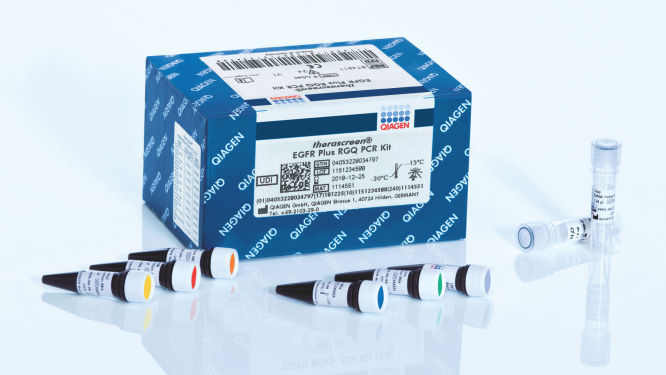
therascreen EGFR Plus RGQ PCR Kit

For detection and identification of 42 mutations in exons 18, 19, 20 and 21 of the EGFR gene

S_1212_6_MDx_CG_theraEGFRPlusRGQPCR_CEIVD

✓ 24/7 automatic processing of online orders

✓ Knowledgeable and professional Product & Technical Support

✓ Fast and reliable (re)-ordering

therascreen EGFR Plus RGQ PCR Kit (24)

Cat no. / ID.   874611

For 24 reactions: T790M & L861Q Mix, Insertions & G719X Mix, L858R & C797S Mix, Deletions & S768I Mix, PCR Master Mix, EGFR Positive Control, RNase/DNase-free Water
€3 918.00
Log in To see your account pricing.
KitProductInstrumentSoftware
therascreen EGFR Plus RGQ PCR Kit (24)
QIAamp DSP DNA FFPE Tissue Kit (50)
QIAamp DSP Circulating NA Kit
QIAsymphony DSP DNA Mini Kit
QIAsymphony DSP Circulating DNA Kit
Rotor-Gene Q MDx HRM System
Rotor-Gene Q MDx HRM Platform
Rotor-Gene AssayManager
The therascreen EGFR Plus RGQ PCR Kit is intended for in vitro diagnostic use.

✓ 24/7 automatic processing of online orders

✓ Knowledgeable and professional Product & Technical Support

✓ Fast and reliable (re)-ordering

Features

  • Detection of TKI resistance biomarkers, including T790M and C797S
  • Run FFPE and liquid biopsy samples in the same PCR run
  • Reliable, sensitive and specific detection of clinically relevant EGFR mutations
  • Automated sample preparation option with QIAsymphony SP
  • Automated analysis and next-day result reporting with Rotor-Gene Assay Manager software

Product Details

The therascreen EGFR Plus RGQ PCR Kit is an in vitro diagnostic real-time PCR test intended for the qualitative detection and identification of 42 mutations in exons 18, 19, 20 and 21 of the epidermal growth factor receptor (EGFR) gene in DNA samples extracted from plasma or formalin-fixed paraffin-embedded (FFPE) tumor tissue taken from non-small cell lung cancer (NSCLC) patients.

Furthermore, the kit also indicated for the semi-quantitative measurement of mutations in exons 18, 20 and 21 of the EGFR gene in DNA samples extracted from human plasma as an aid in the clinical management of NSCLC patients.

The test is intended to be used as an aid in selecting patients with NSCLC for therapy with an EGFR tyrosine kinase inhibitor (TKI).

Performance

When compared to the analytical reference method, there was a high level of concordance between therascreen EGFR Plus RGQ PCR Kit and the analytical accuracy method(s). The reference and discrepancy resolution methods used were: PNA qPCR, Sanger bi-directional sequencing; next-generation sequencing, therascreen EGFR RGQ PCR Kit V2 (cat. no. 874111) and therascreen EGFR Plasma RGQ PCR Kit (cat. no. 870311).

Results were analyzed to assess the positive percent agreement (PPA), negative percent agreement (NPA) and overall percent agreement (OPA) regarding EGFR mutation status (mutant; MT or wild-type; WT) and EGFR target (mutation identification) for FFPE and plasma samples between therascreen EGFR Plus RGQ PCR Kit and respective reference method and following discrepancy resolution method.

FFPE samples

In the study 170 FFPE samples were tested, of which 48 gave valid interpretable results (148 sample status and 155 target status).

When the results of the therascreen EGFR Plus RGQ PCR Kit were compared to the results of the respective reference method, four EGFR sample status (MT or WT) showed discordance. Following discrepancy resolution method analysis, the number of discordant samples statuses (MT or WT) decreased to one discrepant, false-negative sample status. The PPA, NPA and OPA with the corresponding two-sided 95% confidence intervals (CI) are summarized in Table 1 and Table 2.

Table 1. Analysis of agreement of overall mutation status per sample: therascreen EGFR Plus RGQ PCR Kit and reference method comparison for FFPE samples

    Lower limit 95% CI Upper limit 95% CI
OPA 97.30% 93.22% 99.26%
PPA (sensitivity) 93.65% 84.53% 98.24%
NPA (specificity) 100.00% 95.75% 100.00%

Table 2. Analysis of agreement of overall mutation status per sample after discordant investigation for FFPE samples

    Lower limit 95% CI Upper limit 95% CI
OPA 99.32% 96.29% 99.98%
PPA (sensitivity) 98.33% 91.06% 99.96%
NPA (specificity) 100.00% 95.89% 100.00%

Plasma samples

In the study, 106 plasma samples were tested and 106 gave valid interpretable results (106 sample status and 121 target status).

When the results of therascreen EGFR Plus RGQ PCR Kit were compared to the results of the respective reference method, nine EGFR sample status (MT or WT) showed discordance. Following discrepancy resolution method analysis, the number of discordant samples status (MT or WT) decreased to three discrepant, one false-negative, and two false-positive sample status. The PPA, NPA, and OPA with the corresponding two-sided 95% confidence intervals (CI) are summarized in Table 3 and Table 4.

Table 3. Analysis of agreement of overall mutation status per sample: therascreen EGFR Plus RGQ PCR Kit and reference method comparison for plasma samples

    Lower limit 95% CI Upper limit 95% CI
OPA 91.51% 84.49% 96.04%
PPA (sensitivity) 87.27% 75.52% 94.73%
NPA (specificity) 96.08% 86.54% 99.52%

Table 4. Analysis of agreement of overall mutation status per sample after discordant investigation for plasma samples

    Lower limit 95% CI Upper limit 95% CI
OPA 97.17% 91.95% 99.41%
PPA (sensitivity) 97.96% 89.15% 99.95%
NPA (specificity) 96.49% 89.89% 99.57%

Principle

The therascreen EGFR Plus RGQ PCR Kit comprises four triplex assays, each containing all the oligonucleotides (primers, probes and oligonucleotide clamp, where applicable) necessary to amplify and detect the targeted EGFR mutations. In each assay, two target mutations and one internal amplification control are assayed to determine the presence or absence of mutant DNA and to identify reaction failures due to suboptimal DNA input, or the presence of inhibitory substances in the sample matrix.

Allele-specific technology allows accurate and highly reproducible detection of mutations. DNA is selectively amplified using ARMS primers, probes and PCR clamps, with sensitive signal detection using the Rotor-Gene Q MDx 5plex HRM instrument. Result reporting is fully automated using Rotor-Gene AssayManager v2.1 software. If both the positive and no template controls are valid and the sample internal controls are valid, the EGFR mutation status will be displayed in the software.

Procedure

Flexibility is key to the therascreen EGFR Plus RGQ PCR System – with a choice of sample types and DNA extraction methods before real-time PCR.

DNA extraction from FFPE tissue or plasma samples can be performed manually or automated on the QIAsymphony SP, for walkaway sample processing. DNA is extracted from FFPE tissue samples manually using the QIAamp DSP DNA FFPE Tissue Kit, while automated processing uses the QIAsymphony DSP DNA Mini Kit. Plasma samples are processed manually using the QIAamp DSP Circulating Nucleic Acid Kit, while the QIAsymphony DSP Circulating DNA Kit offers automated DNA purification.

Following DNA extraction and quantification, sensitive real-time PCR is performed on the Rotor-Gene Q MDx 5plex HRM instrument. Automated data analysis displays qualitative results in Rotor-Gene AssayManager software, informing the system operator if one or more of the 42 mutations detected by the kit are present. The assay can be completed in ~8 hours, providing next-day results and informing earlier treatment decisions.

Applications

The therascreen EGFR Plus RGQ PCR Kit enables qualitative detection of 42 mutations in the EGFR gene for in vitro diagnostic use. It is an IVD assay to support treatment decisions when selecting NSCLC patients for therapy with an EGFR tyrosine kinase inhibitor (TKI).

Supporting data and figures

Resources

Kit Handbooks (9)
(FR) - QIAsymphony DSP DNA Handbook
PDF (655.3KB)
Download
QIAamp DSP Circulating NA Kit Instructions for Use (Handbook)
PDF (708.8KB)
Download
QIAamp DSP Circulating NA Kit Instructions for Use (Handbook)
PDF (805.8KB)
Download
QIAamp DSP Circulating NA Kit Handbook_V2_In Vitro Diagnostic use according to the Regulation (EU) 2017/746 on in vitro diagnostics medical devices
QIAamp DSP DNA FFPE Tissue Kit Handbook
PDF (244.8KB)
Download
QIAamp DSP DNA FFPE Tissue Kit Instructions for Use (Handbook)
PDF (328.2KB)
Download
QIAamp DSP DNA FFPE Tissue Handbook_V2_In Vitro Diagnostic use according to the Regulation (EU) 2017/746 on in vitro diagnostics medical devices
(FR) QIAsymphony DSP Circulating DNA Kit Instructions for Use (Handbook)
PDF (509.4KB)
Download
QIAsymphony DSP Circulating DNA Kit Handbook_V2_In Vitro Diagnostic use according to the Regulation (EU) 2017/746 on in vitro diagnostics medical devices
QIAsymphony DSP DNA Kit Instructions for Use (Handbook)
PDF (782.5KB)
Download
For verification of thermal accuracy of Rotor-Gene real-time cyclers
therascreen EGFR Plus RGQ PCR Kit Instructions for Use
PDF (3.2MB)
Download
For in vitro diagnostic use
For use with plasma of FFPE tissue
For use with Rotor-Gene Q MDx 5plex HRM instrument and Rotor-Gene AssayManager

March 2022
Protocols (92)
(FR) QIAsymphony SP Protocol Sheet – DNA_Blood_1000_V7_DSP
PDF (86.1KB)
Download
For use with software version 4.0 or higher
For use with software version 4.0
(FR) QIAsymphony SP Protocol Sheet – DNA_Blood_400_V6_DSP
PDF (83.1KB)
Download
For use with software version 4.0 or higher
(FR) - DNA_Blood_200_V7_DSP
PDF (71.9KB)
Download
For use with software version 4.0
(FR) - DNA_Blood_400_V6_DSP
PDF (71.9KB)
Download
For use with software version 4.0
(FR) - VirusBlood200_V5_DSP
PDF (79.8KB)
Download
For use with software version 4.0
(FR) QIAsymphony SP Protocol Sheet – DNA_Buffy_Coat_400_V6_DSP
PDF (102.3KB)
Download
For use with software version 4.0
(FR) - DNA_Buffy_Coat_200_V7 DSP
PDF (76.1KB)
Download
For use with software version 4.0
(FR) QIAsymphony SP Protocol Sheet – Tissue_LC_200_V7_DSP and Tissue_HC_200_V7_DSP
PDF (112.7KB)
Download
For use with software version 4.0 or higher
(FR) - DNA_Blood_1000_V7_DSP
PDF (84.7KB)
Download
For use with software version 4.0
(FR) - Tissue_LC_200_V7_DSP and Tissue_HC_200_V7_DSP
PDF (130.3KB)
Download
For use with software version 4.0
(FR) QIAsymphony SP Protocol Sheet – VirusBlood200_V5_DSP
PDF (95.3KB)
Download
For use with software version 4.0 or higher
For use with software version 4.0
(FR) - DNA_Buffy_Coat_400_V6_DSP
PDF (76.1KB)
Download
For use with software version 4.0
(FR) QIAsymphony SP Protocol Sheet – DNA_Buffy_Coat_200_V7 DSP
PDF (102.3KB)
Download
For use with software version 4.0
Automated DNA purification from cultured cells and bacterial cultures using the QIAsymphony DSP DNA Mini Kit in combination with the QIAsymphony SP.

The QIAsymphony DSP DNA Mini Kit in combination with the Tissue_LC_200_V7_DSP and Tissue_HC_200_V7_DSP (user-validated) protocols for purification of total DNA from cultured cells and bacterial cultures is intended for molecular biology applications. This combination is not intended for the diagnosis, prevention, or treatment of a disease.

For use with software version 4.0
To run and analyze QIAGEN artus PCR kits with the Rotor-Gene AssayManager additionally specific assay profiles need to be imported into the database.
The information about which assay profile is needed for which application is provided in the application sheets on the corresponding artus kit web catalog pages.
To run and analyze QIAGEN artus PCR Kits with Rotor-Gene AssayManager, specific assay profiles need to be imported into the database.
The information about which assay profile is needed for which application is provided in the application sheets or handbook on the corresponding artus Kit web catalog pages.
Report profile for use with the artus basic plug-in V1.0.3 in combination with Rotor-Gene AssayManager
Effect of preanalytical factors on analyte quality as shown with the QIAxcel Connect capillary gel electrophoresis system
Digital PCR (dPCR) is a powerful technique that detects and quantifies ultra-rare mutations in a high background of wild-type cfDNA down to 0.1% variant allele frequency. Here, we describe end-to-end manual and automated workflows that enable accurate detection and absolute quantification of ultra-rare PIK3CA variants in cfDNA using the QIAcuity Digital PCR System.
QIAsymphony DSP Circulating DNA Kit Instructions for Use (Protocol Sheet)
PDF (182.4KB)
Download
circDNA_1000_DSP_V2, circDNA_2000_DSP_V4, circDNA_4000_DSP_V4, circDNA_6000_DSP_V1, circDNA_8000_DSP_V1, and circDNA_10000_DSP_V1
QIAsymphony DSP Circulating DNA Kit Protocol Sheet_V2_In Vitro Diagnostic use according to the Regulation (EU) 2017/746 on in vitro diagnostics medical devices
QIAsymphony DSP DNA Mini Kit Instructions for Use (Protocol Sheet)
PDF (188.4KB)
Download
QIAsymphony DSP DNA Mini Kit Instructions for Use (Protocol Sheet)
PDF (119.7KB)
Download
QIAsymphony DSP DNA Mini Kit Instructions for Use (Protocol Sheet)
PDF (142.5KB)
Download
QIAsymphony DSP DNA Mini Kit Instructions for Use (Protocol Sheet)
PDF (122.5KB)
Download
Tissue_LC_200_V7_DSP and Tissue_HC_200_V7_DSP; Version 2
(FR) QIAsymphony SP Protocol Sheet – DNA_Blood_200_V7_DSP
PDF (86.7KB)
Download
For use with software version 4.0 or higher
To run and analyze assays with Rotor-Gene AssayManager version 1.0
Settings to run artus QS-RGQ Kits (Rotor-Gene Q software 2.1, or higher)
PDF (840.6KB)
Download
Safety Data Sheets (1)
Download Safety Data Sheets for QIAGEN product components.
Certificates of Analysis (1)
Brochures and Guides (3)
For automated purification of nucleic acids or 6xHis-tagged recombinant proteins from a wide variety of sample types
High-quality, nucleic acid purification for successful PCR and NGS experiments.
Performance Data (8)
(FR) - QIAsymphony DSP DNA Performance Data
PDF (1.7MB)
Download
Performance Characteristics: QIAamp DSP DNA FFPE Tissue Kit
PDF (74.6KB)
Download
QIAamp DSP Circulating NA Kit Instructions for Use (Performance Characteristics)
PDF (165.7KB)
Download
QIAamp DSP Circulating NA Kit Performance Characteristics_V2_In Vitro Diagnostic use according to the Regulation (EU) 2017/746 on in vitro diagnostics medical devices
QIAamp DSP Circulating NA Kit Performance Characteristics
PDF (184.9KB)
Download
QIAamp DSP Circulating NA Kit handbook
QIAamp DSP DNA FFPE Tissue Kit Instructions for Use (Performance Characteristics)
PDF (132.2KB)
Download
QIAamp DSP DNA FFPE Tissue Performance Characteristics_V2_In Vitro Diagnostic use according to the Regulation (EU) 2017/746 on in vitro diagnostics medical devices
QIAsymphony DSP Circulating DNA Kit Instructions for Use (Performance Characteristics)
PDF (1.3MB)
Download
QIAsymphony DSP Circulating DNA Kit Performance Characteristics_V2_In Vitro Diagnostic use according to the Regulation (EU) 2017/746 on in vitro diagnostics medical devices
QIAsymphony DSP DNA Kit Instructions for Use (Performance Characteristics)
PDF (834.8KB)
Download
QIAsymphony DSP DNA Kit Performance Characteristics_V2_In Vitro Diagnostic use according to the Regulation (EU) 2017/746 on in vitro diagnostics medical devices
Labware File Documents (4)
(FR) - Labware List — QIAsymphony DSP DNA Mini and Midi Kits (SOW-516-7)
PDF (320.3KB)
Download
For use with software version 4.0 or higher
For use with the QIAsymphony SP/AS instruments (software version 4.0)
QIAsymphony DSP Circulating DNA Kit Instructions for Use (Labware List) (SOW-516-8)
PDF (95.3KB)
Download
QIAsymphony DSP Circulating DNA Kit Labware List_V2_In Vitro Diagnostic use according to the Regulation (EU) 2017/746 on in vitro diagnostics medical devices
QIAsymphony DSP DNA Kit Instructions for Use (Labware List) (SOW-516-9)
PDF (290KB)
Download
Operating Software (3)
For use on the Rotor-Gene Q. Rotor-Gene Q software 2.3.5 is compatible with Windows 7 and Windows 10 operating systems
For use on the Rotor-Gene Q software 2.3.1.
User Manuals (12)
For creation of Rotor-Gene AssayManager assay profiles (only available for the User Defined Test [UDT] mode)
Rotor-Gene AssayManager Core Application User Manual
PDF (14.3MB)
Download
For general use of Rotor-Gene AssayManager
 
For installation and setup of Rotor-Gene AssayManager
For use of Rotor-Gene AssayManager in User Defined Test (UDT) mode in combination with the UDT Basic Plug-in
Rotor-Gene Q Installation Guide
For use with Rotor-Gene Q Software version 2.3.4
Rotor-Gene Q MDx User Manual
PDF (7.2MB)
Download


Rotor-Gene Q MDx User Manual Chinese, for Rotor-Gene Q MDx instruments using Rotor-Gene Q Software version 2.3.1

FAQ

What sample types can be processed using the tissue protocols and the QIAsymphony DSP DNA Mini Kit?
Tissue and FFPE tissue can be processed using the tissue protocols and the QIAsymphony DSP DNA Mini Kit on the QIAsymphony SP.
FAQ-2925
How much starting material can be used with the QIAsymphony DSP DNA Mini Kit on the QIAsymphony SP?

Tissue: If no information about the expected yield is available, we recommend starting with 25 mg sample material. Depending on the yield obtained, the sample size can be increased in subsequent preparations to a maximum of 50 mg.

FFPE: Up to 4 sections, each with a thickness of up to 10 µm, or 8 sections with a thickness of up to 5 µm and a surface area of up to 250 mm2, can be combined in one preparation.

FAQ-2927
What sample types should be processed with the low content (LC) and high content (HC) protocols for DNA extraction on the QIAsymphony SP?
Tissues will give increased DNA yields when processed with the high content protocol, but the low content protocol in combination with a small elution volume (50µl) may be used if high DNA concentration is required. For FFPE tissue we recommend using the low content protocol.
FAQ-2989
Will mitochondrial DNA also be isolated using the DNA tissue protocols and QIAsymphony DSP DNA Mini Kit on the QIAsymphony SP?
Yes. The DNA tissue protocols on the QIAsymphony SP purify genomic and mitochondrial DNA.
FAQ-2991
What sample volumes can be used with the tissue HC and LC protocols on the QIAsymphony SP?
After pretreatment, 220 µl of the lysates must be transferred to the QIAsymphony SP to ensure that 200 µl of sample is processed.
FAQ-2992
What are the recommended lysis times for tissue samples on the QIAsymphony SP?
Lysis time varies depending on the tissue type processed. For recommended lysis times refer to the tissue protocol sheets. If lysis is incomplete after recommended lysis time, as indicated by the presence of insoluble material or highly viscous lysates, lysis time can be prolonged or insoluble material can be removed by centrifugation. Overnight lysis is possible and does not affect the preparation.
FAQ-2993
Are there important considerations for plasma generation and urine handling?

It is strongly advised to follow the recommendations for preparing sample material provided in the corresponding Protocol Sheet to ensure reliable results.

Plasma: It is recommended to perform plasma separation immediately after blood collection when using EDTA as anticoagulant to prevent the release of genomic DNA into the plasma fraction.

Urine: Because circulating cell-free DNA in non-stabilized urine samples is rapidly degraded after sample collection due to high nuclease activity, eluates may contain no DNA or exhibit low DNA concentration. Therefore, it is recommended to stabilize urine samples. Even when using stabilized urine, it is recommended to perform a centrifugation step immediately after stabilization to prevent the release of genomic DNA from cells. Alternatively, non-stabilized urine samples can be processed immediately after collection and centrifugation using ATL pretreatment and automated DNA extraction as described in the corresponding Protocol Sheet.

FAQ-3699
Which sample volumes can be used for the QIAsymphony DSP Circulating DNA Kit?

Sample volumes of 2 ml and 4 ml can be used without affecting the number of preps per kit (i.e., 192 samples per kit).

FAQ-3700
What sample volume should be loaded on the QIAsymphony instrument for extraction of 2 ml and 4 ml samples?

At least 2.4 ml sample for the 2 ml protocol or 4.5 ml for the 4 ml protocol should be loaded.

Loading smaller volumes increases the risk of “unclear” flagged samples. As described in the corresponding labware list, volumes of 1.4–2.4 ml and 3.5–4.5 ml, respectively, will be processed but flagged “unclear” (“Enable less sample” mode).

Loading volumes less than recommended increases the risk that samples are not transferred (“invalid” flagging). If the sample volume is insufficient, add PBS to the required sample volume before loading the sample.

 When using FIX labware (instrument does not perform liquid-level detection and reporting), load at least 2.1 ml for the 2 ml protocol and at least 4.1 ml for the 4 ml protocol. Because the instrument does not detect sample volumes using FIX labware,  insufficient volumes might result in bubble formation during sample transfer and/or the subsequent binding step. If the sample volume is insufficient, add PBS to the required sample volume before loading the sample.

FAQ-3701
Which materials can be used as input samples for the QIAsymphony DSP Circulating DNA Kit?

Human plasma that has been collected in EDTA blood collection tubes or ccfDNA stabilized blood collection tubes can be used as sample material. In addition, human urine (non-stabilized or stabilized) can also be used.

Serum is not recommended as sample material because it contains a large background of genomic DNA.

FAQ-3702
Which elution volume is used for the QIAsymphony DSP Circulating DNA Kit?

When an elution volume of 60 µl is selected, the instrument transfers 75 µl elution buffer to ensure that at least 60 µl eluate is available for downstream analysis. In most cases, the eluate volume is 6070 µl, depending on temperature, humidity and how long the eluate remains on the instrument before being removed. To calculate total yield or recovery of an internal control, an elution volume of 75 µl should be used.

FAQ-3703
How much circulating cell-free DNA can I expect from samples, and how can I quantify the yield?

Typically, a yield of 7.5 ng/ml plasma or urine can be expected. This yield results in <1 ng/µl eluate. However, the yield will vary from sample to sample, due to large donor-dependent variations in circulating cell-free DNA (ccfDNA) concentration in plasma: variation can be approximately 20-fold for healthy blood donors and 1000-fold for both clinical samples and urine.

Because of the very low concentrations of ccfDNA in sample materials (e.g., 0.1 ng/µl eluate is not unusual), measurement of DNA with a spectrophotometer is not recommended. A sensitive and accurate fluorescence-based quantitation assay or a real-time PCR assay should be used for ccfDNA-concentration determination.


FAQ-3704
How can I check the quality or size of my extracted circulating cell-free DNA?

Generation of size-distribution profiles for circulating cell-free DNA (ccfDNA) from eluates can be used to check the quality of fragmented ccfDNA and potential genomic DNA background. However, due to the limited sensitivity of these assays, they are not recommended for quantification of ccfDNA. Samples with low ccfDNA eluate concentration and, thus, low ccfDNA yields might exhibit no peak at approximately 165 bp in size-distribution profile results.  

FAQ-3705
How long can a reagent cartridge of the QIAsymphony DSP Circulating DNA Kits remain open without affecting my results?

Open reagent cartridges can be used for up to 4 weeks without affecting performance. After 4 weeks, circulating cell-free DNA yields are expected to decrease. To ensure the best performance, carefully seal buffer troughs of a partially used reagent cartridge with Reuse Seal Strips when not in use; incomplete sealing of reagent cartridge can reduce the performance.

FAQ-3706
What can be used as an alternative to the A260 measurement for quantification of small amounts of RNA and DNA?

Small amounts of RNA and DNA may be difficult to measure spectrophotometrically. Fluorometric measurements, or quantitative RT-PCR and PCR are more sensitive and accurate methods to quantify low amounts of RNA or DNA.

Fluorometric measurements are carried out using nucleic acid binding dyes, such as RiboGreen® RNA Quantitation Reagent for RNA, and PicoGreen® DNA Quantitation Reagent for DNA (Molecular Probes, Inc.).

FAQ-728