
✓ Automatische Verarbeitung von Online-Bestellungen 24/7
✓ Sachkundiger und professioneller technischer und Produkt-Support
✓ Schnelle und zuverlässige (Nach-)Bestellung
Blood & Cell Culture DNA Mini Kit (25)
Kat.-Nr. / ID. 13323
25 QIAGEN Genomic-tip 20/G, QIAGEN Protease, Puffer
Anmelden Um Ihre Preise zu sehen.
KitPuffer
Blood & Cell Culture DNA Kit
Genomic DNA Buffer Set
Säulentyp
20/G
100/G
500/G
Dieses Produkt enthält Stoffe, die unter REACH (EG 1907/2006 Anhang XIV) geregelt sind. Die Verwendung dieses Produkts in der EU ist im Rahmen einer Ausnahmeregelung zulässig (Artikel 56(3)). Weitere Informationen finden Sie in der REACH-Meldung und im Sicherheitsdatenblatt zu diesem Produkt, die beide im Abschnitt „Ressourcen“ dieser Seite zu finden sind.
Blood & Cell Culture DNA Kits sind für molekularbiologische Anwendungen vorgesehen. Diese Produkte sind nicht zur Diagnose, Prävention oder Behandlung einer Erkrankung vorgesehen.
✓ Automatische Verarbeitung von Online-Bestellungen 24/7
✓ Sachkundiger und professioneller technischer und Produkt-Support
✓ Schnelle und zuverlässige (Nach-)Bestellung
Eigenschaften
- Zuverlässige Isolierung von hochmolekularer DNA mit einer Größe von bis zu 150 kb
- Keine Phenol- oder Chloroformextraktion
- Bequeme, parallele Verarbeitung von mehreren Proben
Angaben zum Produkt
Blood & Cell Culture DNA Kits bieten Schwerkraftfluss- und Anionenaustauscherspitzen sowie Puffer für die effiziente Isolierung genomischer DNA aus einer Vielzahl biologischer Proben. Die aufgereinigte DNA hat eine Größe von bis zu 150 kb mit einer durchschnittlichen Größe von 50–100 kb.
Für Hefe- und Bakterienproben ist der Kauf des Genomic DNA Buffer Set (Kat.-Nr. 19060) erforderlich.
Leistung
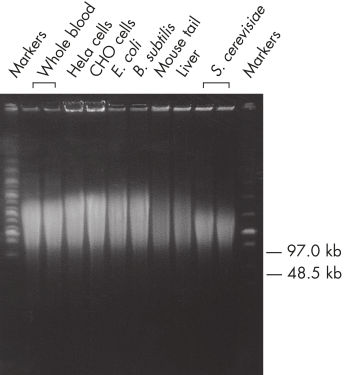
Das Verfahren mit QIAGEN Genomic-tips ist sehr schonend und führt zu einer vernachlässigbaren DNA-Scherung. Die mit QIAGEN Genomic-tips aufgereinigte DNA hat eine Größe von bis zu 150 kb mit einer durchschnittlichen Länge von 50–100 kb (siehe Abbildung „Genomische DNA von bis zu 150 kb“). Die DNA ist frei von allen Verunreinigungen wie RNA, Proteinen und Metaboliten und hat ein A260 / A280-Verhältnis zwischen 1,7 und 1,9.
Die außergewöhnlich große Länge der gewonnenen DNA macht sie besonders geeignet für die Erstellung hochwertiger Bibliotheken für die Sequenzierung der nächsten Generation (NGS) auf verschiedenen Plattformen und wird von mehreren zentralen Einrichtungen empfohlen.
Prinzip
QIAGEN Genomic-tips, die in den Blood & Cell Culture DNA Kits enthalten sind, nutzen die einzigartige QIAGEN-Anionenaustauschertechnologie, um hochmolekulare DNA aus einer Vielzahl von biologischen Proben ohne Phenol oder Chloroform zu reinigen. Die Lysepuffer sind für verschiedene Probentypen optimiert und bieten eine sofortige Denaturierung von Proteinen wie Nukleasen, Histonen und DNA-bindenden Proteinen sowie von potenziell infektiösen Viruspartikeln. Unter dem pH-Wert und den Niedrigsalz-Bedingungen des Puffers bindet die DNA an das QIAGEN-Harz in der Säule. Gleichzeitig fließen andere Zellbestandteile wie Proteine, Kohlenhydrate und Stoffwechselprodukte hindurch. Die aufgereinigte DNA wird in einem Hochsalzpuffer eluiert. Genomic-tips arbeiten nach dem Schwerkraftprinzip und können unbeaufsichtigt gelassen werden, ohne auszutrocknen. Dies reduziert den manuellen Zeitaufwand auf ein Minimum und macht das Verfahren ideal für die gleichzeitige Verarbeitung mehrerer Proben.
Verfahren
Die Proben werden zunächst lysiert (Gewebeproben werden mechanisch zerkleinert) und die Proteine gleichzeitig in dem entsprechenden Lysepuffer denaturiert (siehe Ablaufdiagramm „Verfahren mit QIAGEN Genomic-tips“). Anschließend wird QIAGEN Protease oder Proteinase K zugegeben und nach einer geeigneten Inkubationszeit werden die Lysate auf die QIAGEN Genomic-tip geladen. Die DNA bindet an die Säule, während andere Zellbestandteile durchlaufen. Nach einem Waschschritt zur Entfernung etwaiger Verunreinigungen wird reine, hochmolekulare DNA eluiert und mit Isopropanol ausgefällt. Die manuelle Bearbeitungszeit für das gesamte Verfahren beträgt nur 30 Minuten für Blut und Zellkulturen.
Blood & Cell Culture DNA Kits sind gebrauchsfertige Kits, die alle notwendigen Komponenten für die Aufreinigung von hochmolekularer DNA aus Blut und Zellkulturen enthalten.
Anwendungen
Die mit den Blood & Cell Culture DNA Kits aufgereinigte DNA ist für die folgenden Anwendungen gut geeignet:
- Sanger- und Next-generation Sequencing
- Long-Read-Sequenzierung
- RFLP-Analyse
- Analyse des Gen-Targeting
- Screening von transgenen Tieren
- DNA-Fingerprinting-Studien
- PCR-Amplifikation
| Eigenschaften | Blood & Cell Culture DNA Mini Kit | Blood & Cell Culture DNA Midi Kit | Blood & Cell Culture DNA Maxi Kit |
|---|---|---|---|
| Anwendungen | PCR, RFLP, Blotting, Screening | PCR, RFLP, Blotting, Screening | PCR, RFLP, Blotting, Screening |
| Elutionsvolumen | 0,1–2 ml | 0,1–2 ml | 0,1–2 ml |
| Format | Genomic-tip | Genomic-tip | Genomic-tip |
| Hauptprobentyp | Blut, Zellen | Blut, Zellen | Blut, Zellen |
| Verfahren | Manuell | Manuell | Manuell |
| Aufreinigung von Gesamt-RNA, miRNA, poly A+-mRNA, DNA oder Protein | DNA | DNA | DNA |
| Probenmenge | 1 ml/5 x 106 | 5 ml/2 x 107 | 20 ml/1 x 108 |
| Technologie | Anionenaustauschtechnologie | Anionenaustauschtechnologie | Anionenaustauschtechnologie |
| Ausbeute | 15–20 µg | 80–100 µg | 350–400 µg |
Ergänzende Daten und Abbildungen
Genomische DNA von bis zu 150 kb.
Pulsfeld-Gelelektrophorese von DNA (2 µg), aufgereinigt mit QIAGEN Genomic-tips. M: Marker.
Ressourcen
Kurzprotokolle (1)
Zusätzliche Ressourcen (1)
Sicherheitsdatenblätter (2)
Anwenderentwickelte Protokolle (2)
Kit-Handbücher (1)
Safety Data Sheets (1)
Certificates of Analysis (1)
Publikationen
Lack of telomerase RNA gene hTERC expression in alternative lengthening of telomeres cells is associated with methylation of the hTERC promoter.
Cancer Res; 2001; 61 (1):27-32 2001 Jan 1 PMID:11196173
GATA-3 is an important transcription factor for regulating human NKG2A gene expression.
J Immunol; 2005; 174 (4):2152-9 2005 Feb 15 PMID:15699146
FAQ
How do I safely inactivate biohazardous flow-through material?
Does the Epitect Bisulfite Kit also work on DNA extracted from plants?
What is the size of genomic DNA that is obtained with QIAGEN Genomic-tips?
Do you have a protocol for the purification of DNA from fruit flies?
What is the composition of Buffer G2?
What is the composition of Buffer B1?
What is the composition of Buffer B2?
How do I perform a DNA precipitation to concentrate my sample?
What do you recommend for the cleanup of genomic DNA (gDNA)?
What can be used as an alternative to the A260 measurement for quantification of small amounts of RNA and DNA?
Do you have a protocol for the isolation of genomic DNA from frozen clotted blood?
Do you have a protocol for isolation of genomic DNA from insects?
Do you have a protocol for the isolation of genomic DNA from fungi?