DNeasy Blood and Tissue Kits for DNA Isolation

スピンカラムまたは96ウェルプレートで動物の血液および組織、細胞、酵母、細菌、またはウイルスからトータルDNAを抽出。

あなたにとって持続可能性は重要ですか?
選択した製品に代わるもっと環境に優しい代替品をお探しなら、これ以上探し回る必要はありません。

DNeasy Blood & Tissue Kit(50) icon_0368_ls_gen_eco_friendly-s

カタログ番号 / ID.   69504

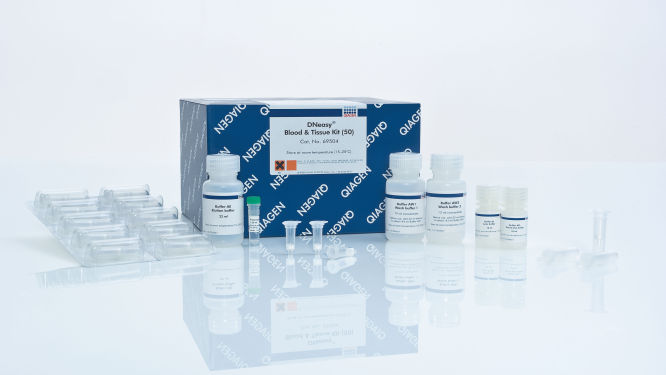
DNeasy Mini Spin Column 250本、プロテイナーゼK、バッファー、採取チューブ(2 ml)
€224.00
ログイン アカウントの価格を確認するには
キット
DNeasy Blood & Tissue Kit
DNeasy Blood & Tissue QIAcube Kit
Eco-friendlier kit
カラムタイププレートタイプ
Mini
96-well
調製
50
250
DNeasy Blood & Tissue Kitは分子生物学的アプリケーション用であり、疾病の診断、予防、あるいは治療に使用することはできません。
あなたにとって持続可能性は重要ですか?
選択した製品に代わるもっと環境に優しい代替品をお探しなら、これ以上探し回る必要はありません。

特徴

  • さまざまなサンプルタイプに使用できる標準化された方法
  • 特殊サンプルでも高収量
  • 高品質なDNA
  • 出発物質の種類に応じた最適化プロトコール
  • スピンカラムおよび96ウェル用高スループットフォーマット
  • QIAcube Connectでワークフローを自動化する

製品詳細

DNeasy Blood & Tissue Kitsは、シリカベースのプロセスを用いて、フェノールやクロロホルムを使用せずに、スピンカラムおよび96ウェルプレートフォーマットで迅速にDNAを抽出します。ほとんどのサンプルにおいて、プロテイナーゼKを使用した直接的な溶解によって、機械的破砕の必要がなくなり、操作時間を短縮できます。特定のサンプルに合わせたプロトコールにより、高品質なDNAを安定して抽出できるため、ライフサイエンス、遺伝子型決定、獣医学的病原体の研究に最適です。また、キットはQIAcube Connectを使用することで自動化が可能です。

よりサステナブルな選択肢として、QIAwave DNA Blood & Tissue Kitは、プラスチックと段ボールの使用をそれぞれ最大62%と58%削減しています。キットに含まれる廃液チューブは100%再生プラスチック製で、手順全体で再利用できます。QIAwaveバッファーは濃縮されており、1ボトルあたりのプラスチック使用量を最大90%削減しています。外見に違いはありますが、QIAwave Kitは標準キットと同様に使いやすく、化学成分と性能は同一です。なお、バッファーの再調製には滅菌ガラス製ボトルが必要です。

My Green Labとの提携のもと、DNeasy Blood & Tissue Kit(50/250)およびQIAwave DNA Blood & Tissue Kit(50/250)の環境影響評価を実施しました。My Green LabのACT環境影響係数ラベルは、以下のようなさまざまなサステナビリティ基準に基づいて製品を評価し、ランク付けすることを目的としています。

  • 製造
  • 責任ある化学薬品管理
  • サステナブルな製品の内容および包装材料
  • 製品使用後のパッケージ処理

製品には1から10のスコアが付けられ、エネルギーと水の消費はそれぞれkWhやガロンごとに1点ずつ評価されます。低いスコアは、環境への負荷が低いことを意味します。詳細については、「DNeasy Blood & Tissue KitおよびQIAwave DNA Blood & Tissue Kit ACT環境影響係数ラベル」US( 50/ 250)、EU( 50/ 250)、UK( 50/ 250)」を参照してください。


パフォーマンス

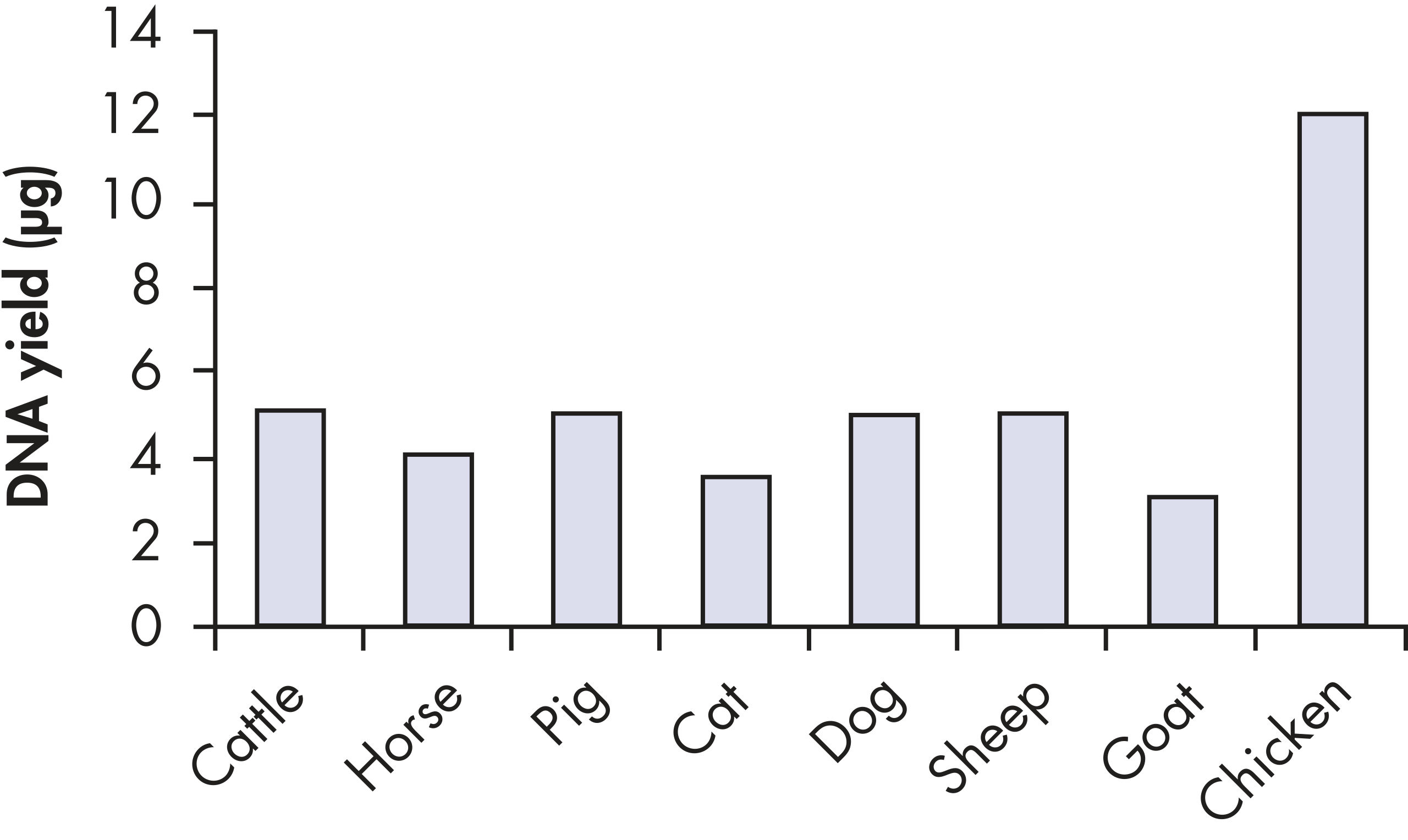
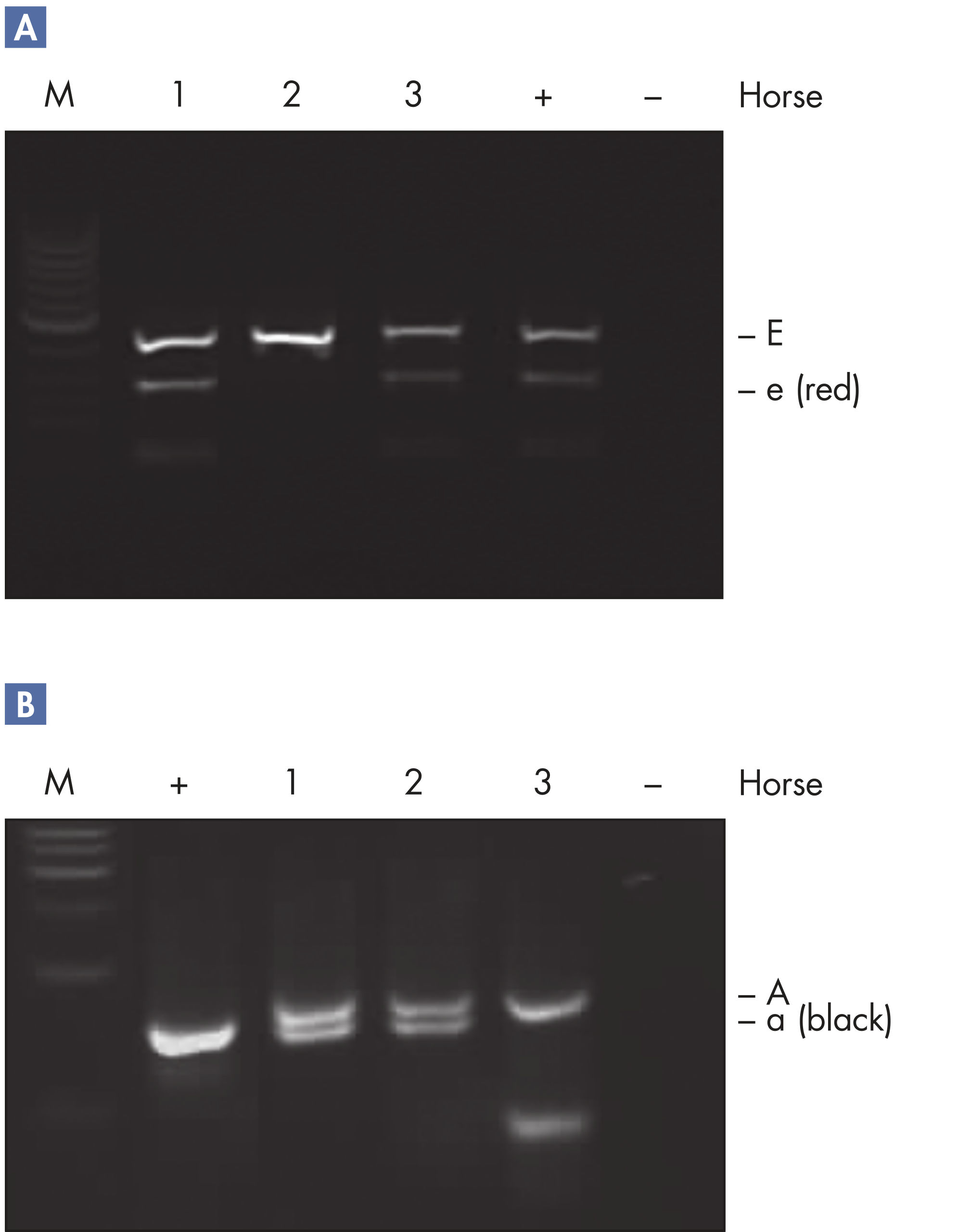
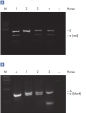
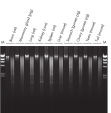
DNeasy DNA Blood & Tissue KitおよびQIAwave DNA Blood & Tissue Kitは効率が良く、動物血液や組織から全DNAを高収量で抽出します(表「動物組織からの一般的なDNA収量」 と図 DNAの収量を参照してください)。プロトコールが最適化され、例えば動物の毛のほか、培養細胞、固定組織、グラム陽性菌、グラム陰性菌といった非標準サンプルからも高い収量が確実に回収できます( ウマの遺伝子型決定を参照)。酵母、昆虫、毛髪などその他のサンプルタイプからのDNA精製用のプロトコールは専用オンラインから入手していただけます。

QIAwave DNA Blood & Tissue KitとDNeasy Blood & Tissue Kitは化学成分が同一であるため、性能も同じです。どちらも競合キットより優れていることが実証されています(図「QIAwave DNA Blood & Tissue Kitの性能」を参照)。
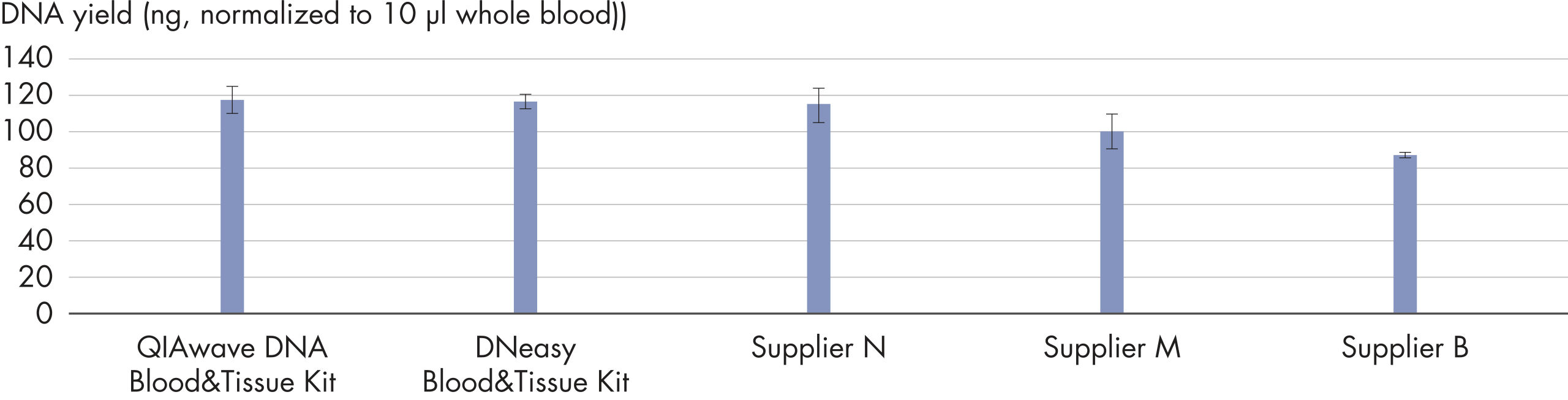
QIAwave DNA Blood & Tissue Kitの標準プロトコールに従うことで、動物血液および組織サンプルから高収量の全DNAを回収できます(表「QIAwave DNA Blood & Tissueを使用した動物組織からの典型的なDNA収量」と図「 DNA収量」を参照)。さらに、以下のような非標準サンプルからも高収量を得られるように最適化されたプロトコールもお求めいただけます。

  • 獣毛
  • 培養細胞
  • グラム陽性菌、グラム陰性菌
  • 酵母
  • 昆虫
  • その他のサンプルタイプ


動物組織からDNeasy and QIAwave Kitを用いて回収した一般的な収量
由来 DNA(µg)
哺乳類の血液 100 µl 3~6
鳥類の血液 5 µl 9~40
HeLa細胞 2 x 10⁶ 15~25
肝臓 25 mg 10~30
25 mg 15~30
腎臓 25 mg 15~30
脾臓 10 mg 5~30
マウス尾 1.2 cm(先端部) 10~25
マウス尾 0.6 cm(先端部) 20~40
ブタの耳 25 mg 10~30
ウマの毛 10本 2~4
魚のひれ 20 mg 10~20
魚卵(サバ) 10 mg 5~10

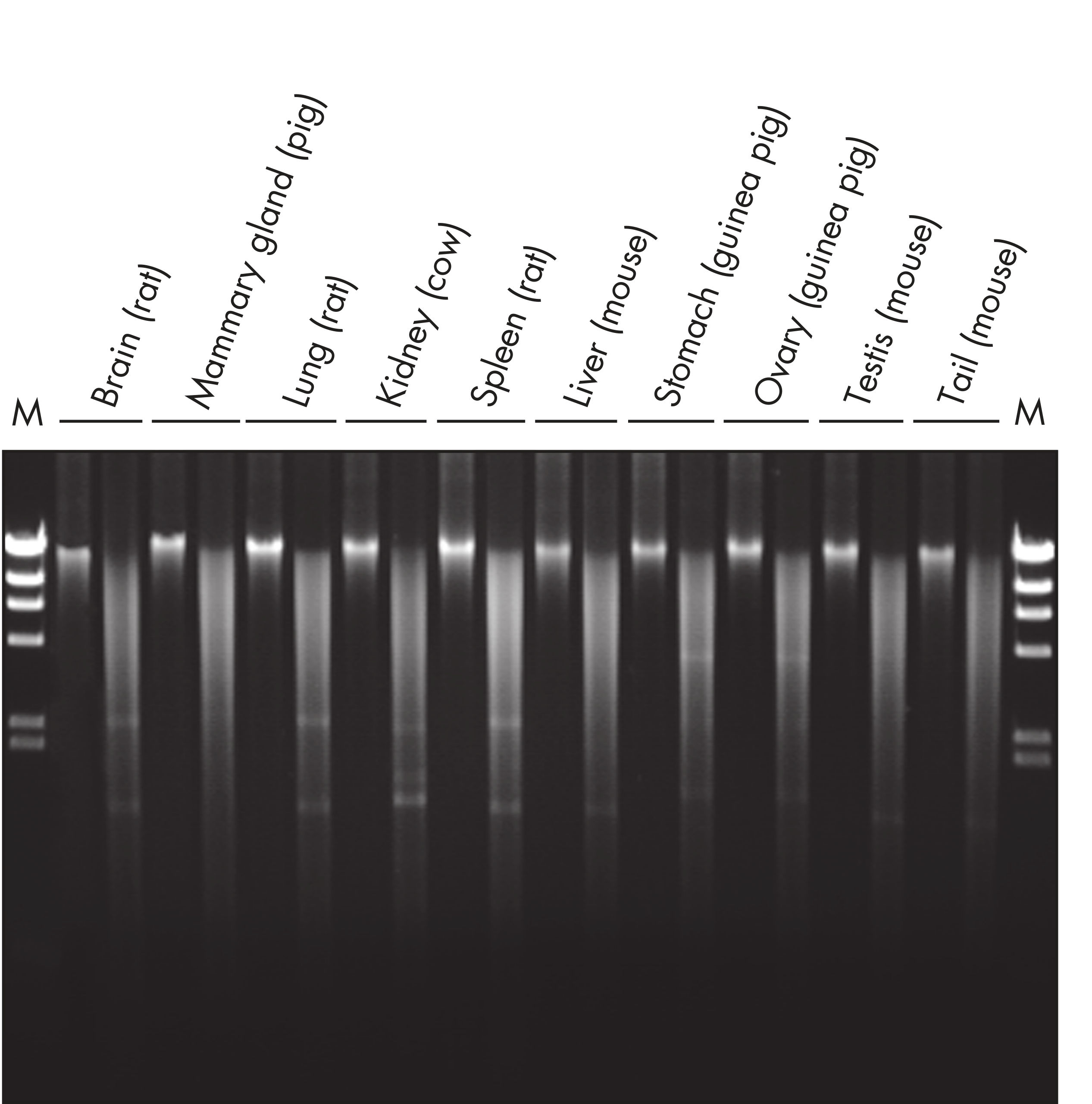
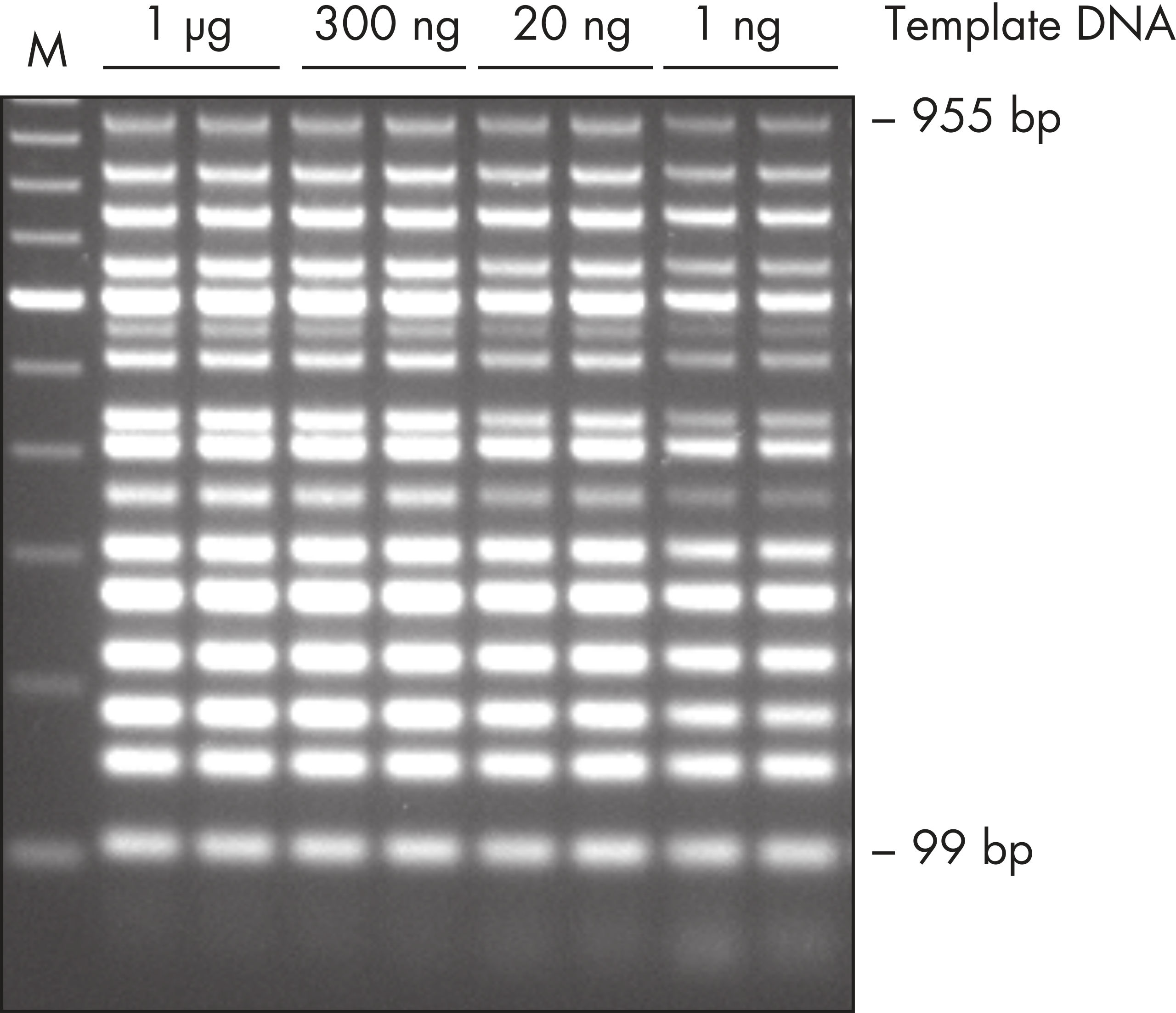
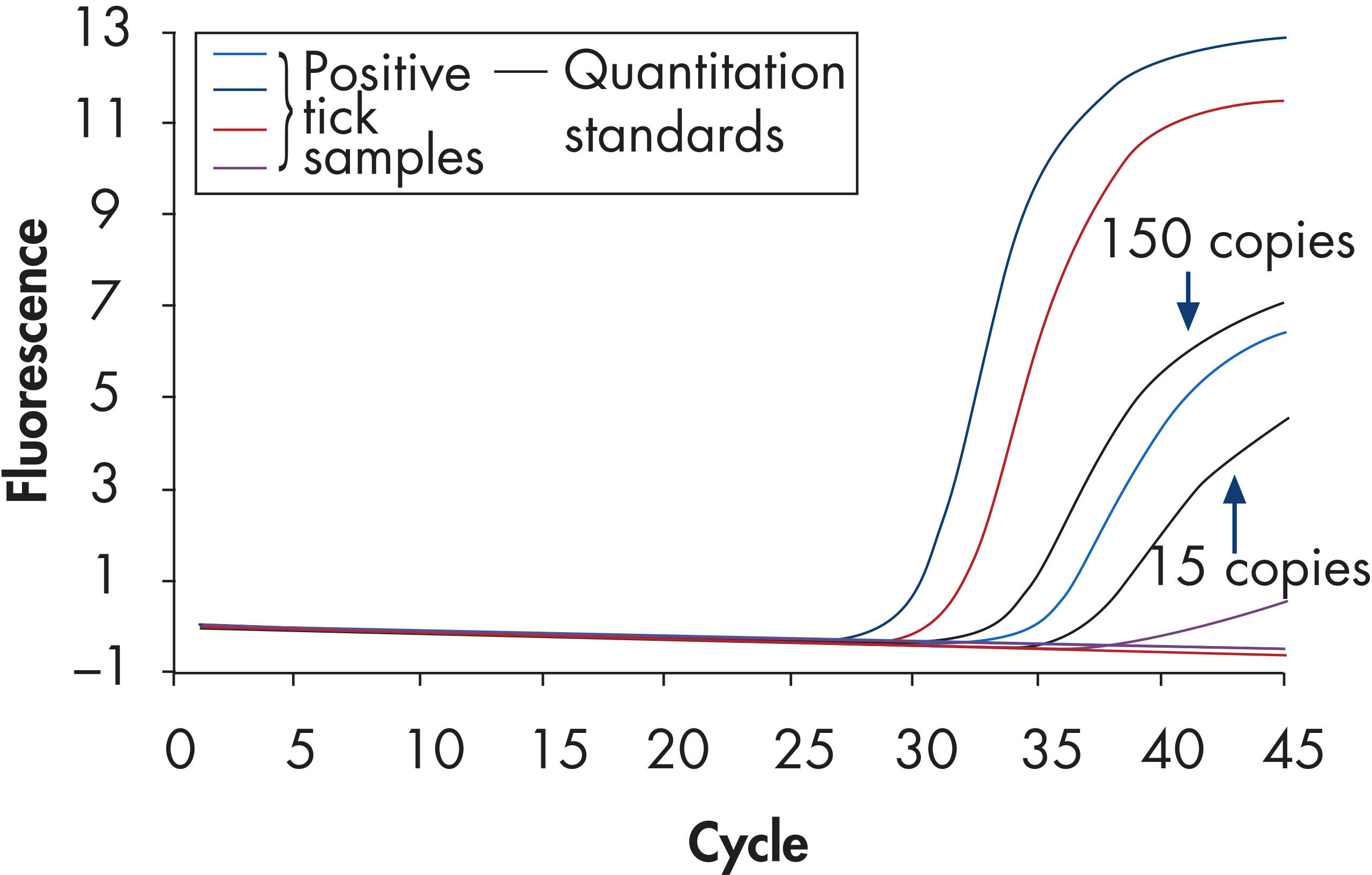
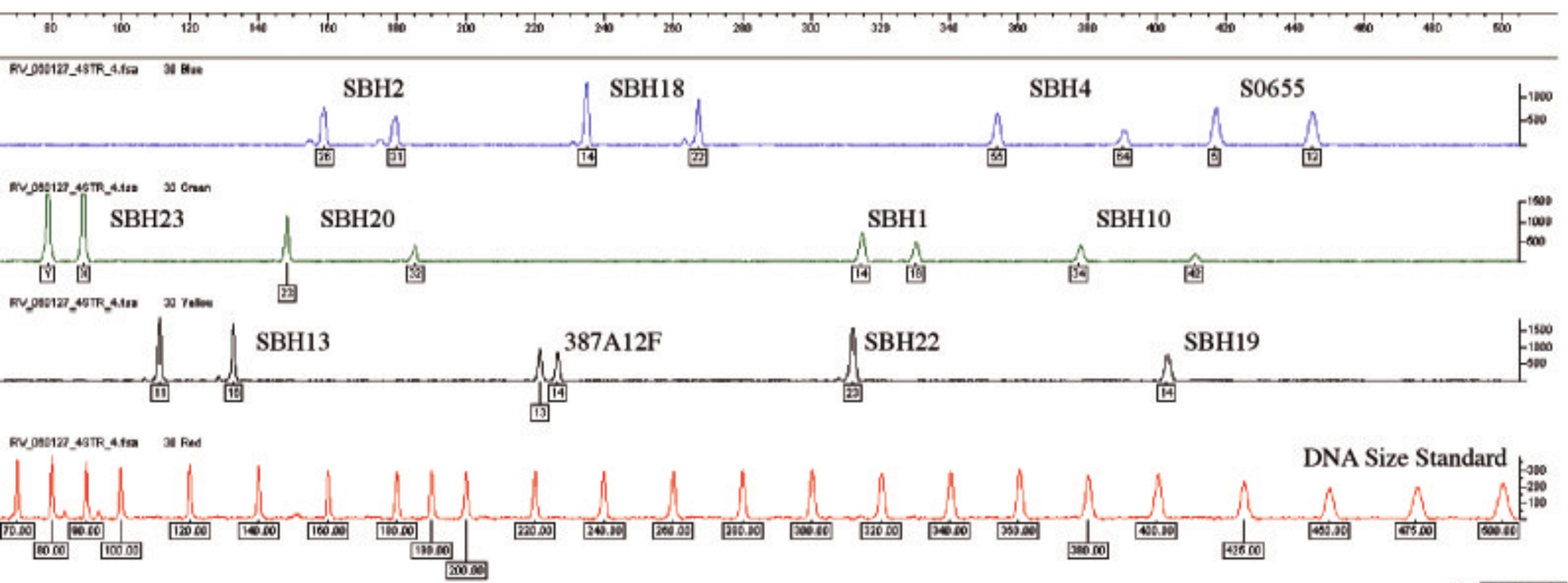
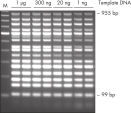
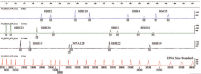
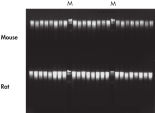
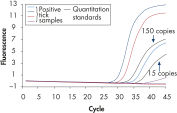
DNeasy Blood & Tissue Kitを使えば、ライフサイエンス、獣医学、遺伝子型決定のアプリケーションで一般的に使用される動物種を含むさまざまなサンプルタイプからDNAを精製する手順を簡略化できます( 高品質DNAを参照)。精製されたDNAには、PCR阻害物質が存在せず、標準なマルチプレックスPCR( 効果的な16plex PCRを参照)およびreal-time PCR( Real-time PCRを参照)を対象とした高感度検出が可能になります。DNeasy Blood & Tissue Kitは、遺伝子導入マウスの実験室での解析(高スループット精製を参照)から家畜の育種プログラム( ブタの血統遺伝子型決定を参照)まで、信頼性の高い結果が得られます。定期検査アプリケーションは、DNeasy 96 Blood & Tissue Kitを使用すれば簡単にスケールアップが図れます(高スループット精製を参照)。


原理

DNeasy and QIAwave DNA Blood & Tissue Kitは、新鮮または冷凍保存された動物組織や細胞、血液、細菌など、さまざまなサンプルソースから全DNA(例えば、ゲノムDNA、ミトコンドリアDNA、病原体DNA)を迅速に精製できるように設計されています。

DNeasy膜は、シリカベース膜の結合特性と、シンプルなマイクロスピン技術、またはQIAGEN 96ウェルプレート遠心分離システムを組み合わせたものです。DNAは、高濃度のカオトロピック塩が溶液中の水和分子から水分を除去する働きのもと、DNeasy膜に吸着します。DNeasy Blood & Tissueプロセスのバッファー条件は、DNAがシリカ膜に特異的に吸着し、汚染物質や酵素阻害物質を最適に除去できるように設計されています。

DNeasy Blood & Tissue Kitを使った精製は、フェノールやクロロホルムによる抽出やアルコール沈殿を必要とせず、最小限の操作で済むため、複数のサンプルを同時に処理するのに非常に適しています。より高スループットのアプリケーションには、DNeasy 96 Blood & Tissue Kitを使用することで、96または192のサンプルを同時に処理することが可能です。


操作手順

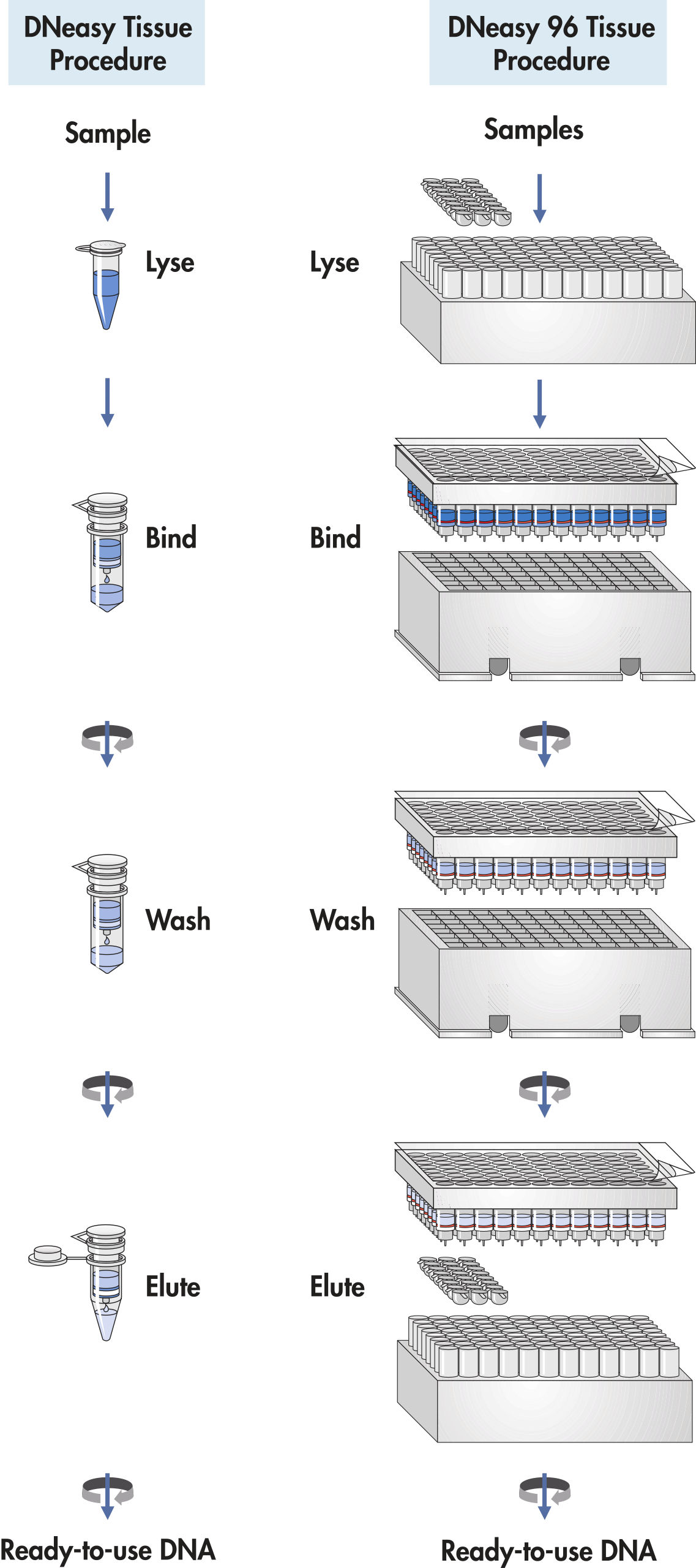
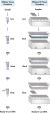
使いやすいスピンカラムまたは96ウェルフォーマットに搭載された高い信頼性のシリカ膜技術で、迅速で再現性の高いDNA精製を実現する一方、有機溶媒による抽出やアルコール沈殿が不要になります。(see  DNeasy Miniおよび96のプロセスを参照)。サンプルを最初にプロテイナーゼKで溶解します。バッファーは最適なDNA結合条件を整えた状態になっています。溶解物をDNeasy Mini spin columnまたはDNeasy 96 plateにロードし、遠心分離すると、DNAは選択的に膜と結合しますが、汚染物質は通過します。残った汚染物質と酵素阻害物質は次に、2回にわたる効果的な洗浄工程で除去され、DNAが水またはバッファーに、すぐに使える状態で溶出されます。

DNeasy Blood & Tissue Kitに付属するDNeasy Miniスピンカラムはあらかじめ採取チューブの中に包装され、個別に密閉されているので、使いやすく安全です。DNeasy Miniスピンカラムを用いた精製プロセスはQIAcube Connectを使えば自動化が可能です。DNeasy 96 Blood & Tissue Kitは、QIAGEN 96-Well-Plate Centrifugation Systemを使った96ウェルフォーマットの精製で高いスループットを実現します。

DNeasy Blood & Tissue Kitに対応した標準プロトコールは、TRACKMAN Connectedシステムを使用することで、シームレスに実行できます。

アプリケーション

DNeasy Blood & Tissue KitとQIAwave DNA Blood & Tissue Kitを使うことで、以下のdPCRおよびNGS アプリケーションを含むすべてのダウンストリームアッセイにすぐに使える高品質DNAが抽出できます。

  • ライフサイエンス研究
  • 家畜の育種
  • 血統遺伝子型決定
  • 獣医学的病原体研究
  • ルーチン適用検査


裏付けデータと数値

仕様

特徴仕様
ApplicationsPCR、real-time PCR、遺伝子型決定
Elution volume100~200 µl
Time per run or per prep20分~1時間
Main sample type血液、組織
Format96ウェルプレート、スピンカラム
Sample amount100 µl/25 mg
Processing手動
Yield6 µg/30 µg
Technologyシリカテクノロジー
Purification of total RNA, miRNA, poly A+ mRNA, DNA or proteinDNA

リソース

アプリケーション/プロトコール文書 (1)
Step up your sustainability by recycling your labware. This handy guide will show you how to quickly and easily recycle kit components and reduce plastic waste in your lab.
補足的プロトコール (4)
This protocol is designed for purification of DNA from up to 5 x 10⁷ yeast cells.
This protocol is designed for purification of DNA from a 200 μl crude lysate.
This protocol is designed for purification of DNA from up to 50 mg of insects, such as drosophila.
安全データシート (1)
Download Safety Data Sheets for QIAGEN product components.
パンフレットとガイド (6)
This fact sheet explains the inclusion of DNeasy Blood & Tissue Kits and DNeasy Plant Mini Kits in our Go Greener program.
This fact sheet explains the inclusion of QIAwave Kits in our Go Greener program.
キットハンドブック (3)
For purification of total DNA from animal blood, animal tissue, rodent tails, ear punches, cultured cells, fixed tissue, bacteria, insects

June 2023
For use on QIAcube Connect
Safety Data Sheets (1)
Certificates of Analysis (1)

出版物

The unique 16S rRNA genes of piezophiles reflect both phylogeny and adaptation.
Lauro FM; Chastain RA; Blankenship LE; Yayanos AA; Bartlett DH;
Appl Environ Microbiol; 2006; 73 (3):838-45 2006 Dec 8 PMID:17158629
Assays to detect beta-tubulin codon 200 polymorphism in Trichuris trichiura and Ascaris lumbricoides.
Diawara A; Drake LJ; Suswillo RR; Kihara J; Bundy DA; Scott ME; Halpenny C; Stothard JR; Prichard RK;
PLoS Negl Trop Dis; 2009; 3 (3):e397 2009 Mar 24 PMID:19308251
Whole genome amplification for array comparative genomic hybridization using DNA extracted from formalin-fixed, paraffin-embedded histological sections.
Huang J; Pang J; Watanabe T; Ng HK; Ohgaki H;
J Mol Diagn; 2009; 11 (2):109-16 2009 Feb 5 PMID:19197000
Real-time PCR detection of pathogenic microorganisms in roof-harvested rainwater in Southeast Queensland, Australia.
Ahmed W; Huygens F; Goonetilleke A; Gardner T;
Appl Environ Microbiol; 2008; 74 (17):5490-6 2008 Jul 11 PMID:18621865
MicroRNA-137 targets microphthalmia-associated transcription factor in melanoma cell lines.
Bemis LT; Chen R; Amato CM; Classen EH; Robinson SE; Coffey DG; Erickson PF; Shellman YG; Robinson WA;
Cancer Res; 2008; 68 (5):1362-8 2008 Mar 1 PMID:18316599

よくある質問

When should carrier be used with the QIAamp DNA Mini or the DNeasy Blood & Tissue Kit?

For DNA isolation using the QIAamp DNA Mini, or the DNeasy Blood & Tissue Kit, we recommend using carrier DNA when expected yields are below 10 ng. If possible, carrier DNAs such as poly-dA, poly-dT or poly-dA:dT should be used. Other carrier DNAs such as herring sperm DNA may interfere with subsequent PCR by binding primers nonspecifically.

Please note that poly-dA may interfere with oligo-dT primers, and, in this case, a different carrier DNA should be used. The concentration of carrier DNA should be at least 10 µg/ml. Optimal amounts need to be determined empirically for each application. The size distribution of carrier DNAs is typically in the range of 100 bp to 10 kb.

FAQ-100
How do I safely inactivate biohazardous flow-through material?

Always dispose of potentially biohazardous solutions according to your institution’s waste-disposal guidelines. Although the lysis and binding buffers in QIAamp, DNeasy, and RNeasy kits contain chaotropic agents that can inactivate some biohazardous material, local regulations dictate the proper way to dispose of biohazards. DO NOT add bleach or acidic solutions directly to the sample-preparation waste. Guanidine hydrochloride in the sample-preparation waste can form highly reactive compounds when combined with bleach.
Please access our Material Safety Data Sheets (MSDS) online for detailed information on the reagents for each respective kit.

FAQ-12
Do you have a protocol for purification of total DNA from yeast?

Yes, please follow the Supplementary Protocol 'Purification of total DNA from yeast using the DNeasy Blood & Tissue Kit' (DY13).


FAQ-1253
Do you have a protocol for purification of total DNA from insects?

Yes, please follow the Supplementary Protocol 'Purification of total DNA from insects using the DNeasy Blood & Tissue Kit' (DY14).


FAQ-1254
Do you have a protocol for purification of total DNA from crude lysates?

Yes, please follow the Supplementary Protocol 'Purification of total DNA from crude lysates using the DNeasy Blood & Tissue Kit' (DY15).


FAQ-1255
Do you have data showing effects of sample size on DNA yield and purity using the DNeasy 96 Blood & Tissue kit?
What dedicated QIAcube Kits are available?
How can I precipitate genomic DNA using isopropanol?

Alcohol precipitation is commonly used for concentrating, desalting, and recovering nucleic acids. Since less alcohol is required for isopropanol precipitation, this is the preferred method for precipitation of DNA from large volumes. In addition, isopropanol precipitation can be performed at room temperature, which minimizes co-precipitation of salt that interferes with downstream applications.


Procedure

  1. Adjust the salt concentration, for example, with sodium acetate (0.3 M, pH 5.2, final concentration) or ammonium acetate (2.0–2.5 M, final concentration).
  2. Add 0.6–0.7 volumes of room-temperature isopropanol to the DNA solution and mix well.
  3. Centrifuge the sample immediately at 10,000–15,000 x g for 15–30 min at 4°C
  4. Carefully decant the supernatant without disturbing the pellet.
  5. Wash the DNA pellet by adding 1–10 ml (depending on the size of the preparation) of room-temperature 70% ethanol. This removes co-precipitated salt and replaces the isopropanol with the more volatile ethanol, making the DNA easier to redissolve.
  6. Centrifuge at 10,000–15,000 x g for 5–15 min at 4°C.
  7. Carefully decant the supernatant without disturbing the pellet.
  8. Air-dry the pellet for 5–20 min (depending on the size of the pellet).
  9. Redissolve the DNA in a suitable buffer.

Tip: Use a buffer with a pH of 7.5–8.0, as DNA does not dissolve easily in acidic buffers. Often distilled water can have an acidic pH. The addition of EDTA protects the DNA from DNase digestion.

Tip: High-molecular-weight DNA, such as genomic DNA, should be redissolved very gently to avoid shearing. If the DNA pellet does not dissolve easily, heat at 55°C for 1–2 h with gentle shaking.

FAQ-2953
303 - Can I use my own lysis buffer with the DNeasy Blood & Tissue or QIAamp DNA Mini Kit?

If you have optimized the lysis conditions for a specific sample type, you can lyse the sample in your lysis buffer, and follow the Supplementary Protocol 'Purification of total DNA from crude lysates using the DNeasy Blood & Tissue Kit' (DY15), or the corresponding protocol in the Appendix of the QIAamp DNA Mini Kit and QIAamp DNA Blood Mini Kit Handbook.


FAQ-303
3192 - Is QIAGEN Protease compatible with Buffer ATL?
No, QIAGEN Protease is not compatible with Buffer ATL.
FAQ-3192
Is it possible to stop the DNeasy tissue protocol and store the tissue lysates after digesting in buffer ATL and Proteinase K?
After proteinase K digestion, tissue samples can be stored in Buffer ATL for up 6 months at ambient temperature without any reduction in DNA quality.
FAQ-3362
What is the shelf-life for QIAGEN Proteinase K (cat. no. 19131, 19133)?

QIAGEN Proteinase K is stable for up to 1 year after delivery when stored at room temperature. To prolong the shelf-life of Proteinase K, storage at 2–8°C is recommended.

FAQ-3447
Is the quality and size of DNA extracted with the DNeasy Blood & Tissue kit good enough to generate DNA-libraries for next generation sequencing?
The size of DNA obtained with DNeasy Blood & Tissue kit ranges between 100 bp and 50 kb, with 30 kb fragments predominating. The 30 kb fragments are a good starting point for most of the library preparations. Furthermore, the purified DNA is free of protein, nucleases, and other contaminants and inhibitors, and therefore is suitable for NGS.
FAQ-3517
What QIAGEN kit can I use to isolate DNA from food products to test for genetically modified organisms (GMOs)?

For plant-based foods, such as soy, tofu, and cookies, DNA isolation has been successfully carried out using the DNeasy Plant Mini Kit. The QIAamp DNA Stool Mini Kit has been used for isolation of genomic DNA from highly processed foods, and foods that contain high levels of PCR inhibitors, such as chocolate. For meat and processed meats, such as sausage, we suggest the DNeasy Blood & Tissue Kit.

See also the QIAGEN News article "Detection of genetically modified soybean and maize in raw and processed foodstuffs", and the accompanying editorial "Detecting genetically modified organisms in food."

FAQ-371
How can I improve DNA yields from very tough tissues using the DNeasy Blood & Tissue Kit or the QIAamp DNA Mini Kit?

Efficient DNA isolation requires thorough sample disruption and digestion.

Although the QIAamp and DNeasy procedures requires no mechanical disruption of the tissue sample, the lysis time will be reduced if the sample is ground in liquid nitrogen or mechanically homogenized in advance. For mechanical homogenization, a rotor–stator homogenizer, such as the QIAGEN TissueRuptor, or a bead mill, such as the QIAGEN TissueLyser, can be used.

To improve digestion of tough tissue samples, Proteinase K incubation at 56°C can be performed overnight. DNA yields may be improved by increasing the amount of Proteinase K or by adding additional proteinase K after several hours of digestion.  

FAQ-374
What is the expected yield of genomic DNA isolated from bacteria with the DNeasy Blood & Tissue or QIAamp DNA Mini Kit?

The expected yield of genomic DNA isolated from bacteria with the DNeasy Blood & Tissue Kit or the QIAamp DNA Mini Kit is approximately 10 ug of DNA per 2x 10⁹ bacterial cells. Note that yields of genomic DNA will vary depending on bacterial strain, quality of the starting material, growing conditions, and the amount of material processed.


FAQ-632
What can be used as an alternative to the A260 measurement for quantification of small amounts of RNA and DNA?

Small amounts of RNA and DNA may be difficult to measure spectrophotometrically. Fluorometric measurements, or quantitative RT-PCR and PCR are more sensitive and accurate methods to quantify low amounts of RNA or DNA.

Fluorometric measurements are carried out using nucleic acid binding dyes, such as RiboGreen® RNA Quantitation Reagent for RNA, and PicoGreen® DNA Quantitation Reagent for DNA (Molecular Probes, Inc.).

FAQ-728
What is the composition of buffer AE?

The composition of Buffer AE is:

  • 10 mM Tris-Cl
  • 0.5 mM EDTA; pH 9.0.
FAQ-730
Do you have a protocol for isolation of genomic DNA from insects?

Yes, we have the following protocols:

  • Isolation of genomic DNA from mosquitoes or other insects using the QIAGEN Genomic tip (QG06).
  • Purification of total DNA from insects using the DNeasy Blood & Tissue Kit (DY14).
FAQ-904
Do you have a protocol for the isolation of genomic DNA from bone?

Yes, we have the following protocols:

  • Isolation of genomic DNA from compact bone using the QIAamp DNA Mini Kit (QA02)
  • Isolation of genomic DNA from compact bone using the DNeasy Blood & Tissue Kit (DY01)
  • Purification of genomic DNA from bones using the QIAamp DNA Micro Kit (QA39)
  • Purification of archive-quality DNA from bone fragments using the Gentra Puregene Tissue Kit (PG38).
FAQ-908
Do you have a protocol for the isolation of genomic DNA from sperm?

Yes, we have the following protocols:

  • Isolation of genomic DNA from sperm using the QIAamp DNA Mini Kit; protocol 1 (QA03), long procedure
  • Isolation of genomic DNA from sperm using the QIAamp DNA Mini Kit; protocol 2 (QA04), short procedure
  • Purification of total DNA from animal sperm using the DNeasy Blood and Tissue kit; protocol 1 (DY02), long procedure
  • Purification of total DNA from animal sperm using the DNeasy Blood and Tissue kit; protocol 2 (DY03), short procedure
  • Purification of DNA from epithelial cells mixed with sperm cells using the QIAamp DNA Micro Kit (QA40).
FAQ-909
Do you have a protocol for Acetyl Cysteine (NALC) treatment of viscous samples?

Yes, please follow either of the User-Developed Protocols:

FAQ-913
Do you have a protocol for isolation of genomic DNA from saliva and mouthwash?

Yes, we have the following protocols:

  • Isolation of genomic DNA from saliva and mouthwash using the QIAamp DNA Mini Kit; vacuum procedure (QA19v)
  • Isolation of genomic DNA from saliva and mouthwash using the QIAamp DNA Mini Kit; spin procedure (QA19s)
  • Isolation of genomic DNA from saliva using the DNeasy Blood & Tissue Kit; spin procedure (DY07)
FAQ-917
Do you have a protocol for the isolation of DNA from soft tissues using the TissueLyser?
Do you have a protocol for the isolation of viral DNA from stool?
Yes, please follow the User-Developed Protocol 'Isolation of viral DNA from stool using the DNeasy Blood & Tissue Kit' (DY05).
FAQ-929
Do you have a protocol for isolation of genomic DNA from saliva using the DNeasy Blood & Tissue Kit?

Yes, please follow the User-Developed Protocol 'Isolation of genomic DNA from saliva using the DNeasy Blood & Tissue Kit; spin procedure' (DY07).


FAQ-931
Do you have a protocol for purification of DNA from cultured animal cells using the DNeasy 96 Blood & Tissue Kit?

Yes, please follow the Supplementary Protocol 'Purification of DNA from cultured animal cells using the DNeasy 96 Blood & Tissue Kit' (DY12).


FAQ-934