
✓ 24/7 automatic processing of online orders
✓ Knowledgeable and professional Product & Technical Support
✓ Fast and reliable (re)-ordering
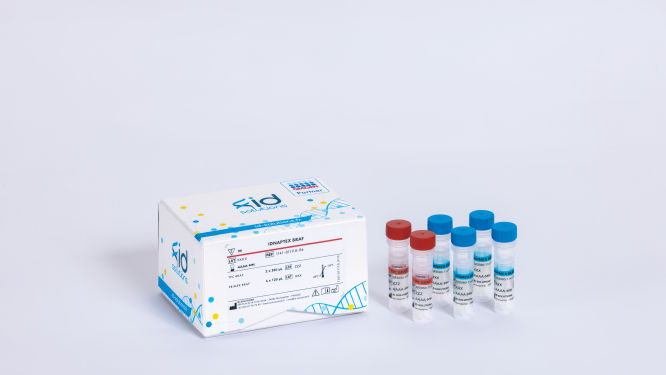
IDNAPTEX BRAF
Cat no. / ID. 1141-011110-96
4 x 24 reactions containing probes and primers for BRAF mutation detection that cover Exon 15 – L597S, L597Q, L597R, L597V, A598V, A598T, V600K, V600R, V600M, V600G, V600D, K601E, V600E and wild-type reference. Target Process Control for 2 × 10 reactions is also included. Works with DNA extracted from plasma (cfDNA) or FFPE tissue (gDNA) and is enabled for ID-ICE detection.
Log in To see your account pricing.
Assay
IDNAPTEX assays
Extraction control
Type
BRAF
BRAF-CNS
EGFR RESIST
EGFR SENSI
ESR1
FGFR1-CNS
H3F3A
IDH1-2
KRAS 3X
KRAS G12C
NRAS
PIK3CA
TERT
The ID SOLUTIONS IDNAPTEX dPCR Assays are intended for non-clinical applications. This product is not intended for the diagnosis, prevention or treatment of a disease.
✓ 24/7 automatic processing of online orders
✓ Knowledgeable and professional Product & Technical Support
✓ Fast and reliable (re)-ordering
Features
- Wet-lab-validated digital PCR assays for cancer research purposes
- Ready-to-use format with Target Process Control and a universal amplification program
- Seamless compatibility with ID SOLUTIONS ID-ICE for fail-proof liquid biopsy testing
- Streamlined workflow with automated nucleic acid extraction on the EZ2 Connect
- Optimized performance on the QIAcuity Digital PCR System
QIAcuity Digital PCR System is intended for non-clinical applications. This system is not intended for the diagnosis, prevention or treatment of a disease.
Product Details
ID SOLUTIONS IDNAPTEX assays are multiplexed, wet-lab-validated digital PCR assays designed for simultaneous detection of multiple tumor-associated DNA variants in a single well for cancer research purposes.
Each kit contains:
- Assay-specific reagents (primers and probe mix) for 4 × 24 reactions
- Target Process Control for 2 × 10 reactions
All IDNAPTEX assays use a universal amplification program, allowing different assays to be run in parallel. Results are available in approximately 2.5 hours.
DNA extracted from both liquid (plasma cfDNA) and tissue biopsies (FFPE gDNA) is suitable for analysis. The assays are compatible with ID SOLUTIONS ID-ICE for liquid biopsy testing, and have been validated for use with DNA extracted using the EZ2 Connect system.
Each assay is to be used in combination with the QIAcuity master mix specified (QIAcuity Probe PCR Kit or QIAcuity High Multiplex Probe PCR Kit) and the QIAcuity Nanoplate 26k 24-well on the QIAcuity Digital PCR System.
Performance
IDNAPTEX assays provide a streamlined, high-performance approach to mutation detection in cancer research. Compatible with cfDNA from plasma and gDNA from FFPE tissues, the system can detect up to 23 targets in a single reaction.
The ready-to-use format and universal amplification program ensure fast setup across all assays. Results are delivered in less than 4 hours on the QIAcuity 5Plex Digital PCR System, with the complete workflow finishing in under a day.
Principle
Absolute quantification of DNA variants
IDNAPTEX assays are designed for use on the QIAcuity Nanoplate-based Digital PCR System for absolute nucleic acid quantification without the need for standard curves. The assays use specific sets of primers and fluorescent probes to detect genomic alterations in genes involved in tumor mechanisms. Results are expressed as presence or absence of each target, with estimated fractional abundance for mutations and/or copy number variation where applicable.
Multiplex target detection
An optimized mix of primers and probes enables the simultaneous amplification of multiple targets in a single reaction well. Up to 23 genomic alterations can be identified in one assay, maintaining precision and reproducibility across targets.
Target Process Control
Each assay includes a built-in Target Process Control to validate the performance of the run. This control confirms that amplification occurred as expected and helps ensure the reliability of results.
ID-ICE control
The optional patented ID-ICE control verifies extraction efficiency and confirms that any absence of detection is not caused by DNA template loss during processing. This is especially important for liquid biopsy samples, as it supports accurate longitudinal monitoring of cfDNA levels over time, which is often critical for tracking disease progression or treatment response.
Procedure
To perform the assay, add the defined volume of the corresponding QIAcuity master mix into the assay tube containing the ready-to-use IDNAPTEX primers and probes. Distribute the resulting amplification reaction mix into the required number of reaction tubes or wells of a multiple-well plate, using one well per assay. Add one sample per well along with the necessary controls, then mix thoroughly to ensure even distribution. Transfer each prepared reaction into a QIAcuity Nanoplate 26k, with one reaction per well, and place the Nanoplate into the QIAcuity Digital PCR System. Initiate the run using the universal IDNAPTEX thermal cycling program, which supports multiple assays simultaneously. Upon completion, review the results using preset auto-thresholds or adjust them manually if needed to confirm the presence or absence of targets. Finally, calculate fractional abundance and copy number variation, if applicable, using either the multiple occupancy table or the copies/µL concentration methods.
Applications
The applications include molecular characterization of tumors from both liquid and tissue biopsy samples, enabling biomarker discovery and cancer mutation profiling. The assays are intended for non-clinical applications and not for the diagnosis, prevention or treatment of a disease.
Resources
Analysis software (1)
Kit Handbooks & Protocols (14)
Software-related downloads (1)
Safety Data Sheets (1)
Certificates of Analysis (1)
Scientific documents (2)
FAQ
Should I proceed with a product calibration before use of each ID SOLUTIONS IDNAPTEX dPCR assays?
Which master mix should I use with ID SOLUTIONS IDNAPTEX dPCR assays?
Do the cycling conditions for ID SOLUTIONS IDNAPTEX dPCR assays vary between assays?
How do I decide when to use threshold or lasso method for signal thresholding with ID SOLUTIONS IDNAPTEX dPCR assays?