HiSpeed Plasmid Kits

用于超快纯化多达 750 µg 转染级质粒或柯斯质粒 DNA

S_1376_DNA_PLS0763

✓ 全天候自动处理在线订单

✓ 博学专业的产品和技术支持

✓ 快速可靠的(再)订购

HiSpeed Plasmid Midi Kit (25)

目录编号 / ID.   12643

25 个 HiSpeed Midi Tips、25 个 QIAfilter Midi Cartridges、25 个 QIAprecipitator Midi Modules,外加注射器、试剂、缓冲液。
试剂盒类型
Midi
Maxi
HiSpeed Plasmid Kits 旨在用于分子生物学应用。这些产品不能用于疾病诊断、预防和治疗。

✓ 全天候自动处理在线订单

✓ 博学专业的产品和技术支持

✓ 快速可靠的(再)订购

特点

  • 制备时间少于 60 分钟
  • 无需离心实现裂解物澄清和异丙醇沉淀
  • 沉淀过程中无 DNA 颗粒损失风险
  • 高拷贝质粒 DNA 产量高达 750 µg
  • LyseBlue 可实现最优裂解和最大 DNA 产量
  • 无需真空歧管即可进行大规模质粒制备

产品详情

HiSpeed Plasmid Kits 无需离心即可提供基于阴离子交换的快速大规模质粒 DNA 制备。纯化后的 DNA 与通过 2 论 CsCl 梯度离心得到的 DNA 相当,适合用于转染级应用。

绩效

HiSpeed Plasmid Kits 包含 QIAfilter Cartridges、HiSpeed Tips 和 QIAprecipitator 模块,无需真空歧管即可快速进行大规模质粒制备。注射器式 QIAfilter 和 QIAprecipitator 模块取代了传统阴离子交换程序中的离心步骤,使质粒纯化更快、更方便。可从 150 ml – 250 ml 或 50 ml – 150 ml 培养液中分别纯化高达 750 µg (Maxi) 或 200 µg (Midi) 高拷贝质粒 DNA(培养液量取决于质粒拷贝数、插入片段大小、宿主菌株和培养基)。HiSpeed Tip 设计可实现很高的流速,让质粒纯化的 DNA 结合、洗涤和洗脱步骤执行速度更快。

HiSpeed Tips 中独特的阴离子交换树脂专为纯化核酸而开发。其卓越的分离性能可使 DNA 纯度相当于或优于连续两轮 CsCI 梯度离心所获的纯度。

原理

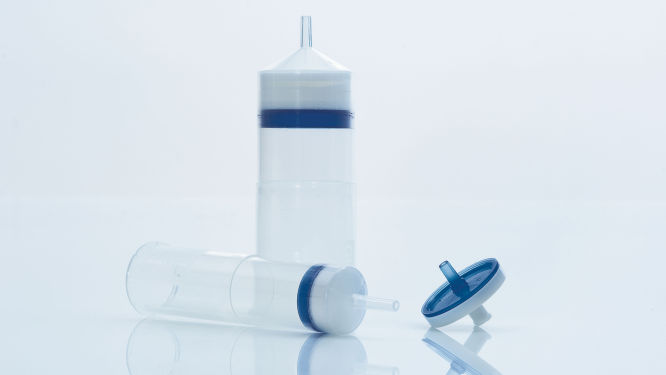
QIAfilter Cartridges(见图“ QIAfilter Cartridge”)是专用过滤装置,设计用于替代细菌细胞碱裂解后的离心步骤。QIAfilter Cartridges 只需离心分离所需的一小部分时间即可完全去除 SDS 沉淀并澄清细菌裂解物。预包装 HiSpeed Tips 靠重力流工作,永远不会干涸,从而尽量减少质粒制备所需的手动操作时间。
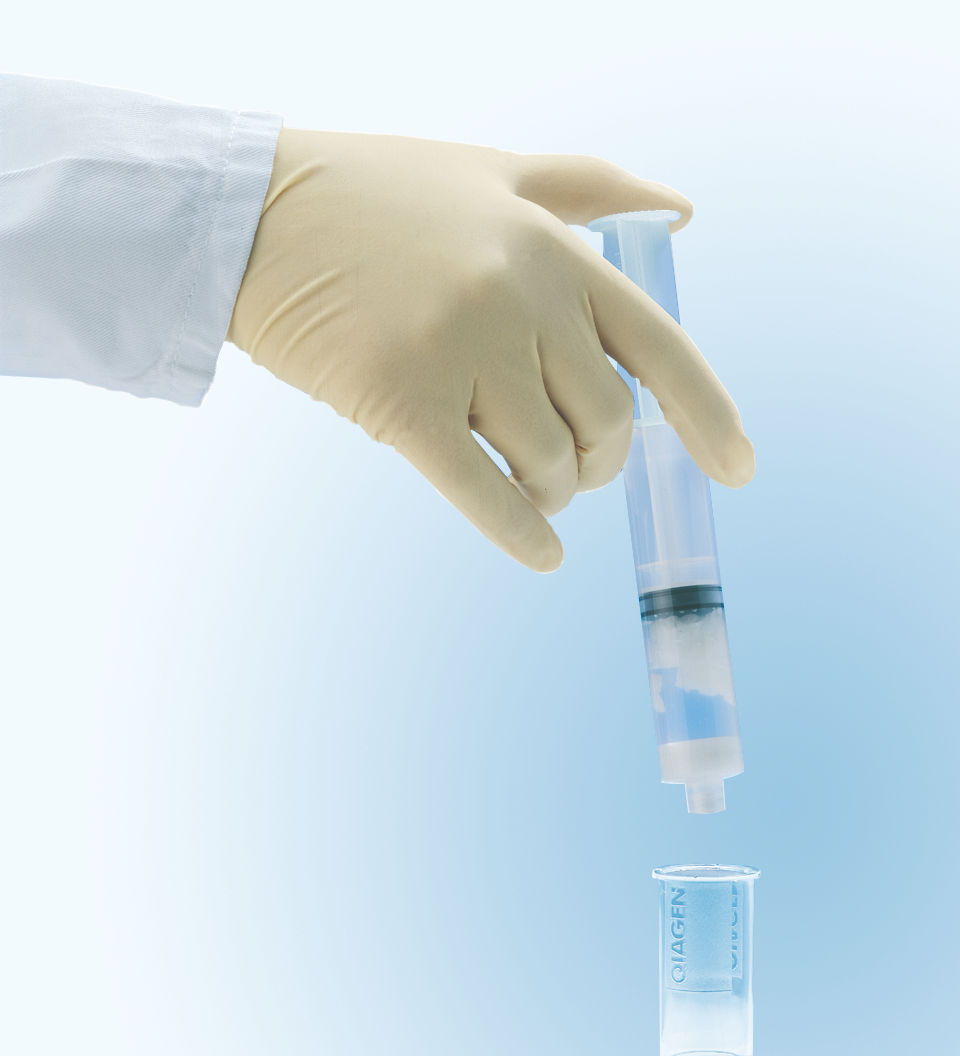
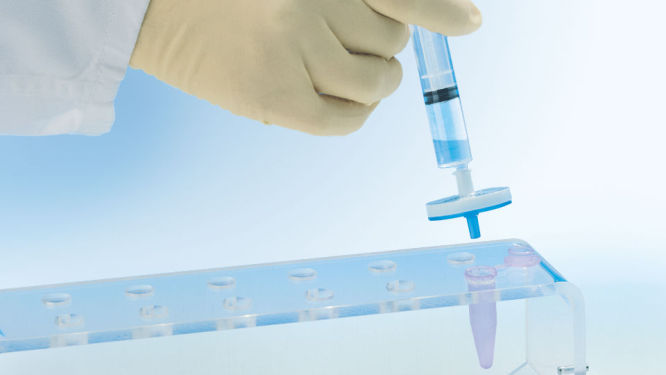
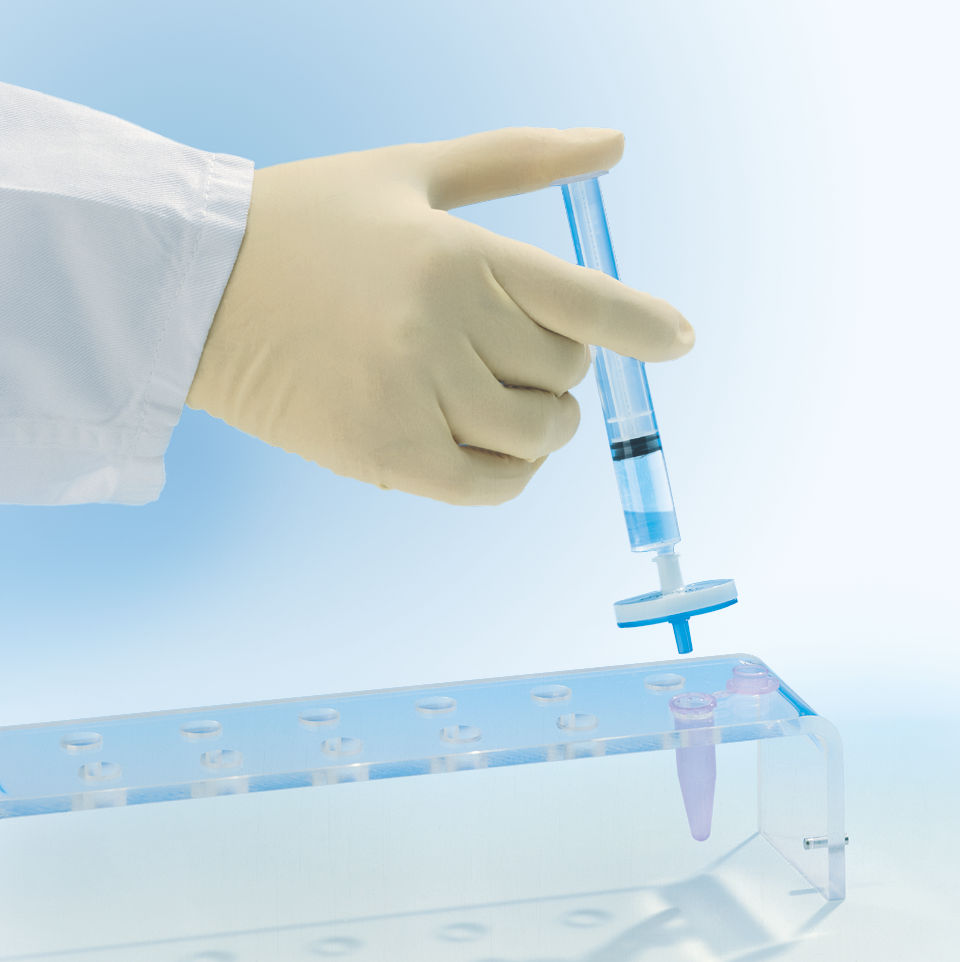
独特的 QIAprecipitator 模块(见图“ QIAprecipitator 模块”)取代了传统上纯化后用于收集异丙醇沉淀 DNA 的离心步骤。QIAprecipitator 模块在异丙醇-缓冲液混合物流过时捕获沉淀的 DNA。然后用 TE 缓冲液或水将 DNA 从 QIAprecipitator 中简单地洗脱到微型离心管中。这一独特模块还消除了颗粒损失风险,该风险可能发生在离心后倾析上清液时。

规格
特点 HiSpeed Plasmid Midi Kit HiSpeed Plasmid Maxi Kit
应用 转染、克隆、测序、基因沉默 转染、克隆、测序、基因沉默
培养体积/起始材料 50 µl – 150 ml 培养液量 150 µl – 250 ml 培养液量
质粒类型 高拷贝柯斯质粒 DNA 高拷贝柯斯质粒 DNA
处理 手动(过滤) 手动(过滤)
每次运行的样本数 每次运行 1 个样本 每次运行 1 个样本
技术 阴离子交换技术 阴离子交换技术
每次运行的时间 45 分钟 60 分钟
产量 <200 µg <750 µg

程序

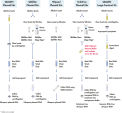
中和的细菌裂解物在 QIAfilter Cartridge 中孵育,数秒内通过过滤澄清。将滤液倒入 HiSpeed 吸头进行质粒 DNA 纯化(见流程图“QIAGEN Plasmid Kit 程序”)。将洗脱 DNA 与异丙醇混合,用提供的注射器注入 QIAprecipitator 模块。然后用 TE 缓冲液或水将浓缩并脱盐的 DNA 从 QIAprecipitator 中直接洗脱到一个微型离心管中。

应用

使用 HiSpeed Plasmid Kits 纯化的 DNA 在从克隆和测序到转染和质粒介导基因沉默等所有应用中都能获得优异的结果。

辅助数据和图表

资源

快速启动实验方案 (2)
安全数据表 (1)
Download Safety Data Sheets for QIAGEN product components.
Safety Data Sheets (1)
Certificates of Analysis (1)

文献

Characterization of Helicobacter pylori lytic transglycosylases Slt and MltD.
Chaput C; Labigne A; Boneca IG;
J Bacteriol; 2006; 189 (2):422-9 2006 Nov 3 PMID:17085576
Identification of a lipase-linked cell membrane receptor for pigment epithelium-derived factor.
Notari L; Baladron V; Aroca-Aguilar JD; Balko N; Heredia R; Meyer C; Notario PM; Saravanamuthu S; Nueda ML; Sanchez-Sanchez F; Escribano J; Laborda J; Becerra SP;
J Biol Chem; 2006; 281 (49):38022-37 2006 Oct 10 PMID:17032652
Role of parathyroid hormone in the downregulation of liver cytochrome P450 in chronic renal failure.
Michaud J; Naud J; Chouinard J; Désy F; Leblond FA; Desbiens K; Bonnardeaux A; Pichette V;
J Am Soc Nephrol; 2006; 17 (11):3041-8 2006 Oct 4 PMID:17021269
A rapid functional assay for the human trace amine-associated receptor 1 based on the mobilization of internal calcium.
Navarro HA; Gilmour BP; Lewin AH;
J Biomol Screen; 2006; 11 (6):688-93 2006 Jul 10 PMID:16831861
Engineering of a xylose metabolic pathway in Corynebacterium glutamicum.
Kawaguchi H; Vertès AA; Okino S; Inui M; Yukawa H;
Appl Environ Microbiol; 2006; 72 (5):3418-28 2006 May PMID:16672486

常见问答

Where can I find a protocol for cleanup of already purified plasmid DNA?

When using the silica-based QIAprep Spin Miniprep Kit, a protocol is contained in the QIAprep Miniprep Handbook, in Appendix C: Special Applications. The protocol is called: 'Purification of plasmid DNA prepared by other methods'.

For our anion-exchange based Plasmid Purification Kits, a protocol can be accessed online at our Plasmid Resource Center, and is called 'Re-Purification of Plasmid DNA Prepared by Methods other than QIAGEN Tips'.


FAQ-1031
I am seeing a precipitate after adding LyseBlue reagent to Buffer P1. What should I do about that?

A precipitate forming upon adding LyseBlue reagent to Buffer P1 is a normal observation. This precipitate will completely dissolve after addition of Buffer P2. Please be sure to shake Buffer P1 vigorously before use to completely resuspend LyseBlue particles.

FAQ-1045
What are the additional plasmid bands I see on my gel?

Open circular plasmid, resulting from single strand nicks, usually migrates slower in agarose gels and forms (faint) bands above the supercoiled plasmid DNA band. Sometimes an additional band of denatured supercoiled DNA migrates just below the supercoiled form. This form may result from prolonged alkaline lysis with Buffer P2 and is resistant to restriction digestion.

For a detailed description on how to run and interpret an analytical gel, please see Appendix A in the QIAGEN Plasmid Purification Handbook: "Agarose Gel Analysis of the Purification Procedure", or visit this link.

FAQ-1059
How can I prevent clogging of QIAfilter cartridges?
It is important to completely mix and lyse bacterial cells with plasmid Buffers P1 and P2. Incomplete mixing results in sticky or slimy areas of lysate, which will clog the filter matrix. It is recommended to completely resuspend cells in Buffer P1 and vigorously mix after addition of Buffer P2. Also mixing after Buffer P3 addition needs to be complete to allow fluffy precipitation of cell debris, which will float up. If the white debris does not float, dislodge it from the QIAfilter barrel wall (e.g. using a sterile pipette tip). Otherwise it will collect on the filter matrix and can lead to clogging. Use of LyseBlue reagent will help to achieve proper mixing results.
FAQ-1060
How can I increase DNA concentration using QIAprecipitators of the HiSpeed Plasmid Kits?
Use 500 µl instead of 1 ml of Buffer TE for elution of plasmid DNA from the QIAprecipitator of the HiSpeed Plasmid Kits. If low copy plasmids are used, the lysates of two QIAfilter Cartridges can be filtered into one equilibrated HiSpeed Tip. HiSpeed Maxi Kits will result in higher DNA concentration than HiSpeed Midi Kits, because the QIAprecipitators in both kits (Midi- and Maxi Module) use the same elution volume.
FAQ-1061
How can I improve the performance of the HiSpeed QIAprecipitator module?

When using the QIAprecipitator module of the HiSpeed Plasmid Midi- or Maxi Kits, make sure to dry the membrane by pressing air through the QIAprecipitator at least twice. Dry the outlet nozzle of the QIAprecipitator with absorbent paper. This will prevent carry-over of alcohol into the eluate and enable optimal performance of the extracted DNA downstream.

Do not load eluate from from several columns on the QIAprecipitator, and be sure that the correct precipitator size is used for the corresponding HiSpeed Tip. Do not replace the isopropanol with ethanol for precipitation, since the use of ethanol will lead to a finer precipitate that can clog the module.

To prevent breakage and leakage of the module it is important to avoid excessive force, bending, or twisting while attaching the QIAprecipitator to the syringe. Do not stress the inlet by resting one edge of the QIAprecipitator on a hard surface (e.g., the edge of a sink) and depressing the syringe plunger. Always apply gentle, even, pressure perpendicularly to the QIAprecipitator.

FAQ-144
What is the RNase A concentration and composition of Buffer P1?

The composition of Buffer P1 is:

  • 50 mM Tris·Cl, pH 8.0
  • 10 mM EDTA
  • 100 µg/ml RNase A

After RNase A addition, the buffer should be stored at 2–8°C.

Buffer P1 is the resuspension buffer used in a variety of QIAGEN kits for plasmid DNA purification. Details on buffer preparation and storage are presented in Appendix B of the QIAGEN Plasmid Purification Handbook.

FAQ-198
Can I use water for elution from the QIAprecipitator of the HiSpeed Plasmid Kits?

Yes, when eluting DNA from the QIAprecipitator Modules of the HiSpeed Plasmid Kits, water or buffers commonly used to dissolve DNA (e.g., Tris) may be employed.

Note: Store DNA at -20°C when eluted with water as DNA may degrade in the absence of buffering and chelating agents.

FAQ-306
What is the lowest elution volume that can be used with QIAprecipitator Midi and Maxi Modules?

The lowest elution volume that should be used for both the QIAprecipitator Midi and the Maxi Module provided in the HiSpeed Plasmid Kits is 500 ul. The official elution volume for both modules is 1 ml. If a higher DNA concentration is desired and a reduction in yield of up to 10% is acceptable, the elution volume can be reduced. Elution volumes smaller than 500 ul will lead to incomplete wetting of the QIAprecipitator membrane and further reduced DNA yields.

FAQ-307
Are the QIAprecipitator Midi and Maxi Modules of the HiSpeed Plasmid Kits interchangeable?
No, the QIAprecipitator Midi and Maxi modules of the HiSpeed Plasmid Midi- and Maxi Kits are not interchangeable. Each module has been designed for different capacities and recoveries.
FAQ-308
Can Buffers N3 and P3 be used interchangeably?
No. Although both Buffers N3 of the QIAprep Spin Miniprep and P3 of the QIAGEN Plasmid Kits perform the neutralization step in an alkaline lysis procedure, they are completely different. Buffer N3 contains a proprietary formula that sets up binding conditions for the QIAprep Miniprep column's silica-gel-membrane. Buffer P3 sets up binding conditions for QIAGEN anion-exchange columns. Our website explains QIAGEN's nucleic acid purification technologies in more detail.
FAQ-310
Can I use ethanol instead of isopropanol for DNA precipitation when using HiSpeed Plasmid Kits?

No. Ethanol is not recommended when using the QIAprecipitator module of the HiSpeed Plasmid Kits for DNA precipitation. The finer precipitates formed with ethanol are likely to clog the QIAprecipitator.

FAQ-354
Can I eliminate RNase A from buffer P1 for my plasmid preparation to obtain RNase-free DNA for in-vitro transcription?
No, RNase A should not be omitted from buffer P1. It is required to prevent RNA contamination of the purified plasmid DNA. RNase A will not interfere with downstream in-vitro transcription experiments, since it will be efficiently removed during the plasmid purification procedures using QIAGEN Plasmid Kits.
FAQ-366
What is the composition of buffer QBT?

Buffer QBT is the equilibration buffer used in QIAGEN Plasmid Kits for plasmid purification and in QIAGEN Blood & Cell culture kits.

The composition of Buffer QBT is:

  • 750mM NaCl • 50 mM MOPS, pH 7.0
  • 15% isopropanol (v/v)
  • 0.15 % Triton® X-100 (v/v)

To make 1 liter of solution, dissolve 43.83 g NaCl, 10.46 g MOPS (free acid) in 800 ml distilled water. Adjust the pH to 7.0 with NaOH. Add 150 ml pure isopropanol and 15 ml 10% Triton X-100 solution (v/v). Adjust the volume to 1 liter with distilled water. Store at 15–25°C

FAQ-411
What is the composition of buffer QC?

Buffer QC is the wash buffer used in QIAGEN Plasmid Kits for plasmid purification and in QIAGEN Blood & Cell Culture kits.

The composition of Buffer QC is:

  • 1.0 M NaCl
  • 50 mM MOPS, pH 7.0
  • 15% isopropanol (v/v)


To make 1 liter of solution, dissolve 58.44 g NaCl, 10.46 g MOPS (free acid) in 800 ml distilled water. Adjust the pH to 7.0 with NaOH. Add 150 ml pure isopropanol. Adjust the volume to 1 liter with distilled water. Store at 15–25°C.

FAQ-412
What is the composition of buffer QF?

Buffer QF is the elution buffer used in QIAGEN Plasmid Kits for plasmid purification and in QIAGEN Blood & Cell culture kits.

The composition of Buffer QF is:

  • 1.25 M NaCl
  • 50 mM Tris-Cl, pH 8.5
  • 15% isopropanol (v/v)


To make 1 liter of solution, dissolve 73.05 g NaCl and 6.06 g Tris base in 800 ml distilled water. Adjust the pH to 8.5 with HCl. Add 150 ml pure isopropanol. Adjust the volume to 1 liter with distilled water. Store at 15–25°C

FAQ-413
What is the composition of buffer STE?

The composition of Buffer STE is:

  • 100 mM NaCl
  • 10 mM Tris-Cl, pH 8.0
  • 1 mM EDTA

Buffer STE is a DNA resuspension and storage buffer used in QIAGEN Plasmid Kits for plasmid purification and in some plasmid supplementary protocols. Details on buffer preparation and storage are presented in Appendix B of the QIAGEN Plasmid Purification Handbook.

FAQ-415
What is the composition of buffer TE?

The composition of Buffer TE is:

  • 10 mM Tris·Cl, pH 8.0
  • 1 mM EDTA

Buffer TE is a commonly used DNA resuspension and storage buffer. It is supplied in QIAGEN's Endofree Plasmid Kits, and used for plasmid DNA resuspension in combination with other QIAGEN Plasmid Kits. Details on buffer preparation and storage are presented in Appendix B of the QIAGEN Plasmid Purification Handbook.

FAQ-416
What is the composition of buffer P3?

The composition of Buffer P3 is:

  • 3.0 M potassium acetate, pH 5.5

Buffer P3 is the neutralization buffer used in QIAGEN's anion-exchange based Kits for plasmid preparation. Details of buffer preparation and storage are presented in Appendix B of the QIAGEN Plasmid Purification Handbook.

FAQ-418
What can I do when the DNA pellet prepared with QIAGEN Plasmid Kits has been overdried?
Redissolve the DNA by warming the solution slightly, e.g. incubate it at 37°C, and allow more time for redissolving.
FAQ-572