Read more about GeneReader NGS System
The first complete Sample to Insight NGS solution.

QIAcuity Cell and Gene Therapy (CGT) dPCR Assays

For vector genome titration and vector copy number determination with superior accuracy, reproducibility and speed on the QIAcuity Digital PCR System

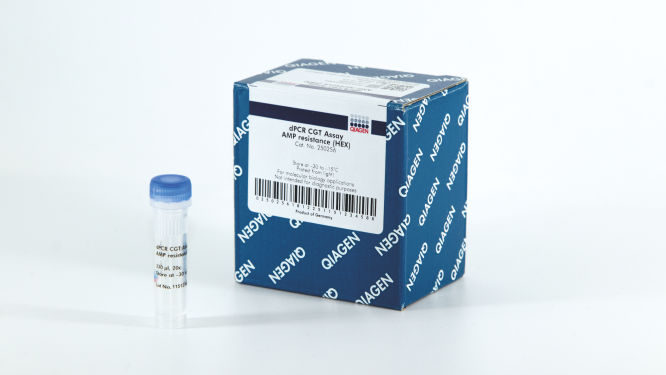
S_1234_8_LS_QF_dPCR_CGT_Assay_AMP_restistance_HEX

✓ 24/7 automatic processing of online orders

✓ Knowledgeable and professional Product & Technical Support

✓ Fast and reliable (re)-ordering

dPCR CGT Assay 5' LTR (FAM)

Cat no. / ID.   250319

For 500x12 µL reactions (20x): QIAGEN Cell and Gene Therapy assay for 5' LTR to be used with the QIAcuity dPCR system.
Kit componentKit
LV-specific targets
Reporter/Resistance
Reference genes
AAV-specific target
Regulatory elements
Promoters/Enhancer
QIAcuity Probe PCR Kit
QIAcuity MasterMix (2x1mL)
Detection of
5’ LTR
RRE
Psi
Dye
FAM
HEX
Cy5

✓ 24/7 automatic processing of online orders

✓ Knowledgeable and professional Product & Technical Support

✓ Fast and reliable (re)-ordering

Features

  • A broad offering of 18 different wet-lab validated dPCR CGT assays
  • Assays with different fluorophore choices allow multiplexing to sustain more information from one sample
  • An easy and fast workflow comparable to qPCR

Product Details

Adeno-associated virus (AAV) and lentivirus (LV) are widely used viral vectors in cell and gene therapy applications. However, the generation and purification of the viral vectors require rigorous quality control to enable safe and reliable dosing during clinical studies or patient care. The ability to accurately quantify vector titers, detect contamination and determine vector copy number (VCN) is critical for safe and effective AAV-based and LV-based cell and gene therapies. 
 
The kit works in conjunction with the QIAcuity Digital PCR System and the QIAcuity Nanoplates. 
 
Would you like to find out more about the product from one of our dPCR specialists? Sign in here, and we will get in touch with you. 

Performance

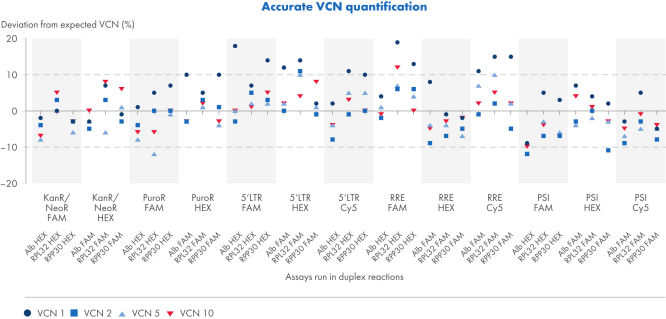
The QIAcuity Cell and Gene Therapy dPCR Assays are a broad offering of 18 different wet-lab validated dPCR CGT assays that come in multiple fluorophores, enabling superior accuracy, reproducibility and a dynamic range of at least four orders of magnitude with speed in measuring viral titers in a multiplex setup. The assays work in conjunction with the QIAcuity Digital PCR System, dedicated QIAcuity MasterMixes and QIAcuity Nanoplates, offering an end-to-end dPCR workflow comparable to qPCR but delivering an absolute quantification of vector genome copies or vector copy numbers in your sample. The assays have been designed with the requirements of biopharma manufacturing and QC in mind. 

Principle

The principle of the dPCR reaction in the nanoplates is described here.

Dedicated CGT assays enable viral vector quantification, such as AAV and LV, on the QIAcuity. These assays are validated and can be used in singleplex and multiplex reactions and can be additionally combined with gene-of-interest assays, delivering: 

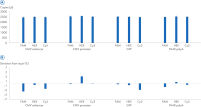
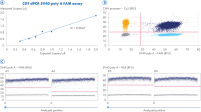
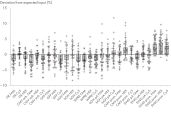
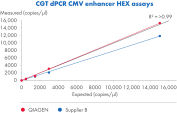
  • Accurate quantification down to 0.3 copies/µL
  • High precision over a broad dynamic range
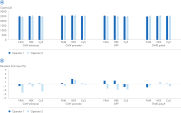
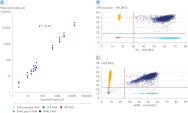
  • High accuracy across assays (independent of fluorophores) and operators
  • High precision (<10% deviation from the mean) independent of fluorophores and operators
  • Compatibility with both dPCR and qPCR readout

Procedure

The QIAcuity Cell and Gene Therapy dPCR Assays are provided in a 20x ready-to-use primer-probe mix, available in multiple fluorophore choices, and optimized for use with dedicated QIAcuity MasterMixes. These assays enable both singleplex and multiplex CGT applications, including absolute quantification of vector titer and assay robustness. 

Applications

The QIAcuity Cell and Gene Therapy (CGT) dPCR Assays, together with the QIAcuity Nanoplates and the QIAcuity PCR kits, enable digital PCR applications, including:  

  • Viral vector titer 
  • Viral vector genome integrity 
  • Vector copy number (VCN) 
  • Residual plasmid (if using Amp plasmids for the production of AAVs) 

Incorporating these CGT dPCR Assays into the quality control process of cell and gene therapy development means greater certainty in producing safe and potent treatments. 

Supporting data and figures

Resources

Brochures & Guides (5)
This fact sheet explains the inclusion of PCR, qPCR and dPCR Kits in our Go Greener program.
Fast. Scalable. Reliable.
Scientific documents (13)
This study tested a workflow for quantitation and qualification of AAV samples using a duplex assay on the QIAcuity dPCR instrument targeting both an insert (GFP) and the viral backbone (AAV2-ITR). With very low intra-assay and inter-assay CVs <6.5%, we demonstrate one of the main benefits of dPCR: reproducibility.
Here, we present a workflow that combines two technologies, cellenONE and QIAcuity Digital PCR, which accelerate and streamline high-throughput analyses of target copy numbers in cultured cells. The workflow starts with detecting and sorting defined populations of cells as well as individual cells using cellenONE, followed by multiplexing dPCR on the QIAcuity platform. Copy number variations of target regions are then analyzed using the QIAcuity Software Suite, providing an intuitive and fast interpretation of results.
The QIAcuity dPCR System, complemented by the QIAcuity Software Suite version 2.5 and higher, offers a powerful solution for determining DNA integrity and stability. Analyzing up to 5 targets simultaneously enables accurate and precise integrity assessment. The importance of determining genome integrity becomes particularly evident in analyzing viral vectors such as AAVs, which are known for their susceptibility to packaging errors. Moreover, dPCR is a valuable tool for assessing DNA stability, providing valuable insights into storage and processing impacts.
The goal of this work was to compare performance of quantitative PCR (qPCR) and digital PCR (dPCR) in the quantification of gene expression and Wolbachia abundances in Nasonia parasitoid wasps.
Here we provide an integrated rAAV genome titer method using the QIAcuity Digital PCR (dPCR) System with detailed parameters for high assay performance. Using this optimized method for pre-PCR handling of in-process rAAV samples, the results demonstrated that QIAcuity dPCR system generates the same level of accuracy and precision as the current gold standard ddPCR system but with much faster sample-to-result times (2 hours vs 7 hours) and higher overall throughput and scalability.
Safety Data Sheets (1)
Download Safety Data Sheets for QIAGEN product components.
Certificates of Analysis (1)
Operating software (1)
"

Version 11

The Volume Precision Factor (VPF) offers a unique feature to secure precision of concentration results obtained from a QIAcuity dPCR run. 

In general, Nanoplates provide partitions of fixed sizes that enable a very precise way of sample concentration calculation. Potential variation of partition sizes in Nanoplate batches, caused by different microstructure molding forms, can be addressed by applying the batch specific VPF. Furthermore, the VPF includes well-specific volume information and therefore further increases precision of concentration calculation in each well of the Nanoplates.

"
Software-related downloads (24)
For Version 1.2
User Manuals (2)
QIAcuity Safety Instructions and Quick-Start Guide
PDF (6.4MB)
Download
May 2025

FAQ

Is it possible to change voltage set-up from 110V to 230V on the QIAcuity instruments?

This is not needed. The QIAcuity is equipped with a flexible power supply technology and operates within a range of 100–240V AC, 50/60 Hz, 1500 VA (max). 

FAQ-3761
Can I see error codes on the instrument touchscreen?

The instrument software GUI shows error codes including a description and information how to resolve the error. The instrument touchscreen shows an alarm icon in the upper right corner that turns red in case of an instrument failure. Accessing the System Status in the Tool tab allows users to clear errors. Rebooting of the instrument is required to complete the removal of the error.  Please do not skip this step. You may always contact QIAGEN Technical Services in case of any question. 

FAQ-3763
What is the scope of a regular maintenance of the QIAcuity?

The user manual contains instructions on how to perform a regular cleaning and decontamination, and how to replace air filters on the QIAcuity instruments. A regular maintenance reduces the dust in the instrument and therefore minimizes the presence of dust particles on the nanoplate, which might interfere with the plate analysis.

FAQ-3765
What is the impact of not applying the latest VPF? Can I reanalyze previously obtained results after installing the latest VPF?

If you had run a nanoplate for which the installed VPF misses the specific factor, the software will notify you. If you then analyze without the specific VPF, the impact depends on the variation of the partition volume of the new Nanoplate batch compared to the latest. Typically this variation is ±6–7% (approx. 5% CV over the entire plate). The analysis may be repeated after updating the VPF file. After installing the latest VPF and re-analysis of the run, a copy of the plate is generated in the QIAcuity Software Suite including the new results. 

FAQ-3769
Can I see on the QIAcuity Software Suite report file if the VPF (Volume Precision Factor) has been used or not?

Yes, the report includes a notification if the matching VPF was missing and, therefore, not applied to the analysis. If the matching VPF was applied there is no notification on the report. 

FAQ-3770
Is it necessary to reanalyze a plate with VPF (Volume Precision Factor) that was already processed using a QIAcuity instrument that was purchased in 2020?

If you had analyzed your nanoplates without VFP, the impact depends on the variation of the partition volume of the new nanoplate batch compared to the latest. The VPF reduces the CV from approximately 5% to 2%. We recommend to reanalyze results in case the data originated from different wells (e.g., copy number variations or gene expression data sets for which the reference sample was measured in a different well). Results obtained across different plates should also be r-analyzed. A reanalysis is not required for assay data that were analyzed within the same well (e.g., mutation rate determination using two channels within the same well).

FAQ-3771
Can I prepare a dPCR reaction directly in QIAcuity Nanoplate?

A standard PCR plate is required to set up dPCR reaction before transferring it to the nanoplate to ensure a proper mixing of the reaction mix before partitioning. 

FAQ-3774
Can I use a custom master mix instead of a QIAGEN master mix?

QIAGEN master mixes are optimized for nanoplate microfluidics and are recommended to be used with our dPCR system. They also include an optimized reference dye required for proper analysis.

FAQ-3777
How to prepare DNA prior to dPCR?

All DNA samples used in reaction mixes should show similar quality and quantity, which can easily be assessed using UV spectrophotometry. DNA samples with an average length of ≥20 kb (e.g., genomic DNA purified via spin column with silica membrane) should be fragmented by restriction digestion before partitioning. Enzymatic fragmentation of larger DNA ensures an even distribution of template throughout the QIAcuity Nanoplate, which in turn leads to an accurate and precise quantification.

FAQ-3778
What are the storage conditions and expiry date of QIAcuity consumables?

The QIAcuity Probe PCR Kit should be stored immediately upon receipt at –30 to –15°C in a constant-temperature freezer and protected from light. The QIAcuity Probe PCR master mix can also be stored protected from light at 2–8°C. Components are stable for 12 months, unless otherwise indicated on the label. 
The QIAcuity EG PCR Kit should be stored immediately upon receipt at –30 to –15°C in a constant-temperature freezer and protected from light. The QIAcuity EG PCR master mix can also be stored protected from light at 2–8°C. Components are stable for 6 months, unless otherwise indicated on the label. 
The QIAcuity Nanoplates does not have expiry date and are stable for at least 1 year when stored at RT. 

FAQ-3780
Can I use the QIAcuity Nanoplate in more than one runs?

The plate is designed for a single use run. For example, even if only 30 samples are loaded into the 96-well plate, a whole plate will be sealed by the roller. It can't be unsealed and used for another run. The QIAcuity Software won’t allow to set up a separate experiment for the same nanoplate to avoid that previously processed plates being not partitioned a second time.

FAQ-3781
Can I optimize a dPCR assay on the QIAcuity using gradient temperature?

An essential temperature gradient functionality was introduced with software version 2.5. When updating older software versions to 2.5, each QIAcuity instrument will offer the temperature gradient and may be used to find the best cycling temperature for new dPCR assays. When running a QIAcuity Four or a QIAcuity Eight, all plates may have their own temperature profile, including the option for a temperature gradient.

FAQ-3783
What is the VPF (Volume Precision Factor)?

The VPF provides a set of well-specific and molding form-specific factors used to specify the exact reaction volume of a nanoplate, thus increasing the concentration calculation of each well. 

FAQ-3784
When and how often do I need a new VPF (Volume Precision Factor)?

 In general, nanoplates provide partitions of fixed sizes that enable a very precise way of sample concentration calculation. If a new molding form is used for nanoplate manufacturing, potential variation of partition sizes can be addressed by applying the molding form-specific VPF. Thus, each time a new molding form is used, a new VPF is created and made available. Currently, the VPF is updated once every 3–6 months.

FAQ-3785
Is a standard curve needed in dPCR?

In dPCR we measure the absolute concentration of targets at endpoint reaction. Concentrations of unknowns can be determined based on dPCR results observed (number of negatives, number of positives, and partition volume analyzed).

FAQ-3786
Do you have any recommendations on how to process my AAV samples?

To ensure consistent and reproducible measurements of viral titers, we recommend the CGT Viral Vector Lysis Kit (cat. no. 250272/250273). It has been optimized to work in conjuction with the QIAcuity Cell and Gene Therapy dPCR Assays and the QIAcuity Probe PCR Kit on the QIAcuity instruments as part of a standardized and complete viral vector titer workflow.

FAQ-3860
Can I combine your CGT dPCR assays with custom designed assays?

Yes, the CGT dPCR assays can be used in singleplex and multiplex reactions. Custom designed assays can be added into a multiplex reaction according to customer needs.

FAQ-3861
How many assays can be multiplexed?

Two to five assays can be combined into a multiplex reaction depending on the QIAcuity Digital PCR platform, hence the 2-plex or 5-plex instruments.

FAQ-3862
In which channels can you detect the CGT dPCR assays?
Most of the assays are offered with a FAM, HEX, or Cy5 fluorophore, and can be detected in the Green, Yellow, or Crimson channel, respectively. SV40 poly A, hGH poly A, Amp resistance, KanR/NeoR, and PuroR assays are only available with a FAM or HEX fluorophore.
FAQ-3863
How can I resuspend the lyophilized assay?

Please resuspend the lyophilized assays in 330 µl TE buffer to obtain a 20× stock. Additional information can be found in the QSP and the data sheets.

FAQ-3864
What quenchers are used?

The probes are double quenched with ZEN/TAO and IOWA black quenchers.

FAQ-3865
Do I need to use restriction enzymes when quantifying AAV and LVV genomes?

In some cases, it is recommended to perform a digest with compatible restriction enzymes. For example, when quantifying ITRs, the strong secondary structure of the terminal repeats might affect titration. Compatible restriction enzymes are indicated in the corresponding data sheets of the CGT dPCR assays.

FAQ-3866
Can the CGT dPCR assays also be used for the quantification of non-AAV or non-LVV samples?

Yes. They can be used as long as the assays match the region of interest.

FAQ-3868
How do I know if the assays are compatible with the sample DNA of interest?

An extended sequence context for each assay is provided in the corresponding data sheet. 

FAQ-3870
Are the assays also compatible with qPCR?

Yes. The assays can also be used for vector genome titration in a qPCR.

FAQ-3871
Which kit is recommended to isolate DNA for vector copy number (VCN) analysis?
We recommend the QIAamp DNA Mini Kit for DNA extraction.
FAQ-4083
What is the optimal input range for VCN analysis?
Template gDNA amounts for VCN should ideally lie within 30–50 ng per reaction.
FAQ-4084
How is the VCN calculated? Is there a formula for VCN determination?
VCN = 2 × (vector target copies ÷ human reference target copies)
FAQ-4085
Is it possible to use the VCN assays (CGT dPCR Assays) for multiplex reactions?
Yes, multiplexing is possible.
FAQ-4086