
✓ 24/7 automatic processing of online orders
✓ Knowledgeable and professional Product & Technical Support
✓ Fast and reliable (re)-ordering
QIAcuity HEK293 resDNA Quant Kit (96)
Cat no. / ID. 250224
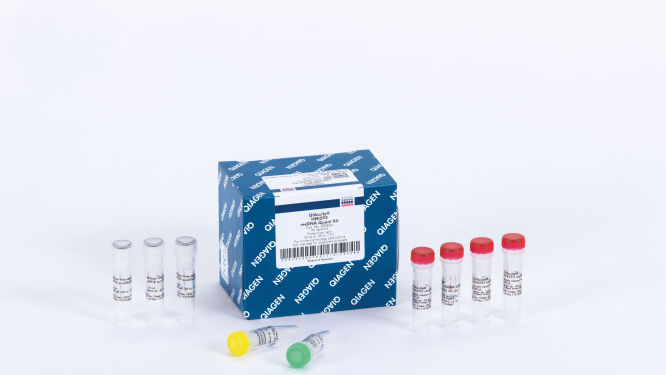
For 96 reactions: 4x QIAcuity HEK293 resDNA Quant Mastermix (2x) lyophilized, 4x QIAcuity Quant Rehydration Buffer, 1x Positive Control, 1x Internal Control, 2x RNAse-Free Water
Kit
resDNA Quant
resDNA Quant Standard
HEK293 resDNA Sizing
Cell type
HEK293
CHO
E. coli
Vero
Sf9/Baculo
P. pastoris
QIAcuity Residual DNA Quantification and Sizing Kits are intended for molecular biology applications. These products are not intended for the diagnosis, prevention, or treatment of a disease.
✓ 24/7 automatic processing of online orders
✓ Knowledgeable and professional Product & Technical Support
✓ Fast and reliable (re)-ordering
Features
- QIAcuity resDNA Quant Kits enable accurate detection of residual host-cell DNA from E. coli, CHO, HEK293, Vero, Sf9/Baculovirus, P. pastoris and Mouse cells down to low femtogram levels
- QIAcuity HEK293 resDNA Sizing Kit is used for precise measurement of both the amount and fragment size distribution of host cell DNA and can be optionally multiplexed with oncogenes (e.g., E1A, E1B or SV40 for HEK293T)
- A multi-copy target assay that detects and quantifies highly fragmented host cell DNA
- Enables host cell DNA detection in both extracted and unextracted samples
- Kits include internal and positive controls and are optimized for the QIAcuity dPCR platform
Product Details
Host cell DNA contamination in products such as vaccines, drugs and other biopharmaceuticals imposes great health risks. Therefore, its safe limits are tightly regulated by agencies such as the FDA and WHO. Clear guidelines for the upper limits of residual DNA are established based on the nature of drug administration, infectivity and oncogenicity of the contaminating cell DNA. For instance, parenteral administration of non-tumorigenic cell DNA should be limited to 10 ng/dose and a maximum length of 200 bp, whereas less than 100 µg/dose of residual DNA is recommended by WHO for orally administered vaccines.
Detection of such contaminations requires highly sensitive and accurate measurements of the extremely low amounts of specific host cell DNA present in the products.
Digital PCR is the preferred method for residual DNA (resDNA) quantification. This is due to its unmatched sensitivity and accuracy, especially at trace levels of contamination compared to other detection methods such as qPCR. QIAcuity Residual DNA Quantification Kits provide the accurate and precise detection of Escherichia coli (E. coli), Chinese Hamster Ovary (CHO) Human Embryonic Kidney 293 (HEK293) Vero, Sf9/Baculovirus, Pichia pastoris (P. pastoris) and Mouse host cell DNA.
The QIAcuity HEK293 resDNA Sizing Kit allows quantification and fragment size determination to meet guidelines for residual DNA size (<200 bp). This kit also allows for multiplexing with an assay resulting in a 200 bp long HEK293 amplicon (GeneGlobe ID DCG0000621, Cat. No. 250210) or oncogene targets like E1A (Geneglobe ID DMA00938, Cat. No. 250207), E1B (Geneglobe ID DMA01000, Cat. No. 250207) or SV40 (Geneglobe ID DMA00936, Cat. No. 250207) for added safety testing flexibility.
The QIAcuity resDNA Quant Standard Kits are dPCR-verified absolute quantification standards that can be used in combination with resDNA Quant and Sizing Kits for validation of quantitation accuracy or bridging studies.
Performance
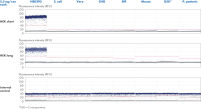
The QIAcuity Residual DNA Quantification Kits provide accurate residual DNA quantification results with or without extraction, even in the presence of PCR contaminants or other inhibitory reagents. The assays are multicopy target assays that accurately determine even very low amounts highly fragmented residual host cell DNA. QIAcuity HEK293 resDNA Sizing Kit targets a proprietary multicopy locus, enabling sensitive detection and sizing of HEK293 or human residual DNA via two amplicons (short with less than 200 bp, and long with more than 200 bp). This allows for precise quantification and assessment of DNA size distribution in a single reaction.
| Assay | Target Copy Number | Amplicon Size | Conversion Factor cp/µL to fg/µL | Conversion Factor cp/µL to pg/µL |
|---|---|---|---|---|
| QIAcuity E. coli resDNA Quant Kit | 7 | <200 | 0.35 | |
| QIAcuity CHO resDNA Quant Kit | ~ 1 million, undefined (repeated element) | <100 | 0.28 | |
| QIAcuity HEK293 resDNA Quant Kit | ~ 1 million, undefined (repeated element) | <100 | 1.54 | |
| QIAcuity Vero resDNA Quant Kit | multicopy | <150 bp | 0.063 | |
| QIAcuity Sf9/Baculo resDNA Quant Kit | multicopy (Sf9), singlecopy (Baculovirus) | <160 bp | 5.35 (Sf9) | |
| QIAcuity P. pastoris resDNA Quant Kit | multicopy | <150 bp | 0.379 | |
| Mouse resDNA Quant Standard Kit | multicopy | <150 bp | 1.06 | |
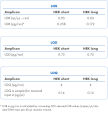
| QIAcuity HEK293 resDNA Sizing Kit | > 20 copies per genome | Short Amplicon (~83 bp) | 0.129 | |
| resDNA Sizing Kit | Long Amplicon (~345 bp) | 0.143 |
Digital PCR provides higher sensitivity of detection at a lower template input range in comparison to qPCR and therefore enables a more robust application.
The kits work in conjunction with the QIAcuity Digital PCR System and QIAcuity Nanoplates, offering an end-to-end fast dPCR workflow comparable to qPCR, but delivering absolute quantification of resDNA in your sample without the need for standard curves. The kits have been designed according to the requirements of bioprocess manufacturing and QC.
Principle
The principle of the dPCR reaction in the nanoplates is described here.
Using QIAcuity digital PCR for host cell DNA monitoring improves the LOD/LOQ through partitioning of the bulk sample with the help of QIAcuity Nanoplate 26k. Partitioning increases the effective concentration of the target, allowing a small amount of host cell DNA to be captured and measured with higher accuracy and precision. The ability to load high template input amounts in the QIAcuity Nanoplate 26k combined with an increased number of partitions is one of the reasons for the higher accuracy precision and reproducibility residual host cell DNA detection.
Procedure
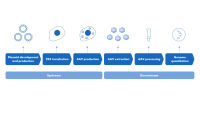
The sample or extracted template DNA is added to the reaction mix together with the internal amplification control in a standard PCR plate. The reactions are transferred to a Nanoplate and target DNA concentration (copies/µL) is measured by absolute quantification on the QIAcuity System. Copies/µL are converted to fg/µL or pg/µL using the provided conversion factor.
Applications
The QIAcuity Residual DNA Quantification and Sizing Kits are optimized for the highly precise host cell DNA monitoring in complex bioprocess intermediates as well as final products.
Supporting data and figures
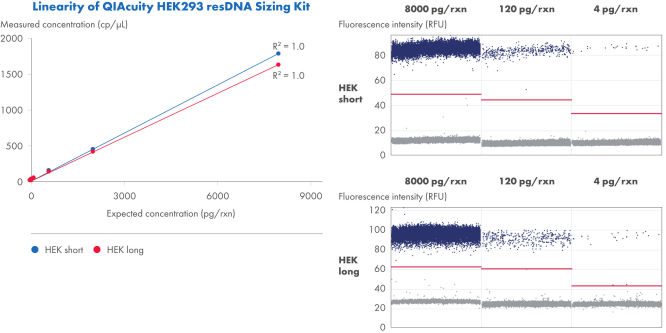
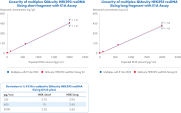
High precision over a broad dynamic range QIAcuity HEK293 resDNA Sizing Kit
High linearity from 0.5–8,000 pg/RxN*
*Nominal values from several replicates
Resources
Brochures & Guides (1)
Kit Handbooks & Protocols (13)
Scientific documents (1)
Safety Data Sheets (1)
Certificates of Analysis (1)
Software-related downloads (1)
FAQ
Is DNA extraction from the samples needed?
Which extraction kits are recommended?
Is restriction enzyme digestion required?
dPCR results are in copies per microliter. How do I calculate host cell DNA impurities in femtogram per microliter or picogram per microliter?
My samples are highly fragmented. Is the dPCR result for resDNA quantification accurate?
What are the ResDNA Quant Kit components?
How much sample can I load for detecting host cell contamination?
Is dPCR sensitive to inhibition?
How long can I store the reconsituted assay regarding QIAcuity HEK293 resDNA Quant Kit (96) at 4°C?
What is the preferred storage temperature for reconstituted assay for the QIAcuity HEK293 resDNA Quant Kit (96)?
What is the amount of standard for the different kit?
How did you calculate the conversion factor?
What does the standard kit contain?
What region is targeted in the QIAcuity E. coli resDNA Quant Kit (96)?
My sample DNA is highly fragmented. What is the principle behind QIAcuity HEK293 resDNA Sizing Kit?
How can I calculate the median fragment size of residual HEK293 DNA?
Which dyes/channels are used for the short and long amplicons of QIAcuity HEK293 resDNA Sizing Kit?
What are the components of QIAcuity Residual DNA Quantification and Sizing Kits? Are controls included?
Is dPCR sensitive to inhibition/matrix effects?