
✓ Automatische Verarbeitung von Online-Bestellungen 24/7
✓ Sachkundiger und professioneller technischer und Produkt-Support
✓ Schnelle und zuverlässige (Nach-)Bestellung
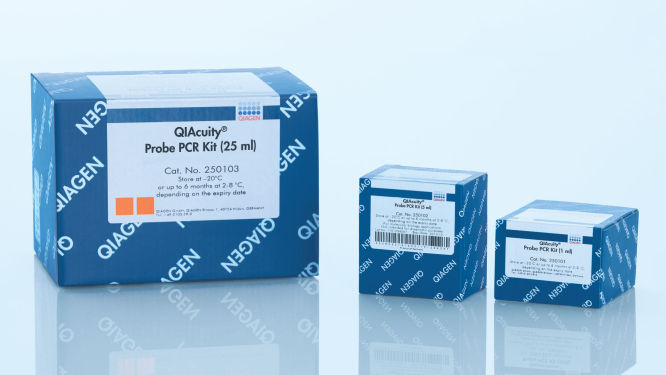
QIAcuity Probe PCR Kit (5 ml) icon_0368_ls_gen_eco_friendly-s
Kat.-Nr. / ID. 250102
5 x 1 ml 4-fach konzentrierter QIAcuity Probe Mastermix, 8 x 1,9 ml Wasser
Volumen
5 ml
1 ml
25 ml
QIAcuity Probe PCR Kit ist für molekularbiologische Anwendungen vorgesehen. Dieses Produkt ist nicht für die Diagnose, Prävention oder Behandlung einer Krankheit bestimmt.
✓ Automatische Verarbeitung von Online-Bestellungen 24/7
✓ Sachkundiger und professioneller technischer und Produkt-Support
✓ Schnelle und zuverlässige (Nach-)Bestellung
Eigenschaften
- Für Singleplex- und bis zu 5-plex-Reaktionen
- 4-fach konzentrierter Master-Mix zum Laden von mehr Proben
- Optimiert für den mikrofluidischen Einsatz in QIAcuity Nanoplates
- Weniger unspezifische PCR-Amplifikation
- REACH-Konformität
Angaben zum Produkt
Das QIAcuity Probe PCR Kit enthält einen 4-fach konzentrierten, gebrauchsfertigen Master-Mix, der für den mikrofluidischen Einsatz in den QIAcuity Nanoplates optimiert ist. Das Kit steigert die Spezifität und Effizienz der sondenbasierten digitalen PCR und ermöglicht eine genaue Singleplex- oder bis zu 5-plex-Analyse. Der QIAcuity Probe Master Mix wurde optimiert, um die Spezifität zu steigern und so eine genaue Quantifizierung von gDNA oder cDNA auf den QIAcuity dPCR-Geräten zu ermöglichen.
Das Kit wird zusammen mit dem QIAcuity Digital PCR System und den QIAcuity Nanoplates verwendet.
Möchten Sie Näheres über das Produkt erfahren und von einer/einem unserer dPCR-Spezialistinnen oder -Spezialisten kontaktiert werden? Registrieren Sie sich hier, und wir werden uns umgehend mit Ihnen in Verbindung setzen.
Leistung
Überlegene Leistung
Die QIAcuity Master-Mixe für die Hydrolysesonden-basierte dPCR nutzen die neuesten Versionen der hochwertigen DNA-Polymerase von QIAGEN. Die einzigartige Kombination von QIAGENs proprietärer und bewährter Puffertechnologie, die für die Nanoplatten-Mikrofluidik optimiert wurde, mit der neuen QuantiNova DNA Polymerase liefert äußerst beständige Ergebnisse hinsichtlich der Sensitivität, Reproduzierbarkeit und Effizienz.
Sondenbasierter Nachweis von Single- bis 5-plex mit dem QIAcuity Probe PCR Kit
Der spezielle Master-Mix im QIAcuity Probe PCR Kit ermöglicht die genaue Quantifizierung von bis zu 5 Zielen mit sehr unterschiedlicher Abundanz in einem Well der QIAcuity Nanoplate. Das spart Zeit und Geld und reduziert die Menge des benötigten Probenmaterials. Darüber hinaus sind die mit der Duplex- oder Multiplex-PCR gewonnenen Daten vergleichbar mit denen einer Singleplex-PCR.
Reaktionsstabilität von bis zu 100 Stunden
Die QIAcuity PCR-Mixe können bis zu 100 Stunden bei 30 °C gelagert werden, ohne dass dies die Leistung der nachfolgenden Reaktionen beeinträchtigt. Die auch nach längerer Lagerung ohne Kühlmittel bei Raumtemperatur gegebene hervorragende Stabilität ermöglicht den Einsatz des QIAcuity Probe PCR Kit für die Arbeit mit Hochdurchsatzreaktionen und Plattenstapeln.
Prinzip
Durch seinen neuartigen, Antikörper-vermittelten Hot-Start-Mechanismus bietet das QIAcuity Probe PCR Kit Single- oder Multiplex-cDNA- und -gDNA-Analysen höchster Spezifität. Bei niedrigen Temperaturen wird die QuantiNova DNA Polymerase durch QuantiNova Antibody und QuantiNova Guard, ein neuartiges, den Komplex stabilisierendes Additiv, in einem inaktiven Zustand gehalten. Dies verbessert die Stringenz des Hot-Starts und verhindert die Verlängerung von unspezifisch hybridisierten Primern und Primer-Dimeren. Innerhalb von 2 Minuten nach Temperaturerhöhung auf 95 °C werden QuantiNova Antibody und QuantiNova Guard denaturiert und die QuantiNova DNA Polymerase wird aktiviert, was die PCR-Amplifikation ermöglicht.
Das Prinzip der dPCR-Reaktion in den Nanoplatten finden Sie hier beschrieben.
Verfahren
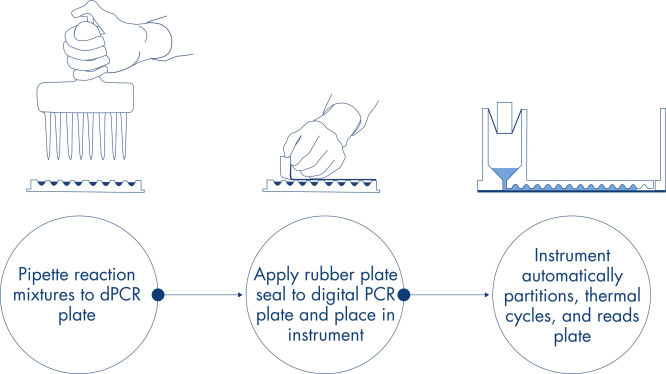
Genau wie bei qPCR-Experimenten umfasst die Probenvorbereitung die Überführung von Master-Mix, Sonden und Primern in eine 96- oder 24-Well-Nanoplatte, gefolgt von der Zugabe der Proben. Das System integriert Partitionierung, Thermocycling und Bildgebung in nur einem vollautomatischen Gerät, mit dem Sie in weniger als 2 Stunden von der Probe zum Ergebnis gelangen. Mit der Software Suite lassen sich Auswertungen durchführen, die die Konzentration der Zielsequenz in Kopien pro Mikroliter sowie Qualitätskontrollen wie positive Proben und NTC liefern. Diese Auswertung kann auch auf Remote-Computer innerhalb desselben lokalen Netzwerks (LAN) ausgedehnt werden.
Anwendungen
In Kombination mit dem QIAcuity Digital PCR System und den QIAcuity Nanoplates ermöglicht das QIAcuity Probe PCR Kit die quantitative Analyse von cDNA-Zielen und gDNA für den Einsatz in Anwendungen wie:
- Nachweis seltener Mutationen
- Analyse von Kopienzahlvariationen
- Genexpressionsanalyse
- Pathogennachweis
- Genotypisierung
- miRNA-Forschung
- Zell- und Gentherapie
- Quantifizierung von Rest-DNA
- Abwasserüberwachung
Ergänzende Daten und Abbildungen
Ein einfacher und schneller plattenbasierter Workflow.
Partitionierung, Thermocycling und Bildgebung sind komplett in einem vollautomatischen Instrument integriert, das Ergebnisse in unter zwei Stunden liefert. Nanoplattenformate eignen sich zur automatisierten Probenvorbereitung, wodurch sich der Zeitaufwand weiter verringert.
Ressourcen
Brochures & Guides (3)
Important Note (1)
Kit Handbooks & Protocols (3)
Operating software (2)
Scientific documents (7)
Software-related downloads (24)
User Manuals (2)
Safety Data Sheets (1)
Certificates of Analysis (1)
FAQ
Is it possible to change voltage set-up from 110V to 230V on the QIAcuity instruments?
Can I see error codes on the instrument touchscreen?
What is the scope of a regular maintenance of the QIAcuity?
What is the impact of not applying the latest VPF? Can I reanalyze previously obtained results after installing the latest VPF?
Can I see on the QIAcuity Software Suite report file if the VPF (Volume Precision Factor) has been used or not?
Is it necessary to reanalyze a plate with VPF (Volume Precision Factor) that was already processed using a QIAcuity instrument that was purchased in 2020?
Can I prepare a dPCR reaction directly in QIAcuity Nanoplate?
Can I use a custom master mix instead of a QIAGEN master mix?
How to prepare DNA prior to dPCR?
What are the storage conditions and expiry date of QIAcuity consumables?
Can I use the QIAcuity Nanoplate in more than one runs?
Can I optimize a dPCR assay on the QIAcuity using gradient temperature?
What is the VPF (Volume Precision Factor)?
When and how often do I need a new VPF (Volume Precision Factor)?
Is a standard curve needed in dPCR?