
Want to try this solution for the first time?
Get in touch with our team today and request a quote to trial the T4 Gene 32 Protein.
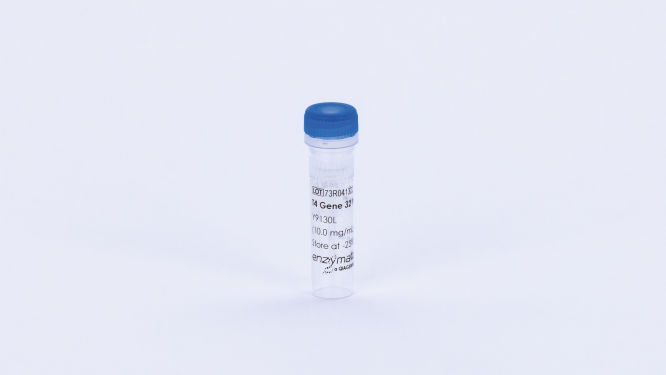
T4 Gene 32 Protein
Cat no. / ID. Y9130L
1.0 mg T4 Gene 32 Protein (0.1 mL at 10 mg/mL)
The T4 Gene 32 Protein is intended for molecular biology applications. This product is neither intended for the diagnosis, prevention or treatment of a disease, nor has it been validated for such use either alone or in combination with other products.
Want to try this solution for the first time?
Get in touch with our team today and request a quote to trial the T4 Gene 32 Protein.
Features
- Stabilizes and protects regions of single-stranded DNA
- Increases efficiency of PCR amplification and RT-PCR yields
- Enhances DNA sequencing in secondary-structure rich regions
- Stimulates T4 DNA Polymerase synthesis on primed ssDNA substrates (5–10X rate increase)
- Glycerol-free format available
Product Details
Native Gene 32 protein from bacteriophage T4 (T4gp32) is a single-stranded DNA binding protein that is required for T4 DNA replication, recombination and repair.
The action of T4 Gene 32 Protein stabilizes ssDNA and unwinds secondary structures. Addition of T4 Gene 32 Protein can enhance the performance of several DNA synthesis-related processes, especially in secondary-structure rich regions. PCR amplification is improved; efficiency of RT-PCR and cDNA synthesis is increased while DNA sequencing benefits from protection of ssDNA.
The T4 Gene 32 Protein stimulates by 5–10-fold the rate of synthesis of T4 DNA Polymerase on primed single-stranded DNA substrates.
QIAGEN T4 Gene 32 Protein is purified from a recombinant E. coli strain that overexpresses the gene 32 protein from bacteriophage T4 (T4gp32).
A glycerol-free (GF) formulation of T4 gene 32 Protein is available. Contact us for more information.
Supplied in:
20 mM Tris-HCl, 100 mM NaCl, 0.5 mM DTT, 1 mM EDTA, 50% glycerol; pH 8.0 at 25°C.
Storage temperature: -25°C to -15°C
Molecular weight: 33,506 Daltons
Performance
T4 Gene 32 Protein is tested for purity, DNA binding and the absence of contaminating endonuclease and exonucleases.
| Assay | Specification |
| Purity | >99% |
| DNA binding | Functional |
| Single-stranded exonuclease | 100 µg <1.0% released |
| Double-stranded exonuclease | 100 µg <1.0% released |
| Double-stranded endonuclease | 100 µg = No conversion |
| E. coli DNA contamination | 25 µg <10 copies |
Principle
T4 Gene 32 Protein is a single-stranded nucleic acid binding protein that has the function of stabilizing single-stranded regions of DNA. The ability of T4 Gene 32 Protein to enhance the performance of several DNA synthesis-related activities is based on its essential function in the replication of bacteriophage T4.
T4 Gene 32 Protein binds ssDNA cooperatively and transiently, stabilizing exposed regions for replication and amplification. This enhances DNA polymerase activity, prevents degradation by nucleases, and increases efficiency and fidelity in PCR, RT-PCR, cDNA synthesis and DNA sequencing reactions.
Procedure
Instructions for the use of T4 Gene 32 Protein can be found in the appropriate QIAGEN kit handbook or in product protocol documents.
Typical workflow for the use of T4 Gene 32 Protein:
- Add protein to PCR, RT-PCR or sequencing reaction as recommended.
- Incubate under standard reaction conditions.
- Heat inactivate (if required) at 65°C for 20 minutes.
As a starting point to identify the optimal concentration in PCR reactions, add T4 Gene 32 Protein at a concentration range between 20–320 ng/μL per 50 µL reaction.
In standard 50 µL Recombinase Polymerase Amplification (RPA) reactions, the optimal working concentration of T4 Gene 32 Protein typically ranges from 0.2–0.6 µg/µL in the final mixture.
Quality Control
DNA binding of single stranded DNA by T4 Gene 32 Protein was measured using a gel shift assay with a single-stranded, fluorescently labeled oligonucleotide. Serial dilutions of the enzyme were made in 1X T4 GP32 reaction buffer (50 mM potassium acetate, 20 mM Tris-acetate, 10 mM magnesium acetate, 1 mM DTT; pH 7.9) and added to 10 μL reactions containing a 5’-FAM–labeled oligonucleotide substrate, and 1X T4 GP32 Reaction Buffer. Reactions were incubated for 20 minutes at 37°C, plunged on ice, and run out on a 15% TBE-Urea gel. DNA binding ability was observed as a band shift in the apparent molecular weight of the oligonucleotide on the TBE-Urea gel.
Protein concentration (OD280) of T4 Gene 32 Protein was determined by OD280 absorbance.
Physical Purity of the product was evaluated by SDS-PAGE of concentrated and diluted enzyme solutions followed by silver stain detection. Purity was assessed by comparing the aggregate mass of contaminant bands in the concentrated sample to the mass of the protein of interest band in the diluted sample.
Single-stranded exonuclease activity was determined in a 50 μL reaction containing a radiolabeled single-stranded DNA substrate and 10 μL of solution incubated for 4 hours at 37°C.
Double-stranded exonuclease activity was determined in a 50 μL reaction containing a radiolabeled double-stranded DNA substrate and 10 μL of protein solution incubated for 4 hours at 37°C.
Double-stranded endonuclease activity was determined in a 50 μL reaction containing 0.5 μg of plasmid DNA and 10 μL of protein solution incubated for 4 hours at 37°C.
E. coli contamination was evaluated using 5 μL replicate samples of protein solution denatured and screened in a TaqMan qPCR assay for the presence of contaminating E. coli genomic DNA using oligonucleotide primers corresponding to the 16S rRNA locus.
Applications
T4 gene 32 Protein binds to ssDNA template sequences then conforms these ssDNA sequences for optimal interaction with DNA polymerases and other replication proteins.
Application benefits
- Increases yield and processivity of Taq DNA polymerase, reverse transcriptase and telomerase (in vitro)
- Enhances DNA synthesis by DNA polymerases
- Reduces inhibitory effects in PCR from complex samples (e.g., secondary-structure rich templates, soil contamination)
- Facilitates Recombinase Polymerase Amplification (RPA)
- Enhances site-specific mutagenesis through action on T4 DNA Polymerase
- Eliminates extra bands during sequencing by reducing secondary structure artifacts
- Marks ssDNA for electron microscopy
Resources
Brochures & Guides (1)
Software-related downloads (1)
Safety Data Sheets (1)
Certificates of Analysis (1)