
✓ 24/7 automatic processing of online orders
✓ Knowledgeable and professional Product & Technical Support
✓ Fast and reliable (re)-ordering
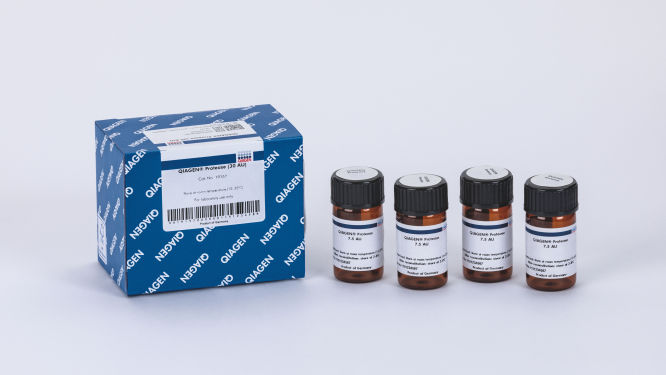
QIAGEN Protease (30 AU)
Cat no. / ID. 19157
4 x 7.5 Anson units per vial (lyophilized)
Log in To see your account pricing.
Enzyme
QIAGEN Protease
QIAGEN Protease Solvent
Quantity
30 AU
7.5 AU
✓ 24/7 automatic processing of online orders
✓ Knowledgeable and professional Product & Technical Support
✓ Fast and reliable (re)-ordering
Features
- For protease digestion in DNA and RNA isolation procedures
- Fully compatible with selected QIAGEN protocols
- High specific activity in Tris-containing buffers of alkaline pH (7.5–10.5)
- Increased activity in the presence of urea and guanidine HCl
- Able to degrade a wide variety of proteins
Product Details
Protease is a broad-specificity serine protease with high activity, cleaving preferentially at neutral and acidic residues. The enzyme is isolated from a recombinant Bacillus strain and offers broad substrate specificity in buffers commonly used in most DNA and RNA extraction procedures.
The protease is an economical alternative endopeptidase for isolation of native DNA and RNA from a variety of biological samples. QIAGEN Protease is dedicated for use in various QIAGEN kits (see list in the Principle section below).
For large-scale and sensitive applications, e.g., next-generation sequencing or diagnostics, we recommend high-purity Proteinase K as the preferred enzyme for proteolysis.
Performance
QIAGEN Protease is particularly stable and active at high pH with a high specific activity in Tris-containing buffers of alkaline pH (7.5–10.5). Bacillus proteases also show increased activity in the presence of strong denaturants like urea and guanidine HCl. Similar stimulation is obtained upon the addition of up to 1% SDS. Enzymatic activity also increases as a function of temperature (30–55°C). (See Figure “Relative activity of QIAGEN Protease”.)
The enzyme is not inhibited by up to 100 mM EDTA in Tris-Cl buffers. However, in the presence of greater than 1% SDS or other strong denaturants, the EDTA concentration must be less than 8 mM. The enzyme is easily inactivated by incubation at 70°C for 15 minutes.
For more information, refer to the QIAGEN Protease Product Sheet in the Resources section.
Principle
Bacillus proteases function in nature as extracellular alkaline hydrolases that efficiently degrade proteins by breaking peptide bonds, acting as endopeptidases. These enzymes are valued for molecular biology applications due to their broad substrate specificity and ability to operate in high pH environments (alkaline, often pH 8.0–12.0). Bacillus proteases maintain stability under harsh conditions, including high temperatures and in the presence of detergents and surfactants.
QIAGEN Protease from Bacillus is classified as serine-type protease, containing a catalytic triad (Ser-His-Asp) in its active site. Proteases from Bacillus work by catalyzing the cleavage of peptide bonds via a two-step mechanism:
- Acylation: The enzyme forms a covalent intermediate with the substrate.
- Deacylation: The intermediate is hydrolyzed by water, releasing the cleaved protein chain and regenerating the enzyme.
QIAGEN Protease is is completely free of DNase and RNase activities and is an economical alternative for proteolysis during isolation of native DNA and RNA from a variety of sources. The enzyme is supplied in the following QIAGEN kits:
- QIAamp DNA Blood Mini, Midi and Maxi Kits
- QIAamp 96 DNA Blood Kit
- Blood & Cell Culture DNA Kits
- QIAamp Virus BioRobot 9604 Kit
- QIAamp DNA Blood BioRobot MDx Kit
- QIAamp DSP Virus Kit
- QIAamp DSP DNA Blood Mini Kit
Note: Users of manual QIAamp DNA Blood Kits and QIAGEN Blood & Cell Culture DNA Kits should resuspend each bottle of QIAGEN Protease with 7 mL distilled water.
Note: Users of the QIAamp DNA Blood BioRobot 9604 Kit should resuspend each bottle of QIAGEN Protease with 10 mL distilled water.
Note: QIAGEN Protease is not compatible with Buffer ATL in the DNeasy Tissue, DNeasy 96 Tissue and QIAamp DNA Mini Kit. In the presence of >0.5% SDS, >1% sarkosyl or high concentrations of other detergents, the EDTA concentration must be <8 mM for full activity over extended incubation times.
Procedure
Instructions for using QIAGEN Protease are provided in corresponding kit handbooks and in the QIAGEN Protease Product Sheet in the Resources section.
Applications
Applications include:
- Removing protein contaminants in DNA and RNA isolation procedures.
- Cell lysis and tissue digestion in combination with SDS and detergents to isolate genomic DNA and cytoplasmic RNA from tissues and cultured cells.
- Degrading proteins (e.g., histones) that bind to DNA in blood to improve DNA yield and purity.
Resources
Safety Data Sheets (1)
Certificates of Analysis (1)
Important Note (1)
FAQ
How can QIAGEN Protease and Proteinase K be inactivated?
3192 - Is QIAGEN Protease compatible with Buffer ATL?
What is the difference between QIAGEN Protease and QIAGEN Proteinase K provided in various QIAamp Kits?