
Want to try this solution for the first time?
Get in touch with our team today and request a quote to trial the dsDNase (5000 U).
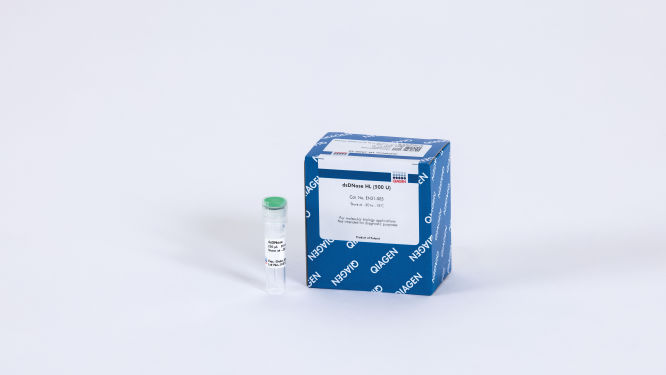
dsDNase (5000 U)
Cat no. / ID. EN33-050
Concentration: ≥20 U/µL.
Shelf life: 36 months.
Storage temperature: -20°C without a defrost cycle.
Log in To see your account pricing.
Quantity
5000 U
25,000 U
The dsDNase is intended for molecular biology applications. This product is neither intended for the diagnosis, prevention or treatment of a disease, nor has it been validated for such use either alone or in combination with other products.
Want to try this solution for the first time?
Get in touch with our team today and request a quote to trial the dsDNase (5000 U).
Features
- Active in a broad temperature range (10–80°C) and broad pH range (optimum at pH 6.0–9.0)
- Highly active at elevated salt concentrations and other typical buffer additives
- Requires bivalent cations (Mg2+ and Ca2+) for maximum activity
- Degrades dsDNA to fragments below 10 nt
- Activity towards dsDNA is at least 1000 times higher than towards ssDNA
Product Details
dsDNase is a 42.8 kDa recombinant endonuclease derived from marine amphipods expressed in Pichia pastoris. The enzyme displays high specific activity towards double-stranded DNA, leaving single-stranded DNA or RNA undamaged in standard conditions. dsDNase is highly active in a broad spectrum of temperatures, buffer conditions and pH.
These features make dsDNase extremely useful for rapid and RNA-safe degradation of genomic DNA, where the absence of ribonucleases is critical to maintaining the integrity of RNA.
The enzyme hydrolyzes phosphodiester linkages yielding oligonucleotides with a 5′-phosphate and 3′-hydroxyl groups.
It is supplied with 20 mM Tris-HCl, pH 8.0; 50 mM KCl; 5 mM MgCl2 ; 50% (v/v) glycerol.
One unit is defined as the amount of enzyme that causes an increase in absorbance at 260 nm of 1.0 in 30 minutes at 37°C and pH 8.0 with herring sperm DNA as a substrate.
Performance
| Assay | Specification |
| Protein Purity | >95% |
| RNase activity | None detected |
| Protease activity | None detected |
Principle
The specific activity is similar to bovine DNase I; however, dsDNase is characterized by higher stability in demanding reaction and storage conditions (e.g., high salt and detergent-containing buffers and elevated temperature).
The optimal concentration of dsDNase in the final reaction mixture depends on several factors (level of nucleic acids contamination, temperature and time of incubation, salt concentration and other compounds present in the reaction mixture). The amount of dsDNase and incubation conditions have to be determined experimentally (we recommend using 35 U dsDNase for digestion of up to 50 µg dsDNA at 37°C for 10–15 minutes).
In the presence of Mg2+ or Ca2+ ions, dsDNase shows high endonuclease activity towards dsDNA, leaving ssDNA and RNA intact. The presence of Ca2+ ions increases the total activity of dsDNase. In the presence of Mn2+ ions, the enzyme shows slightly elevated dsDNase activity, including activity towards ssDNA and RNA. Avoid using Mn2+ ions during the purification of RNA or ssDNA.
The inactivation of dsDNase depends on the concentration of the reducing agent, inactivation time and temperature. We recommend inactivating dsDNase by incubation at 85°C for 15 minutes in the presence of reducing agents such as DTT or TCEP (1–10 mM). The enzyme requires 1–10 mM DTT or TCEP to be completely inactivated. Alternatively, dsDNase can be inactivated and removed using a spin column or phenol/chloroform extraction.
Procedure
Quality Control
Protein concentration was determined by SDS-PAGE electrophoresis using Coomassie Blue detection assay.
The presence of RNase activity was determined by gel electrophoresis following incubation of 1 µg of total eukaryotic RNA with 10 U of enzyme in a 20 µL volume for 1 hour at 37°C.
The presence of protease activity was determined by SDS-PAGE with Coomassie Blue detection following incubation of 1 µg of BSA with 100 U of enzyme for 20 hours at 37°C.
A 1.575 mL reaction volume containing herring sperm DNA as a substrate is incubated for 30 minutes at pH 8 at 37°C with an enzyme that degrades DNA to acid-soluble oligonucleotides. One unit of the enzyme causes an increase in absorbance at A260 of 1.0.
Applications
This is used for applications such as:
- Extraction and purification of RNA
- Removal of contaminating genomic DNA from RNA samples
- Degradation of DNA template in transcription reactions
- Reduction of viscosity in biological samples
- Removal of residual DNA during primary stem cell isolation, biopharma and bioprocessing procedures
Resources
Brochures & Guides (1)
Kit Handbooks & Protocols (1)
Safety Data Sheets (1)
Certificates of Analysis (1)