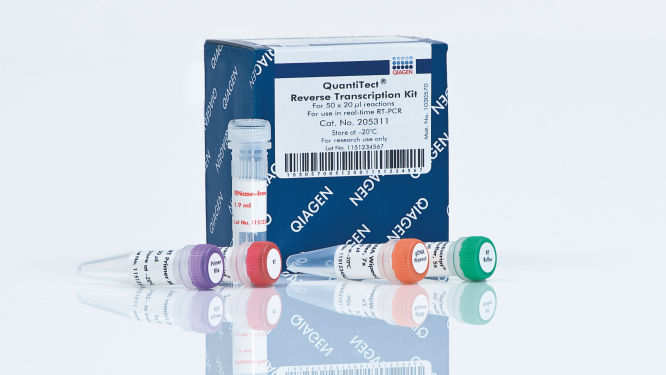
QuantiTect Reverse Transcription Kit

遺伝子発現解析のための高感度な2ステップリアルタイムRT-PCR用cDNAの迅速合成

S_1233_GEF_PCR0053
商業用のバルク製品、カスタマイズ製品、最適化された製品が必要ですか? QIAGENでは、ロジスティクスやコンプライアンスなどのサポートも行っています。QIAGEN Strategic Partnerships & OEMにお問い合わせください。

QuantiTect Rev. Transcription Kit (50)

カタログ番号 / ID.   205311

For 50 x 20 µl reactions: 100 µl 7x gDNA Wipeout Buffer, 50 µl Quantiscript Reverse Transcriptase, 200 µl 5x Quantiscript RT Buffer, 50 µl RT Primer Mix, 1.9 ml RNase-Free Water
反応
50
200
400
QuantiTect Reverse Transcription Kitは分子生物学的アプリケーション用であり、疾病の診断、予防、あるいは治療に使用することはできません。
商業用のバルク製品、カスタマイズ製品、最適化された製品が必要ですか? QIAGENでは、ロジスティクスやコンプライアンスなどのサポートも行っています。QIAGEN Strategic Partnerships & OEMにお問い合わせください。

特徴

  • わずか20分でcDNA合成およびgDNA除去を完了
  • 低発現量の転写物からでも高収量でcDNAを合成
  • 転写物の5'および3'領域からでもcDNAを合成
  • RNA特異的なプライマーやプローブのデザインは不要

製品詳細

QuantiTect Reverse Transcription KitはゲノムDNA除去を組み込んだcDNA合成を迅速かつ簡便な方法で実現します。RNAサンプル中のゲノムDNAコンタミはgDNA Wipeout Bufferで効率的に除去されます。Quantiscript Reverse Transcriptase、Quantiscript RT Buffer、画期的なRT Primer Mixにより、迅速かつ効率的な逆転写反応に必要な全ての成分が提供されます。合成されたcDNAはリアルタイムPCRでの使用に至適化され、mRNA転写物のどの領域の標的も確実に定量できます。

パフォーマンス

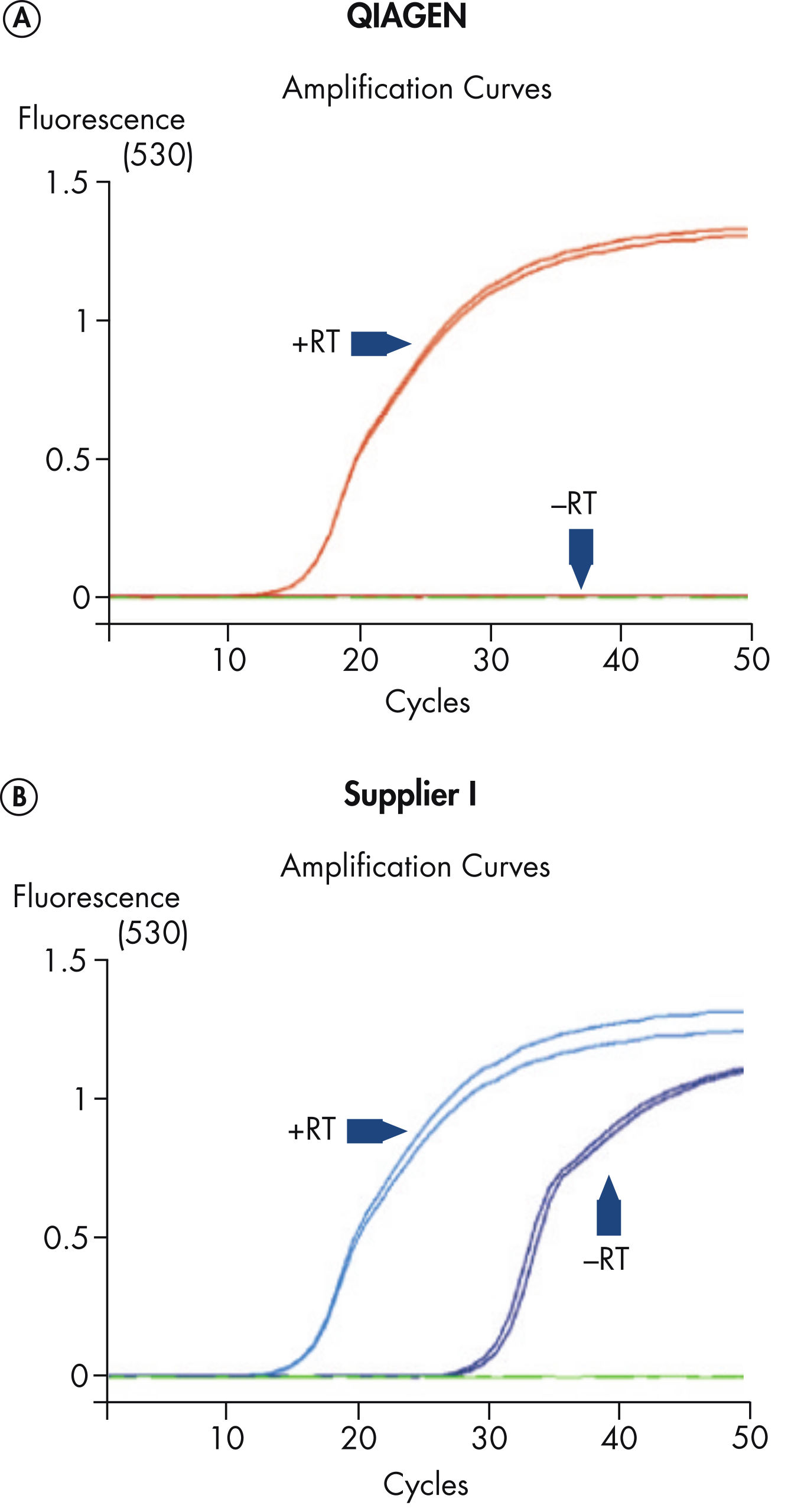
QuantiTect Reverse Transcription Kitを用いることにより、RNAサンプル中に混入しているゲノムDNAはユニークなgDNA Wipeout Bufferで効率的かつ迅速に除去されます(図" 効果的なゲノムDNA除去による正確なリアルタイムRT-PCR")。ゲノムDNAの排除は正確な遺伝子発現結果を得るために極めて重要であり、RNA特異的プライマーまたはプローブのデザインは必ずしも可能とは限りません。gDNA Wipeout Bufferを用いると、RNAサンプルの精製中あるいは精製後に別途にDNase分解を行なう必要がないため、時間および経費を節約できます。 

Quantiscript RT Bufferと組み合わせて用いることにより、Quantiscript Reverse Transcriptaseの高いRNAアフィニティーはどのようなRNAテンプレートからも高い収量でcDNAを合成できます(表"より少量の転写物からより高いcDNA収量")。GC含有率が高いあるいは複雑な二次構造を持つ逆転写が困難なテンプレートでさえも問題なく逆転写できます。

より少量の転写物からより高いcDNA収量
IL12AのCT
(低発現量)
IL1RNのCT
(高発現量)
スタートRNA(ng) QIAGEN Supplier AII QIAGEN Supplier AII
1000 30.9 32.0 23.1 24.9
100 34.2 35.4 26.3 26.6
10 37.8 46.8 29.7 30.3
1 非検出 非検出 32.4 34.5
種々のスタートRNA量を用いたIL12AとIL1RNの2ステップリアルタイムRT-PCR解析。トータルRNAからQuantiTect Reverse Transcription Kit あるいはSupplier AIIのキットを用いて逆転写反応を行なった。合成したcDNAをQuantiTect Probe PCR KitとIL12AあるいはIL1RN用QuantiTect Gene Expression Assayを用いてABI PRISM 7900上で解析した。QIAGENキットでのより低いCT値は(特に発現量が中等度のIL12A遺伝子、太字)、より高いcDNA収量を示唆している。N.D.:検出されなかった。

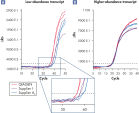
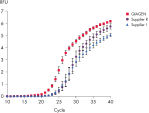
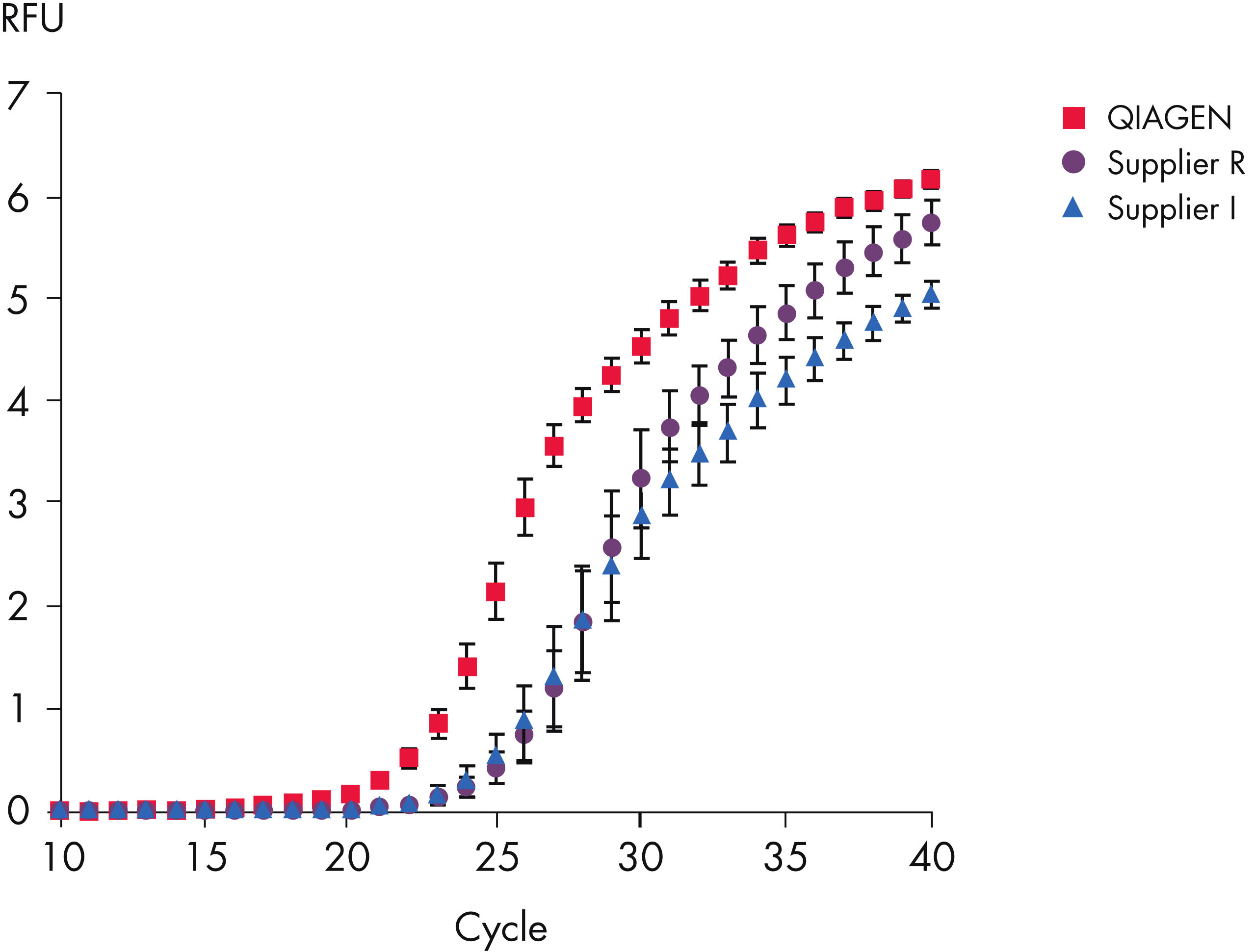
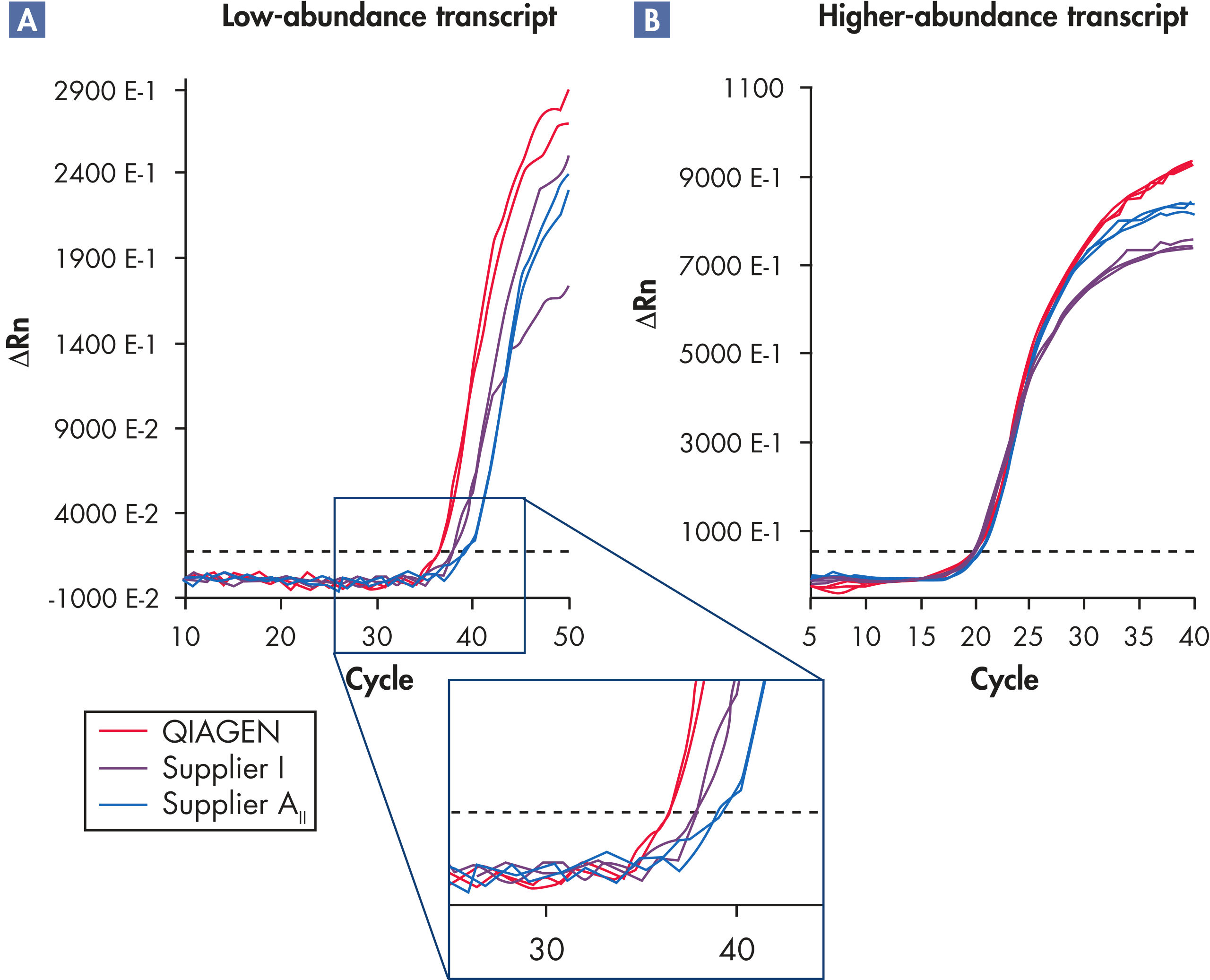
RT Primer Mixには全てのRNA転写物の5'領域も含むあらゆる領域からcDNA合成を実現する特別に至適化されたoligo-dTオリゴ-dTとランダムプライマーのミックスが含まれています(図" 12.5 kbの転写物の5'領域における標的を高感度で検出")。他社のキットと比較して、QuantiTect Reverse Transcription Kitは増幅する標的領域が転写物のどこに局在しているかに関係なく、リアルタイムPCR解析用のcDNAテンプレートを高い収量で合成し、発現量が少ない遺伝子の検出感度を上昇させます(図" より高い感度の2ステップリアルタイムRT-PCR")。また、QuantiTect Reverse Transcription Kitは、再現性のより高いリアルタイムRT-PCRを実現します。

原理

QuantiTect Reverse TranscriptaseはOmniscriptとSensiscript Reverse Transcriptaseのブレンドで、RNAに対して高いアフィニティーを有し、幅広いRNA量(10 pg~1 µg)からcDNA合成が可能です。他社のキットと比較して、QuantiTect Reverse Transcription Kitは増幅する標的領域が転写物のどこに局在しているかに関係なく、リアルタイムPCR解析用のcDNAテンプレートを高い収量で合成します。GC含有率が高いあるいは複雑な二次構造を持つ逆転写が困難なテンプレートでさえも問題なく逆転写できます。また、QuantiTect RT BufferはリアルタイムPCRバッファーと互換性があるようにも至適化されています。

リアルタイムRT-PCRによる遺伝子発現アッセイで正確な結果を得るためには、cDNAのみを増幅し検出することが重要です。ゲノムDNAによるアッセイへの悪影響はエクソン/エクソン境界にまたがるプライマーやプローブをデザインすることにより避けることができます。しかし、この方法が不可能な場合もあり(例えばシングルエクソン遺伝子からのcDNA)、スタートとなるRNAサンプルがゲノムDNAを含まないことが必須です。QuantiTect Reverse Transcription Kitを用いることにより、RNAサンプル中に混入しているゲノムDNAはユニークなgDNA Wipeout Bufferで効率的かつ迅速に除去されます。RNAサンプルの精製中あるいは精製後に別途にDNase分解を行なう必要がないため、時間および経費を節約できます。RNA特異的なプライマーやプローブのデザインも不要です。 

QuantiTect Reverse Transcriptase Kitの構成
構成利点
gDNA Wipeout BufferリアルタイムRT-PCRのみでRNAを検出
Quantiscript Reverse Transcriptase幅広いRNA量(10 pg~1 µg RNA)の使用
高感度
Quantiscript RT Buffer増幅困難なテンプレートの読み取り
RT Primer Mix転写物の全ての領域、5'領域からもcDNAを合成

操作手順

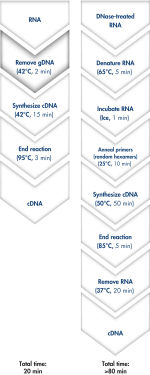
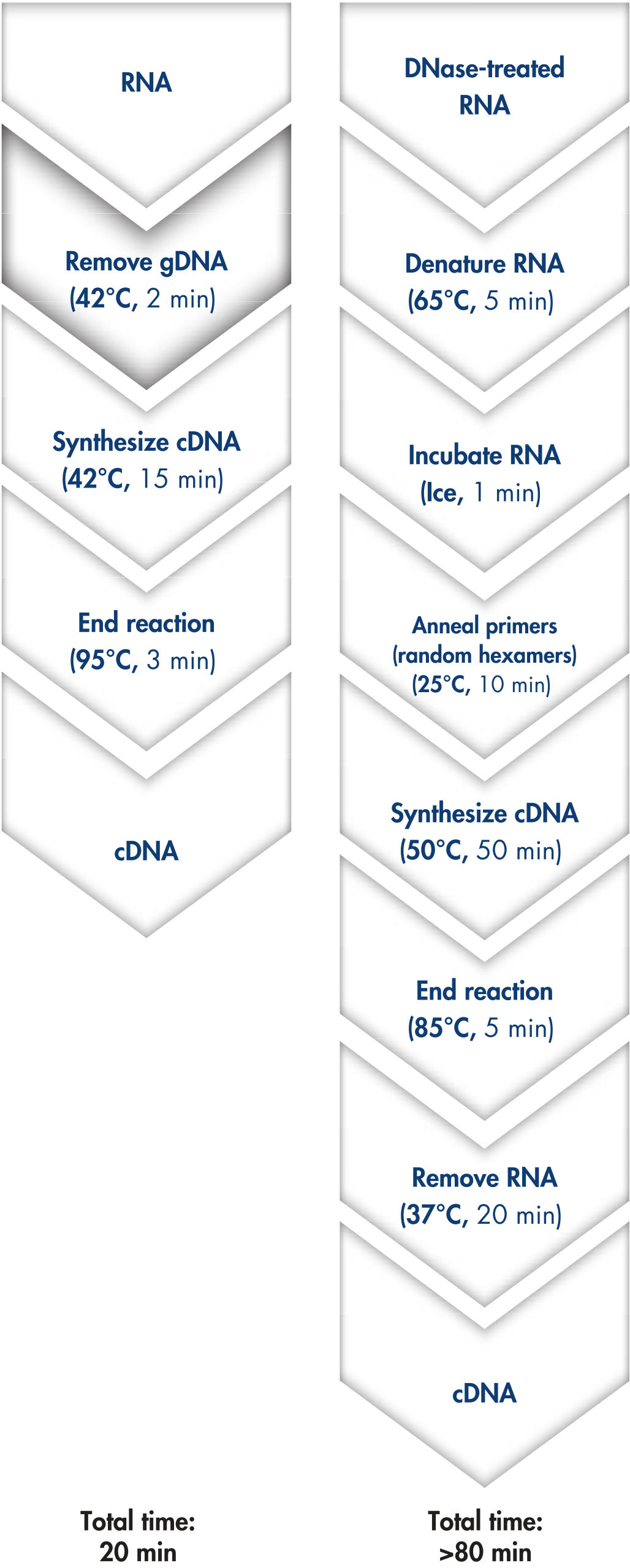
QuantiTect Reverse Transcription Kitを用いれば、ゲノムDNA除去とcDNA合成はわずか20分で完了します(フローチャート" 迅速で簡便なcDNA合成")。両反応とも同一のインキュベーション温度で行なうことができ、マスターミックスによるセットアップができるため、操作は迅速かつ簡便です。

QuantiTect Reverse Transcription Kitには、迅速なcDNA合成に必要なものが全て含まれています。精製したRNAはgDNA Wipeout Bufferで短時間インキュベートし、混入したゲノムDNAを効率的に除去します。他の方法と比較し、逆転写反応において、Quantiscript Reverse Transcriptase、Quantiscript RT Buffer、RT Primer Mixで調製したマスターミックスを用い、RNAサンプルを直接使用します。Quantiscript Reverse Transcriptaseを用いると、複雑な2°構造でもRNAは低温で転写され、RNAは分解されません。反応全体は42℃で起こり、95℃で不活化されます。RNA変性、プライマーアニーリング、RNase H分解の追加ステップは必要ありません。

アプリケーション

QuantiTect Reverse Transcription Kitはレーザーマイクロダイセクションサンプルや組織生検を含む全ての種類のスタートサンプルから感度および効率の良いリアルタイムRT-PCRを実現します。

裏付けデータと数値

仕様

特徴仕様
ApplicationsQuantification of (even low-abundance) transcripts
Sample/target typeRNA template
Enzyme activityReverse transcription
Real-time or endpointReal time
Reaction typeTwo-step, cDNA production, genomic DNA digestion
Single or multiplexSingle
MastermixNo

リソース

安全データシート (1)
Download Safety Data Sheets for QIAGEN product components.
クイックスタートプロトコール (1)
パンフレットとガイド (1)
RNA Universe brochure
PDF (927KB)
キットハンドブック (1)
For cDNA synthesis with integrated removal of genomic DNA contamination For use in real-time two-step RT-PCR
Safety Data Sheets (1)
Certificates of Analysis (1)

よくある質問

Is it possible to scale up QuantiTect Reverse Transcription reactions to allow use of larger amounts of RNA?
Yes, reactions using the QuantiTect Reverse Transcription Kit can be scaled up. Please scale up all reaction components proportionally.
FAQ-1063
Can the Reverse Transcriptases of the QuantiTect Reverse Transcription Kit and the QuantiTect Probe RT-PCR Kit be used interchangeably?

No, please do not exchange Quantiscript Reverse Transcriptase of the QuantiTect Reverse Transcription Kit with QuantiTect RT Mix of the QuantiTect Probe RT-PCR Kit.

Although both are an optimized mixture of Omniscript and Sensiscript Reverse Transcriptases, the mixture provided in the QuantiTect Reverse Transription Kit is optimized for random priming in a two-step reaction, whereas the mixture in the QuantiTect Probe RT-PCR Kit is optimized for gene-specific priming in a one-step RT-PCR reaction.


FAQ-1066
What are the recommended storage conditions for the QuantiTect Reverse Transcription Kit and its components?

The QuantiTect Reverse Transription Kit should be stored at -20°C immediately upon receipt. We recommend to aliquot the RT Primer Mix and keep it at -20°C.

If the kit is being used routinely, it may be convenient to prepare a premix of RT Primer Mix and 5x Quantiscript RT Buffer at a ratio of 1:4. Aliquot the premix and store at -20°C.

FAQ-1077
Is mRNA isolation necessary for sensitive RT-PCR?
Usually not. Since RT-PCR is extremely sensitive, as little as 10–200 ng total RNA is sufficient for each 25–50 µl reaction mix, depending on the RT system. For abundant mRNA species, it is possible to use even less than 10 ng total RNA. For rare mRNA species, use a sequence-specific primer in the RT reaction to increase sensitivity. RNA content in various cells and tissues can be found here.
FAQ-111
Do QuantiTect Primer Assays contain SYBR Green dye?

No, QuantiTect Primer Assays are supplied as lyophilized, premixed primer pairs. Reaction components for SYBR Green real-time RT-PCR must be purchased separately.

To find a QuantiTect Primer Assay for your target gene of interest, please visit our GeneGlobe data base.

FAQ-1143
Can T-Script® enzyme of the QuantiTect Whole Transcriptome Kit be substituted by Quantiscript Reverse Transcriptase?

No, the T-Script® enzyme of the QuantiTect Whole Transcriptome Kit is an optimized blend for whole transcriptome amplification and cannot be substituted by Quantiscript Reverse Transcriptase of the QuantiTect Reverse Transcription Kit, or any other reverse-transcription enzyme.


FAQ-1617
What is the recommended solution in which to store RNA samples that will be used as templates for cDNA synthesis?
For best results, all RNA samples should be suspended in RNase-free water. Alternatively, RNase-free 1 mM sodium citrate (pH 6.5) or 10 mM Tris buffer (pH 7.0) may be used. Do not use DEPC-treated water, as most DEPC preparations are contaminated with molecules that are inhibitory to reverse transcription and/or PCR. For long-term storage, RNA preps may be stored at -70 ºC in RNase-free water, or the buffers listed above, or precipitated in ethanol or isopropanol. In order to avoid repeated freeze-thaw cycles, it is recommended that frozen RNA samples be stored as multiple, single-use aliquots.
FAQ-2659
What is the threshold cycle or Ct value?
The Ct or threshold cycle value is the cycle number at which the fluorescence generated within a reaction crosses the fluorescence threshold, a fluorescent signal significantly above the background fluorescence. At the threshold cycle, a detectable amount of amplicon product has been generated during the early exponential phase of the reaction. The threshold cycle is inversely proportional to the original relative expression level of the gene of interest.
FAQ-2682
Why should DNA or cDNA targets be less than 250 bp long for real-time PCR?

Shorter amplification products facilitate high PCR efficiencies. Ideally, amplicon length should be less than 150 bp for optimal amplification efficiency. PCR efficiencies close to 100% are a crucial prerequisite for accurate quantification of target copy numbers in real-time PCR.

FAQ-751
How do the FastLane Cell cDNA Kit and QuantiTect Reverse Transcription Kit eliminate genomic DNA contamination?
The FastLane Cell cDNA Kit and QuantiTect Reverse Transcription Kit contain a unique buffer, called gDNA Wipeout Buffer, which ensures complete removal of gDNA after a brief incubation step.
FAQ-783
Is it possible to use the QuantiTect Reverse Transcription Kit with bacterial RNA?

Yes, it is possible to use the QuantiTect Reverse Transcription Kit for bacteria. The RT Primer Mix provided in the kit is a unique, optimized blend of random primers and oligo-dT allowing high cDNA yields from all regions of RNA transcripts. It has successfully been tested for Reverse Transcription in bacteria as well. We strongly recommend to isolate bacterial RNA using the RNeasy Mini Kit prior to performing Reverse Transcription. This will ensure the high prep quality necessary for optimal RT results with the QuantiTect Reverse Transcription Kit.

FAQ-785
Can I use my gene-specific primers with the FastLane Cell cDNA Kit and the QuantiTect Reverse Transcription Kit?

Yes, you can substitute the RT Primer Mix supplied in the FastLane Cell cDNA Kit and the QuantiTect Reverse Transcription Kit with your gene-specific primers. We suggest optimizinig the primer concentration by titration, starting at 1 uM, and gradually decreasing it to 0.5 uM final concentration in the reaction. Optimal amounts will depend on the specific primers you are using.

FAQ-812