Blood & Cell Culture DNA Mini Kit

血液および培養細胞から最大20 µg、100 µg、または500 µgの高分子量DNAを分離する

S_1084_5_GEN_V2

✓ オンライン注文による24時間年中無休の自動処理システム

✓ 知識豊富で専門的な製品&テクニカルサポート

✓ 迅速で信頼性の高い(再)注文

Blood & Cell Culture DNA Mini Kit(25)

カタログ番号 / ID.   13323

QIAGEN Genomic-tip 20/G、QIAGEN Protease、バッファー25回分
キットバッファー
Blood & Cell Culture DNA Kit
Genomic DNA Buffer Set
カラムタイプ
20/G
100/G
500/G
Blood & Cell Culture DNA Mini Kitは分子生物学的アプリケーション用であり、疾病の診断、予防、あるいは治療に使用することはできません。

✓ オンライン注文による24時間年中無休の自動処理システム

✓ 知識豊富で専門的な製品&テクニカルサポート

✓ 迅速で信頼性の高い(再)注文

特徴

  • 最大150 kbの長さの高分子量DNAを確実に分離
  • フェノール抽出およびクロロホルム抽出は不要
  • 利便性に優れ、複数のサンプルの並行処理が可能

製品詳細

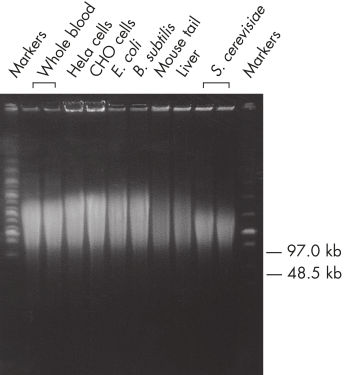
Blood & Cell Culture DNA Kitには、さまざまな生物学的サンプルから効率的にゲノムDNAを分離するための重力流動、陰イオン交換チップ、バッファーが付属しています。精製されたDNAは最大150 kb、平均50~100 kbの長さとなります。

酵母および細菌のサンプルの場合は、Genomic DNA Buffer Set(カタログ番号19060)の購入が必要です。

パフォーマンス

QIAGEN Genomic-tipのプロセスは非常に穏やかで、DNAの剪断はほとんど発生せず、無視できる程度です。QIAGEN Genomic-tipで精製されたDNAは最大150 kb、平均で50~100 kbの長さとなります(図「最大150 kbのゲノムDNA」を参照)。このDNAにはRNA、タンパク質、代謝産物の汚染がなく、A260 / A280の割合は1.7~1.9の範囲になります。

回収されたDNAの中でも特に大きなサイズのものは、さまざまなプラットフォームを使用した次世代シークエンシング(NGS)用の高品質なライブラリーの調製に非常に適しており、複数のコア施設で推奨されています。

原理

Blood & Cell Culture DNA Kitに付属するQIAGEN Genomic-tipは、フェノールやクロロホルムを使用せず、独自のQIAGEN陰イオン交換技術により、さまざまな生物学的サンプルから高分子量DNAを精製できます。溶解緩衝液は異なるサンプルタイプに最適化されており、ヌクレアーゼ、ヒストン、DNA結合タンパク質をはじめ、潜在的に感染性のあるウイルス粒子を即座に変性させます。バッファーによって調整されたpHと低塩環境下で、DNAはカラム内のQIAGENレジンに結合します。同時に、タンパク質、炭水化物、代謝産物などの他の細胞成分は流れ出し、精製されたDNAは高塩バッファーで溶出されます。Genomic-tipは重力流で動作し、乾燥せずに放置することができるため、実際の操作時間を最小限に抑え、複数のサンプルを同時に処理するのに理想的です。

操作手順

サンプルはまず溶解され(組織サンプルであれば機械的に破砕)、同時にすべてのタンパク質は適切な溶解緩衝液で変性されます(フローチャート「QIAGEN Genomic-tipのプロセス」を参照)。次にQIAGEN ProteaseまたはプロテイナーゼKが添加され、適切なインキュベーション時間が経過したら溶解物はQIAGEN Genomic-tipにロードされます。DNAはカラムに結合しますが、他の細胞成分は通過します。残った汚染物質を洗い流す工程後、高純度の高分子量DNAが溶出し、イソプロパノールを加えると沈殿します。全プロセスで実際操作にかかる時間は、血液および培養細胞であればわずか30分です。

Blood & Cell Culture DNA Kitは、血液や培養細胞から高分子量DNAを精製するために必要なすべての成分が揃った、すぐに使用できるキットです。

アプリケーション

Blood & Cell Culture DNA Kitで精製されたDNAは、次のアプリケーションで使用するのに最適です。

  • サンガーと次世代シークエンシング
  • ロングリードシークエンシング
  • RFLP解析
  • 遺伝子ターゲティング解析
  • 遺伝子組み換え動物のスクリーニング
  • DNAフィンガープリント研究
  • PCRの増幅

特徴 Blood & Cell Culture DNA Mini Kit Blood & Cell Culture DNA Midi Kit Blood & Cell Culture DNA Maxi Kit
アプリケーション PCR、RFLP、ブロッティング、スクリーニング PCR、RFLP、ブロッティング、スクリーニング PCR、RFLP、ブロッティング、スクリーニング
溶出量 0.1~2 ml 0.1~2 ml 0.1~2 ml
フォーマット Genomic-tip Genomic-tip Genomic-tip
主なサンプルタイプ 血液、細胞 血液、細胞 血液、細胞
処理 手動 手動 手動
トータルRNA、miRNA、poly A+ mRNA、DNA、タンパク質の精製 DNA DNA DNA
サンプル量 1 ml/5 x 106 5 ml/2 x 107 20 ml/1 x 108
技術 陰イオン交換テクノロジー 陰イオン交換テクノロジー 陰イオン交換テクノロジー
収量 15~20 µg 80~100 µg 350~400 µg

裏付けデータと数値

リソース

クイックスタートプロトコール (1)
安全データシート (2)
Download Safety Data Sheets for QIAGEN product components.
キットハンドブック (1)
Safety Data Sheets (1)
Certificates of Analysis (1)

出版物

Lack of telomerase RNA gene hTERC expression in alternative lengthening of telomeres cells is associated with methylation of the hTERC promoter.
Hoare SF; Bryce LA; Wisman GB; Burns S; Going JJ; van der Zee AG; Keith WN;
Cancer Res; 2001; 61 (1):27-32 2001 Jan 1 PMID:11196173
GATA-3 is an important transcription factor for regulating human NKG2A gene expression.
Marusina AI; Kim DK; Lieto LD; Borrego F; Coligan JE;
J Immunol; 2005; 174 (4):2152-9 2005 Feb 15 PMID:15699146

よくある質問

How do I safely inactivate biohazardous flow-through material?

Always dispose of potentially biohazardous solutions according to your institution’s waste-disposal guidelines. Although the lysis and binding buffers in QIAamp, DNeasy, and RNeasy kits contain chaotropic agents that can inactivate some biohazardous material, local regulations dictate the proper way to dispose of biohazards. DO NOT add bleach or acidic solutions directly to the sample-preparation waste. Guanidine hydrochloride in the sample-preparation waste can form highly reactive compounds when combined with bleach.
Please access our Material Safety Data Sheets (MSDS) online for detailed information on the reagents for each respective kit.

FAQ-12
Does the Epitect Bisulfite Kit also work on DNA extracted from plants?

Bisulfite conversion of unmethylated cytosines into uracils with the EpiTect Bisulfite Kit works on DNA irrespective of the source organism. The DNA template needs to be of high purity for efficient conversion. We recommend to use genomic DNA extracted with our DNA isolation kits for clinical or animal and plant samples as a template for the EpiTect Bisulfite Kit.

FAQ-1209
What is the size of genomic DNA that is obtained with QIAGEN Genomic-tips?
Genomic DNA purified using QIAGEN Genomic-tips ranges in size from 20–150 kb, with an average length of 50–100 kb. Vortexing the lysate for about 20 seconds may reduce the size of the genomic DNA slightly to 20–130 kb, but can help to improve flow rates.
FAQ-142
Do you have a protocol for the purification of DNA from fruit flies?

Using Gentra Puregene Cell kit:


• Purification of archive-quality DNA from up to 30 Drosophila melanogaster using the Gentra Puregene Cell Kit (PG20)

• Purification of archive-quality DNA from 100 Drosophila melanogaster using the Gentra Puregene Cell Kit (PG21)

• Purification of archive-quality DNA from 300–700 Drosophila melanogaster using the Gentra Puregene Cell Kit (PG22)


Using the QIAGEN Genomic tips:

• Isolation of genomic DNA from flies using the QIAGEN Genomic-tip 100/G (QG05)

FAQ-1970
What is the composition of Buffer G2?

Buffer G2 is a component of QIAGEN Blood & Cell Culture DNA Kits, but is also provided with several other kits (e.g., for automation on the EZ1 Advanced instrument). Usually Buffer G2 is used in combination with Proteinase K or QIAGEN Protease for efficient lysis.

Buffer G2 (General Lysis Buffer ) consists of: 800 mM guanidine hydrochloride; 30 mM Tris•Cl, pH 8.0; 30 mM EDTA, pH 8.0; 5% Tween 20; 0.5% Triton X-100.

How to prepare Buffer G2: Dissolve 76.42 g guanidine hydrochloride, 11.17g Na2EDTA•2H2O, and 3.63 g Tris base in 600 ml distilled water. Add 250 ml 20% Tween 20 solution and 50 ml 10% Triton X-100 solution. Adjust the pH to 8.0 with NaOH. Adjust the volume to 1 liter with distilled water.

FAQ-2943
What is the composition of Buffer B1?

Buffer B1 is used in combination with lysozyme or lysostaphin and proteinase K for the efficient lysis of bacteria prior to DNA purification using QIAGEN Genomic-tips. Please note this buffer is not recommended for any purification procedures using QIAGEN’s silica-membrane-based spin columns.

Buffer B1 (Bacterial Lysis Buffer 1) consists of 50 mM Tris•Cl pH 8.0; 50 mM EDTA pH 8.0; 0.5% Tween 20; 0.5% Triton-X100.

How to prepare Buffer B1: Dissolve 18.61 g Na2EDTA•2H2O and 6.06 g Tris base in 800 ml distilled water. Add 50 ml 10% Tween 20 solution and 50 ml 10% Triton X-100 solution. Adjust the pH to 8.0 with HCl. Adjust the volume to 1 liter with distilled water.

FAQ-2944
What is the composition of Buffer B2?

Buffer B2 is used in combination with Buffer B1, lysozyme or lysostaphin and Proteinase K for efficient lysis of bacteria prior to DNA purification using QIAGEN Genomic-tips. Genomic-tips are gravity-flow, anion-exchange columns. Please note this buffer is not recommended for any purification procedures using QIAGEN’s silica-membrane-based spin columns.

Buffer B2 (Bacterial Lysis Buffer 2) consists of 3 M guanidine hydrochloride, 20% Tween 20.

How to prepare Buffer B2: Dissolve 286.59 g guanidine hydrochloride in 700 ml distilled water. Add 200 ml 100% Tween 20. Adjust the volume to 1 liter with distilled water. pH does not need to be adjusted.

FAQ-2945
How do I perform a DNA precipitation to concentrate my sample?
  • Add 1/10 volume of 3 M Na-Acetate pH 5.2, and 2 to 2.5 volumes of ice-cold 100% ethanol to the DNA sample
  • Mix, and store at –20°C for at least 1 h to precipitate the DNA
  • Recover the precipitated DNA by centrifugation at full speed in a microcentrifuge for 15–20 min
  • Pour off the ethanol and wash the pellet twice with room-temperature 70% ethanol
  • Allow the DNA pellet to air-dry
  • resuspend the DNA in a suitable volume of sterile TE buffer or distilled water
FAQ-305
What do you recommend for the cleanup of genomic DNA (gDNA)?

Using QIAGEN Genomic-tips

Protocol for DNA cleanup using Genomic-tips can be found in the 'Special Applications' section of the QIAGEN Genomic DNA Handbook.


Using QIAamp DNA Micro kit

Up to 10ug of gDNA can be cleaned using the cleanup protocol in the QIAamp DNA Micro Handbook.


Using Gentra Puregene Reagents

Gentra Puregene Handbook has protocols for removal of proteins and RNA from purified gDNA in Appendix C and Appendix D respectively.

FAQ-618
What can be used as an alternative to the A260 measurement for quantification of small amounts of RNA and DNA?

Small amounts of RNA and DNA may be difficult to measure spectrophotometrically. Fluorometric measurements, or quantitative RT-PCR and PCR are more sensitive and accurate methods to quantify low amounts of RNA or DNA.

Fluorometric measurements are carried out using nucleic acid binding dyes, such as RiboGreen® RNA Quantitation Reagent for RNA, and PicoGreen® DNA Quantitation Reagent for DNA (Molecular Probes, Inc.).

FAQ-728
Do you have a protocol for the isolation of genomic DNA from frozen clotted blood?

Yes, we have the following protocols:

  • Isolation of genomic DNA from frozen clotted whole blood using the QIAGEN Genomic-tip 100/G (QG02). TEST

You will need to prepare the required buffers according to the recipes in Appendix A of the QIAGEN Genomic DNA Handbook, or you can purchase the Genomic DNA Buffer Set containing pre-made solutions. Alternatively, the QIAGEN Blood & Cell Culture Midi Kit, containing Genomic-tips 100/G and buffers, can be used.

  • Purification of archive-quality DNA from clotted whole blood using Clotspin Baskets and the Gentra Puregene Blood Kit (PG03).
  • Purification of archive-quality DNA from clotted whole blood using the Gentra Puregene Tissue Kit or Gentra Puregene Mouse Tail Kit (PG04).
  • Purification of DNA from clotted blood using the FlexiGene DNA Kit (FG01).
FAQ-900
Do you have a protocol for isolation of genomic DNA from insects?

Yes, we have the following protocols:

  • Isolation of genomic DNA from mosquitoes or other insects using the QIAGEN Genomic tip (QG06).
  • Purification of total DNA from insects using the DNeasy Blood & Tissue Kit (DY14).
FAQ-904
Do you have a protocol for the isolation of genomic DNA from fungi?

Yes, we have the following protocols:

  • Isolation of genomic DNA from fungi (culture and blood) using the QIAamp DNA Mini Kit (QA09).
  • Isolation of genomic DNA from plants and filamentous fungi using the QIAGEN Genomic-tip (QG08).
FAQ-911