QuantiTect Primer Assays

SYBR® Green 検出による遺伝子発現解析のための2ステップおよび1ステップリアルタイム定量RT-PCR用

S_1574_GEF_QT_50
GeneGlobeで探索・設定する
適切なターゲット特異的アッセイおよびパネルを探すか、またはターゲットをカスタムデザインし、お客様のご興味のある生物学的ターゲット評価にお使いください。

QuantiTect Primer Assay (200)

カタログ番号 / ID.   249900

For 200 x 50 µl reactions or 400 x 25 µl reactions: 10x QuantiTect Primer Assay (lyophilized) supplied in single tube
GeneGlobeで探索・設定する 価格を確認するには
QuantiTect Primer Assaysは分子生物学的アプリケーション用であり、疾病の診断、予防、あるいは治療に使用することはできません。
GeneGlobeで探索・設定する
適切なターゲット特異的アッセイおよびパネルを探すか、またはターゲットをカスタムデザインし、お客様のご興味のある生物学的ターゲット評価にお使いください。

特徴

  • ゲノムワイドなデザイン済みプライマーで良好な実験結果
  • ほぼ100%のPCR 効率で信頼できる相対定量
  • 高い感度と特異性
  • 幅広い濃度範囲で正確な定量
  • SYBR Green 検出で時間と経費を節約

製品詳細

QuantiTect Primer Assay は、バイオインフォマティクスで検証済みのゲノムワイドなプライマー・セットで、サイクラーを選ばないSYBR Green ベースのリアルタイムRT-PCR に使用できます。ヒト、ラット、マウス、その他の種からの全遺伝子に対応するアッセイが入手可能です。各アッセイは、遺伝子特異的なforward とreverse プライマーの凍結乾燥ミックスとしてお届けし、簡単に溶解して10倍濃度のアッセイ溶液が得られます(リアルタイムRT-PCR 用反応試薬は別途にご注文ください)。SYBR Green 検出用のQuantiFast、QuantiTect、Rotor-Gene、FastLane Kit と組み合わせて使用する場合、QuantiTect Primer Assay はプローブを用いた検出に匹敵する特異性と感度の高いリアルタイムRT-PCRを実現します。

パフォーマンス

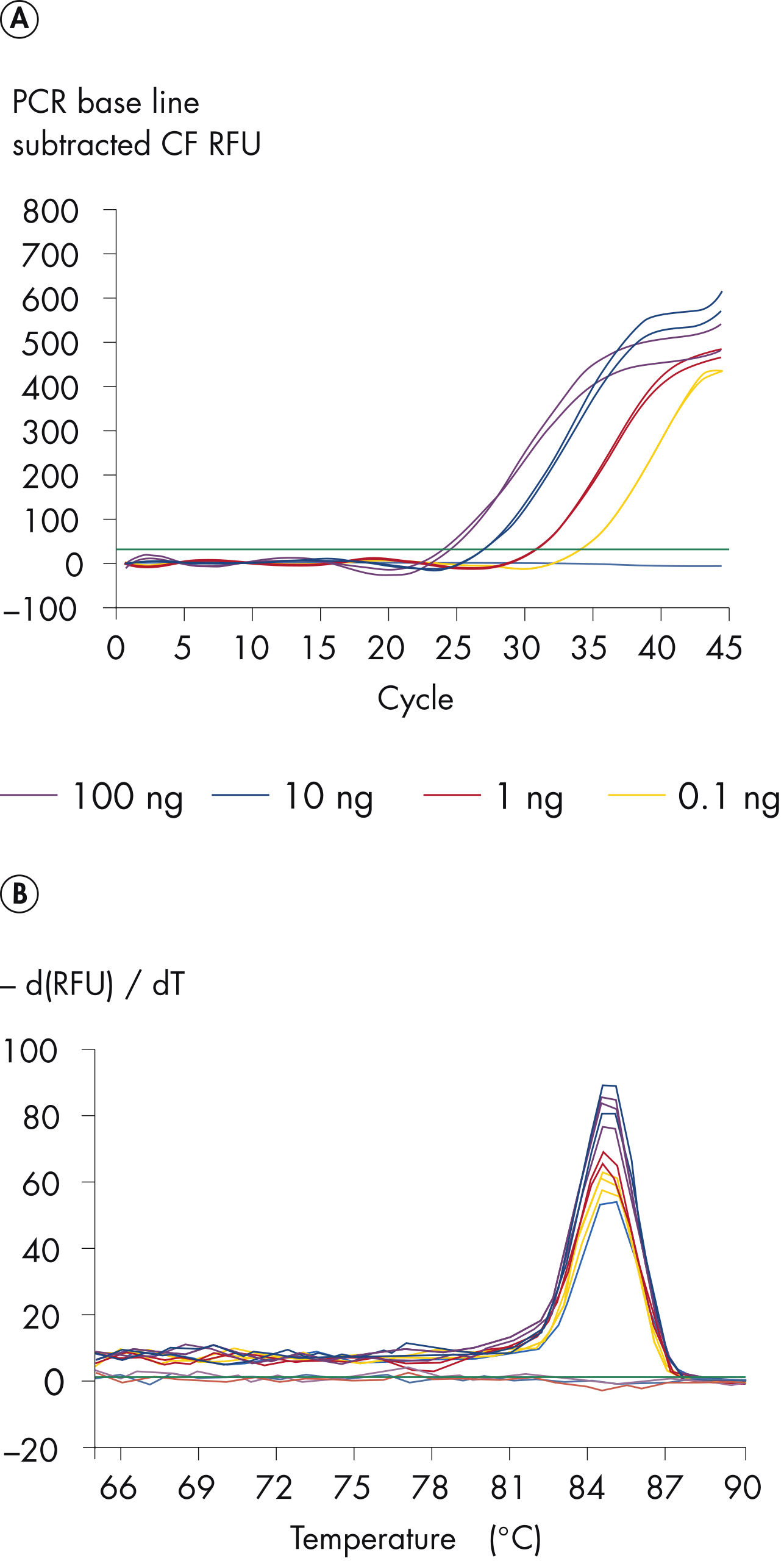
QuantiTect Primer Assay は、RNA 転写物の定量を幅広い濃度範囲において高い再現性で実現します(図 “ 再現性のあるリアルタイムRT-PCR”の [A])。QuantiFast SYBR Green Kits または弊社のその他のSYBR Green キットを用いてアッセイを行なった場合のみ、正確な定量が保証されています。これらのキットはPCR アーティファクトの形成を回避します(図 “ 再現性のあるリアルタイムRT-PCR”の[B])。

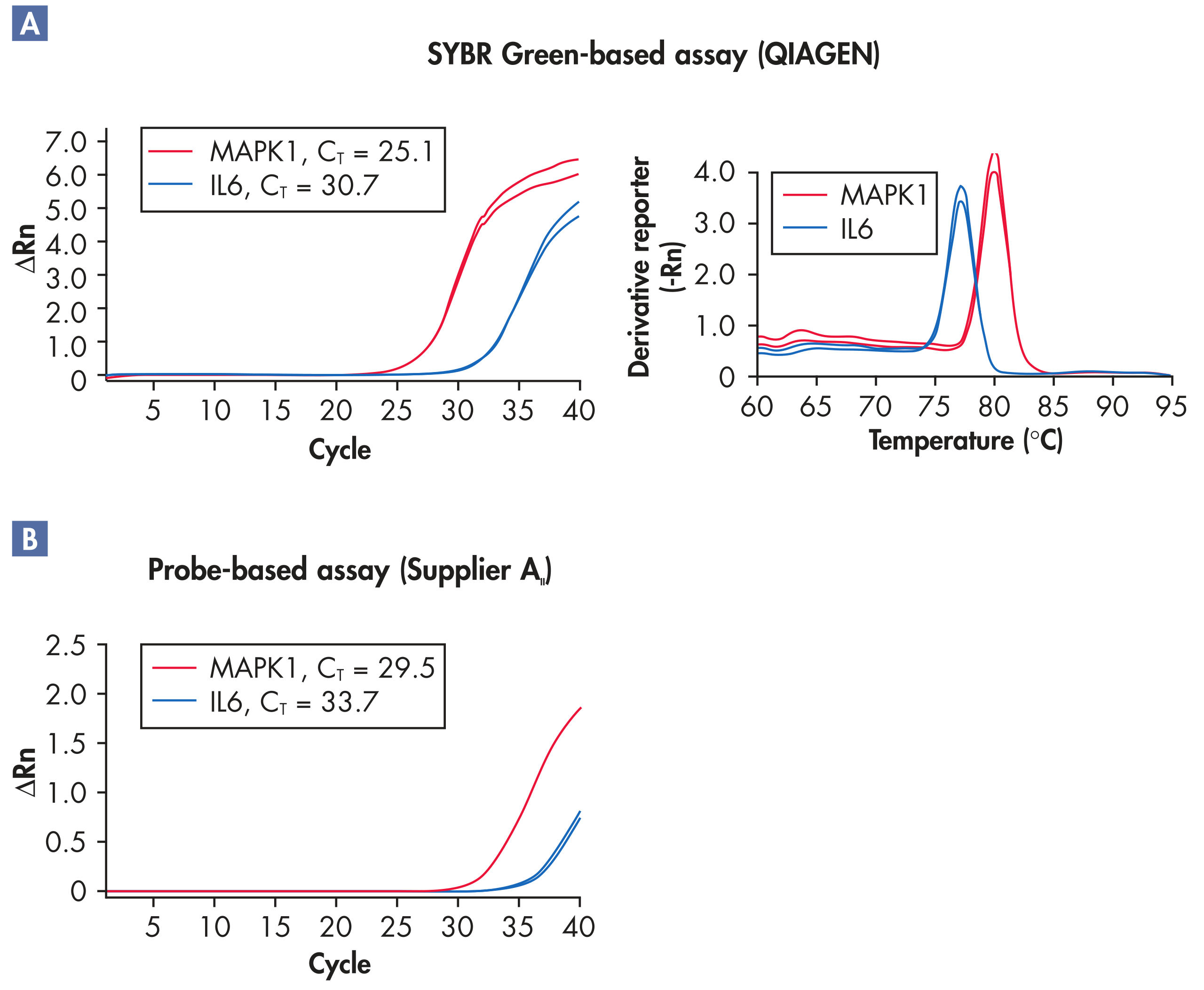
QuantiFast、QuantiTect、Rotor-Gene、FastLane SYBR Green Kits(2 ステップあるいは1 ステップRT-PCR 用マスターミックス)と組み合わせて使用すると、プローブを用いたアッセイに比べて小さいCT 値が得られます(図 “ StepOnePlus において卓越した感度のリアルタイムRT-PCR”)。これはキットが高いPCR 特異性を持ち、各PCR 産物に大量のSYBR Green 色素が結合することに起因します。発現量の低い転写物でも高感度定量が可能です。

原理

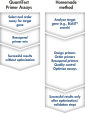
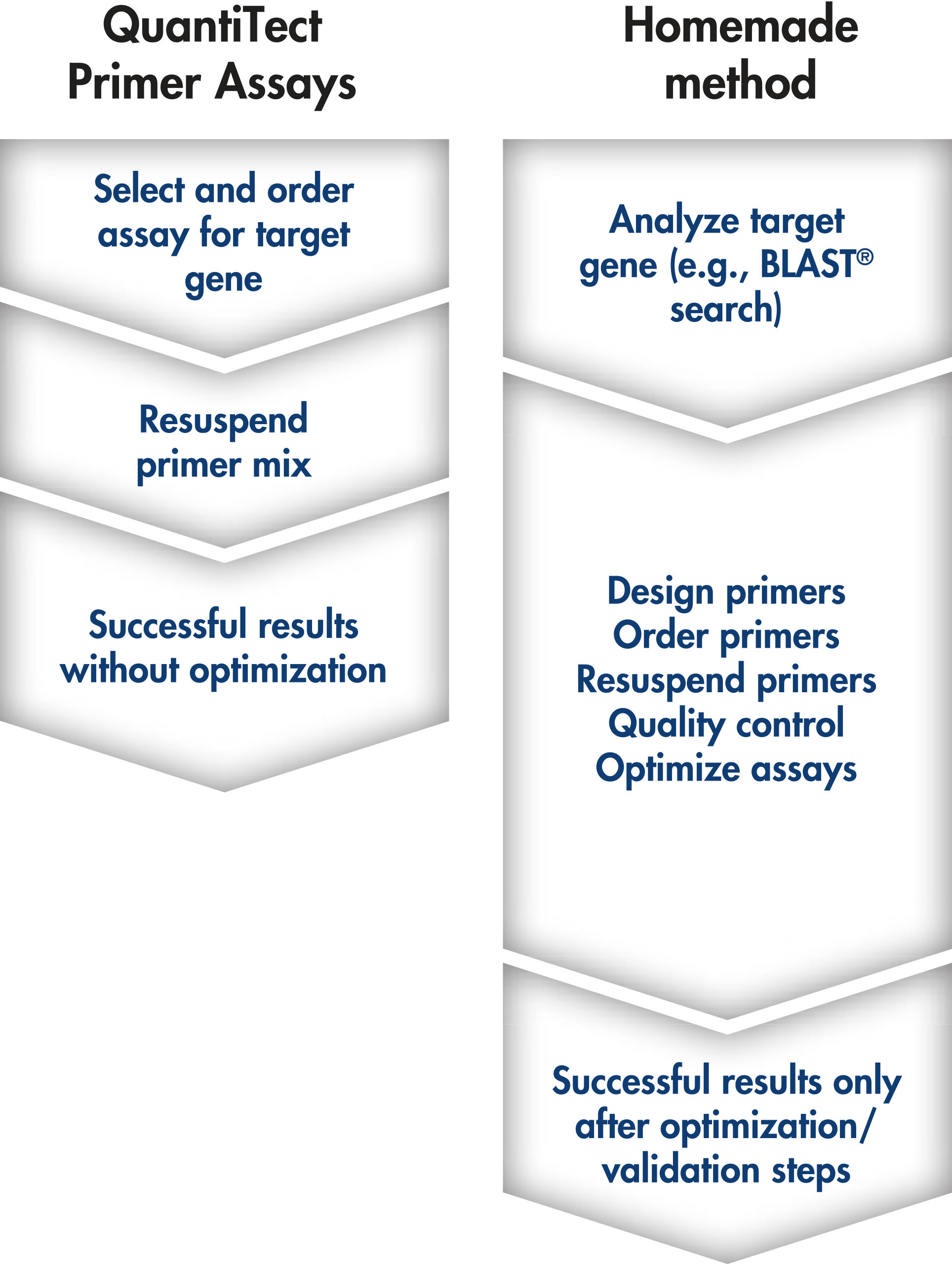
QuantiTect Primer Assays ではリアルタイムRT-PCR アッセイの開発や検証が不要です(図 “ リアルタイムRT-PCR アッセイの開発に必要な時間を節約”)。これらは1ステップおよび2ステップ定量RT-PCRのどちらでも使用いただけます。GeneGlobeポータルサイトで、ヒト、ラット、マウス、ショウジョウバエ、シロイヌナズナ、その他の種からの遺伝子に対応するアッセイが検索・注文できます。QuantiTect Primer AssayをQuantiFast、QuantiTect、Rotor-GeneあるいはFastLane SYBR Green Kitと組み合わせて使用することで、確実な結果が得られます(2 ステップあるいは1 ステップRT-PCR 用マスターミックス)。

操作手順

各 QuantiTect Primer Assay は、遺伝子特異的なforwardおよびreverseプライマーの凍結乾燥ミックスとしてお届けします。プライマーをTE, pH 8.0で溶解し10xのプライマー溶液を調製します。これをSYBR Green検出用のQuantiFast、QuantiTect、Rotor-Gene、FastLane Kit に添付されているマスターミックスに加えます。プライマーを添加したマスターミックスをPCRチューブあるいはウェルに分注し、その後、個々のテンプレートを加えます。

QuantiTect Primer Assaysは、表に記載されている以下のようなキットと組み合わせて使用すると、遺伝子発現解析において良好な結果が得られます。

QuantiTect Primer Assaysと併せて使用する2 ステップおよび1 ステップ定量RT-PCRキット
2 ステップ定量RT-PCR 1ステップ定量RT-PCR
QuantiFast SYBR Green PCR Kit QuantiFast SYBR Green RT-PCR Kit
Rotor-Gene SYBR Green PCR Kit Rotor-Gene SYBR Green RT-PCR Kit
QuantiTect SYBR Green PCR Kit QuantiTect SYBR Green RT-PCR Kit

QuantiTect Primer Assayは可能な限りRNA のみを検出するようにデザインされています。ゲノムDNA の検出が避けられないアッセイでは、QuantiTect Reverse Transcription Kit あるいは FastLane Cell cDNA Kit を用いてcDNA を調製します。両キットともに、cDNA 合成にゲノムDNA コンタミの除去が組み込まれています。

ネーミング

選択した遺伝子に対応する入手可能なQuantiTect Primer Assayを区別するために、製品名内の遺伝子記号の後に数字がつけられています。詳細はGeneGlobe FAQをご覧ください。

アプリケーション

QuantiTect Primer AssaysはSYBR Green検出による1ステップおよび2ステップqRT-PCRを用いた遺伝子発現解析用アッセイです。この組み合わせは、次のようなアプリケーションに最適です:
  • siRNAによる遺伝子ノックダウンの検証
  • マイクロアレイ結果の検証
  • ハイスループットスクリーニング

裏付けデータと数値

仕様

特徴仕様
ApplicationsGene expression analysis
Kit for this application on the instrumentQuantiFast SYBR Green PCR or RT-PCR Kit, QuantiTect SYBR Green PCR or RT-PCR Kit
検出SYBR Green I
Real-time or endpointReal-time
SpeciesHuman, mouse, rat, drosophila arabidopsis, chicken, dog, nematode, and zebrafish
FormatLyophylized primer set

リソース

キットハンドブック (2)
For genomewide, ready-to-use real-time RT-PCR assays using SYBR Green detection
クイックスタートプロトコール (1)
For the quantification of mRNA targets using the QuantiTect Primer Assays with the QIAcuity OneStep Advanced EvaGreen Kit
記事 (1)
QuantiTect Primer Assays for housekeeping genes can be used as endogenous controls in qRT-PCR.
安全データシート (1)
Download Safety Data Sheets for QIAGEN product components.
遺伝子発現解析 (1)
Safety Data Sheets (1)
Certificates of Analysis (1)

よくある質問

Do I have to use a ramp time of 2°C/sec on the LightCycler when using Quantitect Primer Assays?

We strictly recommend to use a ramp time of 2°C/sec when running QuantiTect Primer Assays on the LightCycler because cycling is much more robust when compared to using 20°C/sec for ramping. If optimal assay conditions have been established using our recommended ramp time, customers can of course try to use 20°C/sec ramping for denaturation and annealing steps at their own risk.

FAQ-1065
What is the range of melting temperatures for the QuantiTect Primer Assay amplicons in the dissociation curve?
The melting temperatures of the amplicons of the QuantiTect Primer Assays are between 72°C and 86°C.
FAQ-1079
What should I use as a standard for absolute quantification in real-time PCR?

For quantification of RNA, we strongly recommend using RNA molecules as standards. Use of in vitro transcripts as standards takes into account the variable efficiency of the RT reaction. An alternative to the use of in vitro transcripts as RNA standards is the use of a defined RNA preparation (e.g., from a cell line or virus preparation), for which the absolute concentration of the target has already been determined.

For quantification of DNA, several types of DNA can be used, such as plasmids, PCR products, or genomic DNA.

For more information, see Appendix E 'Generating Standard Curves' in the QuantiTect Probe PCR Handbook.

FAQ-1085
Why are there various different QuantiTect Primer Assays for my gene (previous versions, transcript variants)?

QuantiTect Primer Assays are designed using sequences from the Entrez and Ensembl databases, which are both updated regularly. New sequence information may allow us to design improved assays that detect all transcript variants and/or avoid detection of genomic DNA.

Some assays may have been originally designed using sequences only from Entrez because the sequences were not available in Ensembl or because there were discrepancies between Entrez and Ensembl. Subsequent updates to Ensembl may have allowed us to design an improved assay.

For certain genes, we also offer QuantiTect Primer Assays that detect specific transcript variants. These assays can be used in experiments in which only a specific splice variant is to be detected.

To find a QuantiTect Primer Assay for your target gene of interest, please visit our GeneGlobe data base.

FAQ-1133
Why does the QuantiTect Primer Assay for my gene of interest have only one version number?

Although there may have been sequence updates in Entrez and/or Ensembl which serve as the basis for our QuantiTect Primer Assay design, the assay still matches the amplified region. Therefore, there is no need to design a new assay.

The version number of an assay appears in the assay name as in the following example:

Hs_LTA_2_SG QuantiTect Primer Assay (200)

Hs:       human

LTA:     lymphotoxin alpha (TNF superfamily, member 1)

2:         assay version 2

SG:      assay is for SYBR Green based real-time RT-PCR

(200):   200 x 50 µl reactions

FAQ-1134
Which QuantiTect Primer Assay should I choose for my gene of interest?

When retrieving a QuantiTect Primer Assay for your gene of interest in GeneGlobe, you will find a link ('View Details') to the main assay. Right below, you may also see a link to previous versions of the assay and/or a link to assays for transcript variants if these are available.

We recommend choosing the main QuantiTect Primer Assay, since it has the latest version number and is designed to detect the main transcript and all possible transcript variants. You can choose a previous version of the assay if you have ordered it before and it works in your experiments. If you only want to detect a certain splice variant, choose an assay for a specific transcript variant.

FAQ-1135
If a QuantiTect Primer Assay has more than one version number, does this mean that earlier assay versions may not work?

In most cases, earlier versions of the QuantiTect Primer Assays do work:

  • earlier versions may detect both RNA and genomic DNA sequences, while the latest version may be specific for RNA sequences
  • there may be only a difference of one nucleotide between the latest and the previous assay version
  • earlier versions may not detect all transcript variants, while the latest version can

Previous assay versions can still be used if they work in your experiments. However, we recommend using the latest version. In very rare cases, original versions of the assay may not perform due to significant updates of transcript sequence information in Entrez or Ensembl, which our QuantiTect Primer Assays are based on.

(To find a QuantiTect Primer Assay for your target gene of interest, please visit our GeneGlobe data base).

FAQ-1136
What does transcript variant mean when searching for specific QuantiTect Primer Assays?

Many genes have more than one transcript due to alternative splicing. We refer to the various transcripts (splice variants) for a particular gene as transcript variants. When searching GeneGlobe for a QuantiTect Primer Assay, you may locate a link below the assay name saying 'Show Primer Assays for transcript variants', whenever there are assays for transcript variants available. If there is no such link below an assay name, then the specific Primer Assay can detect all transript variants simultaneously.


Example:

Human adrenergic, alpha-1A-, receptor ADRA1A

For this specific QuantiTect Primer Assay there are assays for transcript variants available which can be accessed via the link below the QuantiTect Primer Assay name.

Assays for transcript variants are named as follows:

Hs_ADRA1A_vb.1_SG QuantiTect Primer Assay (200)

Hs:            human

ADRA1A:   adrenergic, alpha-1A-, receptor

vb.1:         transcript variant b for a specific RefSeq ID Number; assay version 1

SG:           assay is for SYBR Green based real-time RT-PCR

(200):        200 x 50 µl reactions

In this specific example, the letters 'vb.1' in 'Hs_ADRA1A_vb.1_SG' are used to indicate that the assay is specific for the transcript variant with RefSeq ID NM_033302, and that the Primer Assay is the first version for this particular transcript variant.

Click the 'View details' link for a particular assay to find out which transcript variant it is detecting.

FAQ-1137
Why can I not find the QuantiTect Primer Assay in GeneGlobe that I had previously ordered from QIAGEN?

The QuantiTect Primer Assay may have been renamed. Since we only use official gene names from Entrez to name our QuantiTect Primer Assays, names are subject to change in case an update occurs at NCBI's Entrez data base. 

For example, Hs_GYG was officially renamed by Entrez to Hs_GYG1, so we changed the name of the Primer Assay accordingly:

Hs_GYG_1_SG QuantiTect Primer Assay was renamed Hs_GYG1_1_SG QuantiTect Primer Assay.

Performing a search in GeneGlobe using the gene symbol for the gene of interest should retrieve the corresponding QuantiTect Primer Assay with the new name. To find the original name, click on the link to the assay and look under 'Other names' on the 'View Details' page.

FAQ-1138
When searching for a QuantiTect Primer Assay for my gene of interest, why do I only find the assay for human but not for rat?

Since we only use official gene names from Entrez to name our QuantiTect Primer Assays, the name of the assay for one species may differ from that of another species.

For example, interleukin 17 is known as IL-17 in human, and as LOC301289 in rat.

FAQ-1139
Why is there no QuantiTect Primer Assay for my gene of interest?

Our QuantiTect Primer Assays for the genomes of human, rat, mouse, and many other species cover >90% of the transcripts listed in the NCBI Reference Sequence (RefSeq) database (e.g., for human, >98% of the transcripts are covered). The RefSeq database is a comprehensive, integrated, nonredundant and curated collection of sequences, including genomic DNA, transcript RNA, and protein products for major research organisms.

Lack of certain QuantiTect Primer Assays for specific transcripts can be due to unreliable or missing sequence information, or due to the fact that no assay can be found which meets our high-stringency assay design criteria.

Regular updates to our QuantiTect Primer Assay database are performed every 8–12 weeks, depending on the organism, so a QuantiTect Primer Assay for your gene of interest may be available via GeneGlobe in the future.

FAQ-1140
What is a QuantiTect Primer Assay?

QuantiTect Primer Assays are primer pairs designed and bioinformatically validated specifically for real-time RT-PCR with SYBR Green detection. To find a primer assay for your target gene of interest, please visit our GeneGlobe data base.

For best results, we strongly recommend using QuantiTect Primer Assays in combination with QIAGEN's products for SYBR Green-based Real-Time PCR and RT-PCR.

FAQ-1141
What is the delivery time for QuantiTect Primer Assays?

For American and Canadian customers, it takes about 3 days for delivery of the QuantiTect Primer Assays.

For the rest of the world, there are 7 working days between ordering online and receiving the assay.

To find a QuantiTect Primer Assay for your target gene of interest, please visit our GeneGlobe data base.


FAQ-1142
Do QuantiTect Primer Assays contain SYBR Green dye?

No, QuantiTect Primer Assays are supplied as lyophilized, premixed primer pairs. Reaction components for SYBR Green real-time RT-PCR must be purchased separately.

To find a QuantiTect Primer Assay for your target gene of interest, please visit our GeneGlobe data base.

FAQ-1143
If I cannot find a QuantiTect Primer Assay for my target gene in rat, can I use the assays for the orthologous genes in mouse and human?

QIAGEN cannot guarantee that QuantiTect Primer Assays designed for mouse or human will also work for rat.

To find a QuantiTect Primer Assay for your target gene of interest, please visit our GeneGlobe data base.


FAQ-1145
Can I increase the annealing temperature recommended for QuantiTect Primer Assays used with the QuantiTect SYBR Green PCR Kits?

QuantiTect Primer Assays are optimized for an annealing temperature of 55ºC when using the QuantiTect SYBR Green PCR Kit (for two-step RT-PCR) or the QuantiTect SYBR Green RT-PCR Kit (for one-step RT-PCR) .

Increasing the annealing temperature will reduce PCR performance (sensitivity and PCR efficiency) when using QuantiTect Primer Assays with these kits.


FAQ-1146
Do the QuantiTect Primer Assays work with QuantiFast SYBR Green Kits?

We have performed numerous tests comparing the performance of QuantiFast Kits and QuantiTect Kits with QuantiTect Primer Assays. Due to the optimized ion concentrations in the PCR buffers, both perform equally well with QuantiTect Primer Assays and do not require any adjustment of primer concentration.


FAQ-1439
Will QuantiTect Primer Assays work at an annealing temperature of 60ºC with QuantiFast SYBR Green PCR and RT-PCR Kits?

Yes. QuantiTect Primer Assays are guaranteed for use with QuantiFast SYBR Green PCR and QuantiFast SYBR Green RT-PCR Kits at the specified annealing temperature of 60ºC. We have extensively tested many QuantiTect Primer Assays with success under these conditions.


FAQ-1553
Do I need to use the miScript Universal Primer for detection of mRNA?

No. The miScript Universal Primer contained in the miScript SYBR Green PCR Kit is necessary for the detection of miRNA.

For detection of mRNA, a QuantiTect Primer Assay for the gene of interest should be used.


FAQ-1600
Have QuantiTect Primer Assays been tested with QuantiFast SYBR Green PCR Kits on the Mastercycler ep realplex?

Yes, QuantiTect Primer Assays work very well under fast-cycling conditions. Results achieved with QuantiFast SYBR Green Kits are comparable to those achieved with QuantiTect SYBR Green Kits.


FAQ-1714
QuantiTect Primer Assays are bioinformatically validated, genomewide primer sets. What does “bioinformatically validated” mean?

For each QuantiTect Primer Assay, we retrieve the sequence of the target gene from curated databases and exclude SNP regions from assay design.

We then use our proprietary algorithm to design assays that amplify RNA sequences only (i.e., at least one primer overlaps a splice site), provided that information on the position of splice sites is available. The assays are designed to provide optimal performance with QuantiFast and QuantiTect SYBR Green Kits.

After assay design, we validate randomly selected QuantiTect Primer Assays using real-time RT-PCR to check their compatibility with various real-time cyclers. Both two-step and one-step RT-PCR are carried out. Successful amplification of the target is indicated by the following factors: high sensitivity, high efficiency, high specificity (i.e., a single peak in melting curve analysis), and no primer–dimers in the no-template control (NTC).

To find a QuantiTect Primer Assay for your target gene of interest, please visit our GeneGlobe data base.


FAQ-1982
Which plate formats are offered for QuantiTect Primer Assay Plates?
QuantiTect Primer Assay Plates are available in 96- and 384-well plate format.
FAQ-2106
How many reactions can be performed per well of the QuantiTect Primer Assay Plates?

This depends on the QuantiTect Primer Assay Plate format.

QuantiTect Primer Assay 96 Plate (20):

  • 20 x 50 ul reactions or 40 x 25 ul reactions

QuantiTect Primer Assay 96 Plate (100):

  • 100 x 50 ul reactions or 200 x 25 ul reactions

QuantiTect Primer Assay 384 Plate (20):

  • 20 x 50 ul reactions or 40 x 25 ul reactions
FAQ-2107
Can assays for 20 and 100 reactions be ordered on the same QuantiTect Primer Assay Plate?

No. All assays on a single QuantiTect Primer Assay Plate are for the same number of reactions.

QuantiTect Primer Assays for your target genes of interest can be conveniently ordered via GeneGlobe.


FAQ-2108
What is the minimum number of assays that can be ordered on QuantiTect Primer Assay Plates?

The minimum order is 24 assays per QuantiTect Primer Assay 96 Plate, and 96 assays per QuantiTect Primer Assay 384 Plate.


FAQ-2109
What species are QuantiTect Primer Assay Plates offered for?

QuantiTect Primer Assays in plate format are available for Human, Mouse, Rat, Drosophila, Arabidopsis, Chicken, and Dog, with more species to come.

QuantiTect Primer Assays can be searched for and ordered in either tube or plate format online via GeneGlobe.


FAQ-2110
Are the layouts for both 96- and 384-well QuantiTect Primer Assay Plates visible when ordering online?

Yes, the layout of the QuantiTect Primer Assay Plates can be seen when ordering online via GeneGlobe. However, the drag-and-drop function for manual re-positioning of individual assays on the plate is only available for the 96-well format.


FAQ-2111
Can QuantiTect Primer Assay Plates be ordered offline via e-mail or fax?

Yes, it is possible to order QuantiTect Primer Assay Plates by e-mailing or faxing the completed order documentation, containing order form and separate plate layout information. Note that the respective Excel file containing the plate layout information has to be sent electronically. Only the order form itself may be sent by fax.


FAQ-2112
Do QuantiTect Primer Assays also work with Rotor-Gene SYBR Green PCR Kits?

We have performed numerous tests comparing the performance of Rotor-Gene SYBR Green PCR Kits and QuantiTect Kits with QuantiTect Primer Assays. Due to the optimized ion concentrations in the PCR buffers, both perform equally well with QuantiTect Primer Assays and do not require any adjustment of primer concentration.


FAQ-2123
Will QuantiTect Primer Assays work with Rotor-Gene SYBR Green Kits using an annealing step at 60ºC?

Based on our extensive and successful testing of many QuantiTect Primer Assays with Rotor-Gene SYBR Green PCR Kits, we guarantee this.


FAQ-2124
Do you have any information or guidelines regarding the choice of reference genes for real-time PCR?

Yes, please visit our website section 'Using endogenous control genes in real-time RT-PCR' for general information. It provides a list of relative gene expression levels for commonly used human and mouse reference genes.

We offer a set of ready-to-order control genes for use in SYBR Green based as well as probe based real-time RT-PCR.

In addition, you may want to refer to the following citations on reference gene selection for quantitative real-time PCR:

• Vandesompele J, De Preter K, Pattyn F, Poppe B, Van Roy N, DePaepe A, Speleman F [2002]: Accurate normalization of real-time quantitative RT-PCR data by geometric averaging of multiple internal control genes. Genome Biol 2002, 3:0034.

• Radonic A, Thulke S, Mackay IM, Landt O, Siegert W, Nitsche A., 2004. Guideline to reference gene selection for quantitative real-time PCR. Biochem Biophys Res Commun. 313(4): 856-62.

• Katrien Smits,Karen Goossens, Ann Van Soom, Jan Govaere, Maarten Hoogewijs, Emilie Vanhaesebrouck,Cesare Galli, Silvia Colleoni, Jo Vandesompele, and Luc Peelman [2009]Selection of reference genes for quantitative real-time PCR in equine in vivo and fresh and frozen-thawed in vitro blastocysts. BMC Res Notes. Dec 11;2:246.

FAQ-2371
What is the threshold cycle or Ct value?
The Ct or threshold cycle value is the cycle number at which the fluorescence generated within a reaction crosses the fluorescence threshold, a fluorescent signal significantly above the background fluorescence. At the threshold cycle, a detectable amount of amplicon product has been generated during the early exponential phase of the reaction. The threshold cycle is inversely proportional to the original relative expression level of the gene of interest.
FAQ-2682
What is the standard curve method for qPCR assay data analysis? How is the standard curve method for qPCR assay data analysis performed?

When using the standard curve method, the quantity of each experimental sample is first determined using a standard curve, and is then expressed relative to a calibrator sample.

In order to use this quantification method, prepare five (5) 2-fold, 5-fold, or 10-fold serial dilutions of cDNA template known to express the gene of interest in high abundance. Use each serial dilution in separate real-time reactions, and determine their threshold cycle values.

In a base-10 semi-logarithmic graph, plot the threshold cycle versus the dilution factor and fit the data to a straight line. Confirm that the correlation coefficient (R2) for the line is 0.99 or greater.

This plot is then used as a standard or calibration curve for extrapolating relative expression level information for the same gene of interest in unknown experimental samples. The relative quantification calibration curve result for the gene of interest is normalized to that of a housekeeping gene in the same sample, and then the normalized numbers are compared between samples to get a fold change in expression.

A standard or calibration curve must be generated separately for each gene of interest and each housekeeping gene.


See Critical Factors for Successful Real-Time PCR for additional details.

FAQ-2691
What is the difference between Absolute Quantification and Relative Quantification in qPCR, using the standard curve approach?

Absolute Quantification determines expression levels in absolute numbers of copies. Relative Quantification determines fold changes in expression between two samples. In absolute quantification, the precise amount of the message or template used for the curve is known. In relative quantification, the template is simply known to contain the message of interest in high abundance, but its absolute amount is not necessarily known. Unknowns are compared to either standard curve and a value is extrapolated. The absolute quantification standard curve provides the final answer. The relative quantification calibration curve result for the gene of interest is normalized to that of a housekeeping gene in the same sample, and then the normalized numbers are compared between samples to obtain a fold change.


See Critical Factors for Sucessful Real-Time PCR for more information.

FAQ-2692
What is the comparative or ??Ct method for qPCR assay data analysis? How is the comparative or ??Ct method for qPCR assay data analysis performed?

In the comparative or ΔΔCt method of qPCR data analysis, the Ct values obtained from two different experimental RNA samples are directly normalized to a housekeeping gene and then compared. This method assumes that the amplification efficiencies of the gene of interest and the housekeeping genes are close to 100 percent (meaning a standard or calibration curve slope of -3.32) First, the difference between the Ct values (ΔCt) of the gene of interest and the housekeeping gene is calculated for each experimental sample. Then, the difference in the ΔCt values between the experimental and control samples ΔΔCt is calculated. The fold-change in expression of the gene of interest between the two samples is then equal to 2^(-ΔΔCt).


See Critical Factors for Successful Real-Time PCR for more information.

FAQ-2693
How do I determine the amplification efficiency of my qPCR assay?

Prepare five (5) 2-fold, 5-fold, or 10-fold serial dilutions of cDNA template known to express the gene of interest in high abundance. Use each serial dilution in separate real-time reactions, and determine their threshold cycle values. In a base-10 semi-logarithmic graph, plot the threshold cycle versus the dilution factor and fit the data to a straight line. Confirm that the correlation coefficient (R2) is 0.99 or greater. The closer the slope of this straight line is to -3.32, the closer the amplification efficiency is to 100 percent.

The amplification efficiency = [10(-1/slope)] - 1

Alternatively, a number of data analysis models have been developed that enable the calculation of PCR amplification efficiencies from individual amplification plots, without the use of standard curves. These include the Data Analysis for Real-time PCR (DART-PCR), LinReg, and the Real-time PCR Miner algorithms. Because these methods do not require the generation of standard curves, they are well suited for large scale experiments

FAQ-2694
Why do I see low, poor, or sub-standard amplification efficiency in my qRT-PCR assay?
The template that you chose to use in generating your standard curve may not express your gene of interest abundantly enough to be detected after the several 10-fold serial dilutions required for the standard curve. In such a case, many of the standard curve reactions should be yielding high Ct values (> 30). You can lower the serial dilution factor to 2-fold, and generate a new standard curve. You can also try using an alternate source of template for the standard curve reactions, such as cDNA derived from a universal source of RNA, cDNA derived from a full-length in vitro transcript of the gene of interest, or even a full-length cDNA clone of the gene of interest.
FAQ-2695
How do I determine the linear dynamic range of my qPCR or qRT-PCR assay?
Prepare five (5) 10-fold serial dilutions of cDNA template known to express the gene of interest in high abundance. Use each serial dilution in separate real-time reactions, and determine their threshold cycle values. In a base-10 semi-logarithmic graph, plot the threshold cycle versus the dilution factor and fit the data to a straight line. The linear range of this plot is the linear dynamic range of the qPCR assay.
FAQ-2696
3315-What is the concentration of the reconstituted QuantiTect Primer Assay (200)?

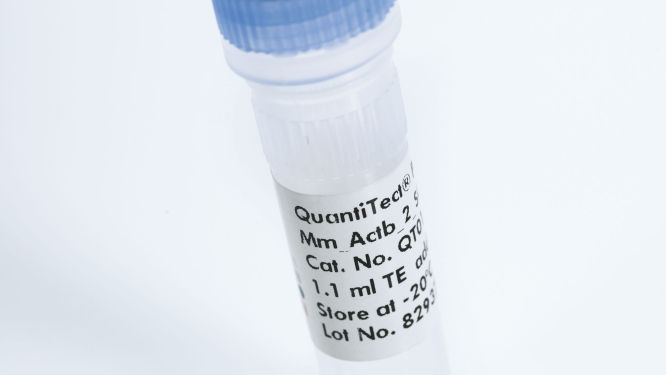
After reconstitution of the lyophilized primers in 1.1ml of TE, pH 8.0, the QuantiTect Primer Assay will be at 10X stock concentration.  It should be used at 1X final concentration in the PCR/RT-PCR reaction (eg. for a 25ul reaction, 1/10th of the total volume, or 2.5ul, should be primer).  The exact concentration of the primers is proprietary.

FAQ-3315
How would I provide information on the QuantiTect Primer assays in publications when the sequence is confidential?

We would recommend citing the name of the QuantiTect Primer assay and its source, QIAGEN.

FAQ-3593
Where can I find QIAGEN products for a specific gene or gene product?
You can search for specific gene products in the QIAGEN GeneGlobe Database. This easy-to-use, comprehensive Web portal allows you to find information about, search for, and order high-quality products for human, mouse, and rat genes. QIAGEN provides a vast range of gene-specific products covering every aspect of an experiment, from gene silencing to expression analysis at the mRNA or protein level.
FAQ-803
Will the sequences of the QuantiTect Primer Assays be provided?

Sequences of the QuantiTect Primer Assays are not provided. Approximate location of primers within a specific gene can be viewed on the Product Detail pages retrieved via our GeneGlobe data base.

FAQ-804
Can the QuantiTect Primer Assays be used for detection of genomic DNA?
The QuantiTect Primer Assays are RNA specific. The primers cross exon-exon boundaries, so in most cases they will not work for genomic DNA detection. In case the transcript contains only one exon or there are pseudogenes present, genomic DNA will be amplified too.
FAQ-811
What annealing temperature should be used with the QuantiTect Primer Assays?

The annealing temperature for QuantiTect Primer Assays should be 55oC when used with the QuantiTect SYBR Green PCR Kit and the QuantiTect SYBR Green RT-PCR Kit.

Use of the QuantiFast SYBR Green PCR and QuantiFast SYBR Green RT-PCR Kits requires a combined annealing/extension step at 60oC, as described in the QuantiTect Primer Assay Handbook.

Note that these Assays are guaranteed for use with the QuantiTect or QuantiFast chemistries only!


FAQ-849
What is the concentration of the primers in a reaction using the QuantiTect Primer Assays?

The primers of the QuantiTect Primer Assays are at a proprietary concentration that was specially optimized for sensitive and efficient amplification in any real time cycler. Always dilute these primers to a final work solution of 1x in your reaction, using either the QuantiTect SYBR Green PCR Kit or the QuantiTect SYBR Green RT-PCR Kit. Follow the instructions for use of the Primer Assays in the QuantiTect Primer Assay handbook.

FAQ-850