QuantiFast Pathogen +IC Kits

Pour une détection sensible et fiable de l’ARN/ADN viral et de l’ADN bactérien, y compris le contrôle interne

S_2537_GEF_QFPatho

✓ Traitement automatique des commandes en ligne 24 h/24 7 j/7

✓ Assistance technique et produits pertinente et professionnelle

✓ Commande (ou réapprovisionnement) rapide et fiable

QuantiFast Pathogen RT-PCR +IC Kit (400)

N° de réf. / ID.   211454

Pour 400 x 25 µl de réactions : Master Mix, RT Mix, lyophilized Internal Control Assay, lyophilized Internal Control RNA, ROX Dye Solution, High-ROX Dye Solution, RNase-Free Water, Nucleic Acid Dilution Buffer, Buffer TE
KitContrôle
QuantiFast Pathogen Kit
Internal Control
Type
RT-PCR
PCR
Les QuantiFast Pathogen +IC Kits sont destinés aux applications de biologie moléculaire. Ces produits ne sont pas conçus pour le diagnostic, la prévention ou le traitement des maladies.

✓ Traitement automatique des commandes en ligne 24 h/24 7 j/7

✓ Assistance technique et produits pertinente et professionnelle

✓ Commande (ou réapprovisionnement) rapide et fiable

Caractéristiques

  • Détection simultanée de la cible pathogène et du contrôle interne
  • 5x mélanges principaux pour une plus grande sensibilité avec plus d’échantillons
  • Interprétation correcte des résultats négatifs pour une plus grande sécurité du processus
  • Détection claire des signaux positifs faibles de la cible
  • Protocole rapide et universel sur les thermocycleurs standards et rapides

Détails produit

Les QuantiFast Pathogen +IC Kits sont conçus pour une détection sensible et rapide par PCR à temps réel ou RT-PCR en une étape des acides nucléiques de pathogènes à l’aide de sondes spécifiques à une séquence. Chaque kit contient des réactifs pour la détection multiplex en temps réel d’un maximum de 4 cibles pathogènes définies par l’utilisateur (par exemple, virus, bactéries, champignons, etc.) ainsi que du contrôle interne (IC), afin de garantir la sécurité du processus grâce à une interprétation correcte des résultats de détection négatifs. Deux formats de kits sont disponibles : Le QuantiFast Pathogen RT-PCR +IC Kit pour la détection de l’ARN viral, qui contient une matrice de contrôle interne de l’ARN, ainsi que l’ensemble d’amorces/sondes de contrôle interne, ou le QuantiFast Pathogen PCR +IC Kit pour la détection de l’ADN viral, bactérien ou fongique, qui contient une matrice de contrôle interne de l’ADN, ainsi que l’ensemble d’amorces/sondes de contrôle interne. Le ROX est fourni avec les deux kits dans 2 tubes de concentrations différentes, ce qui permet de l’utiliser sur pratiquement n’importe quel appareil en temps réel. Pour des raisons de commodité, le mélange principal peut être conservé entre 2 et 8 °C.

Performances

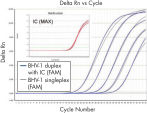
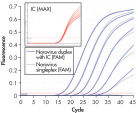
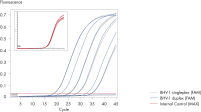
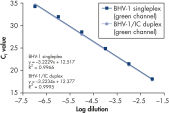
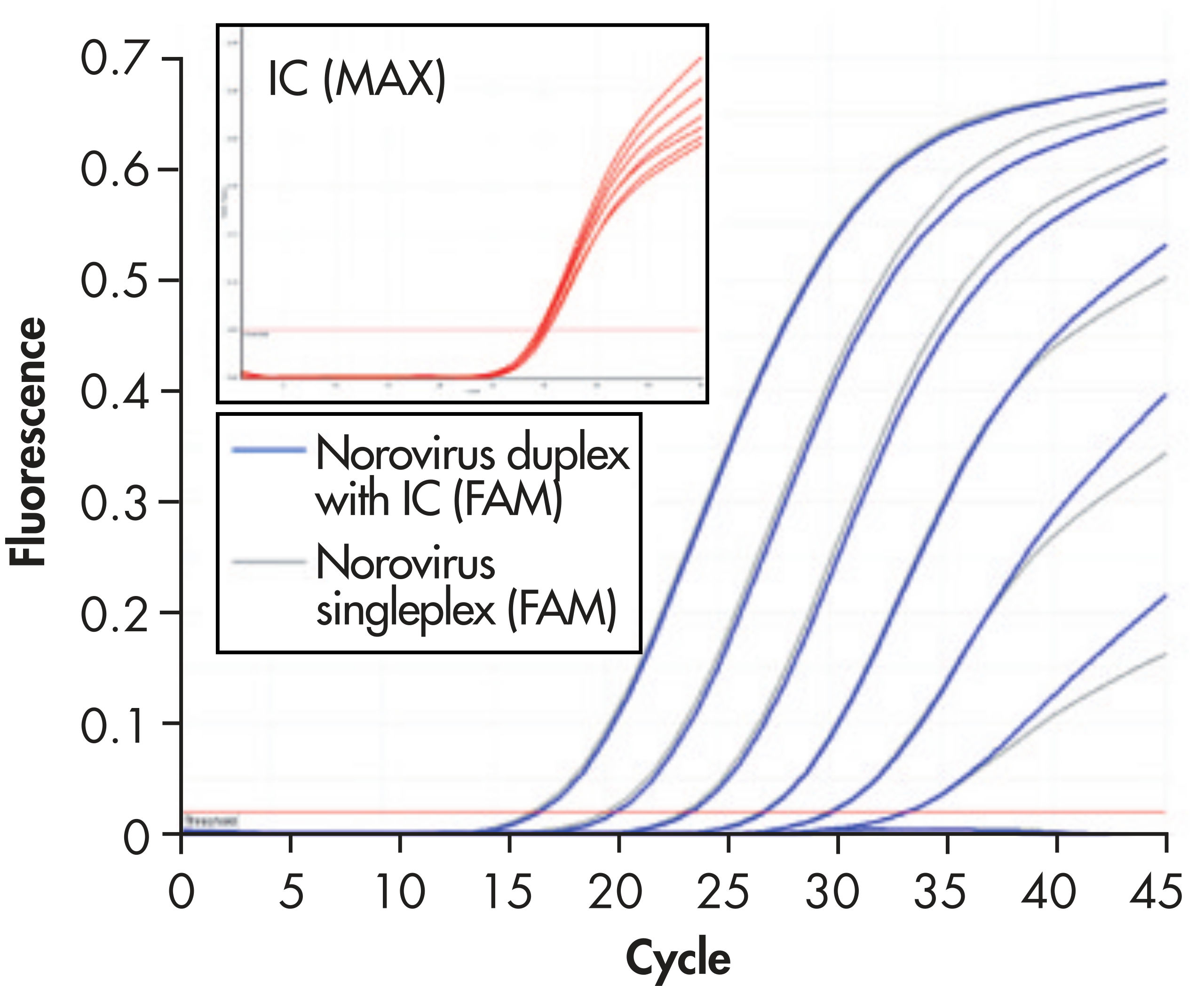
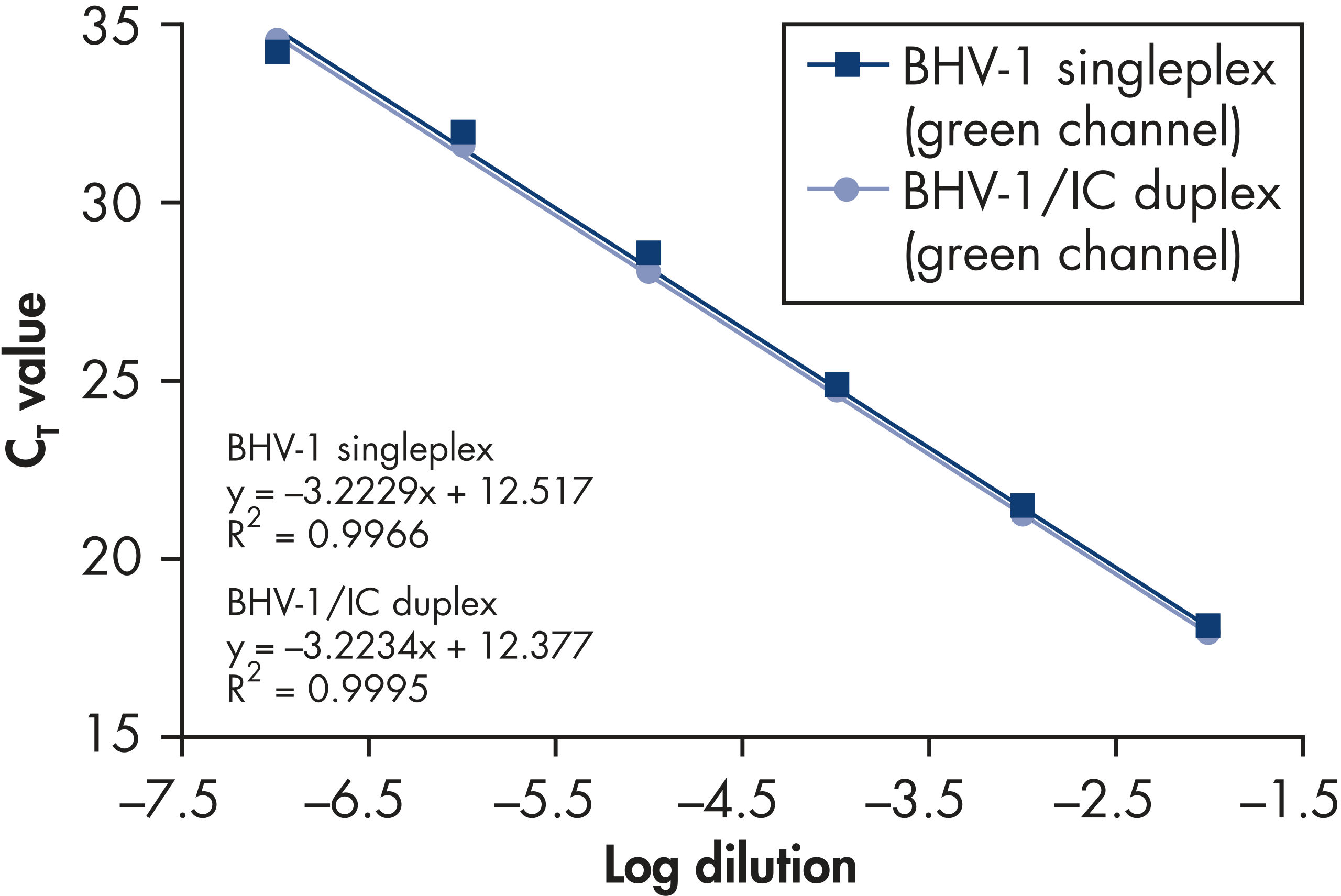
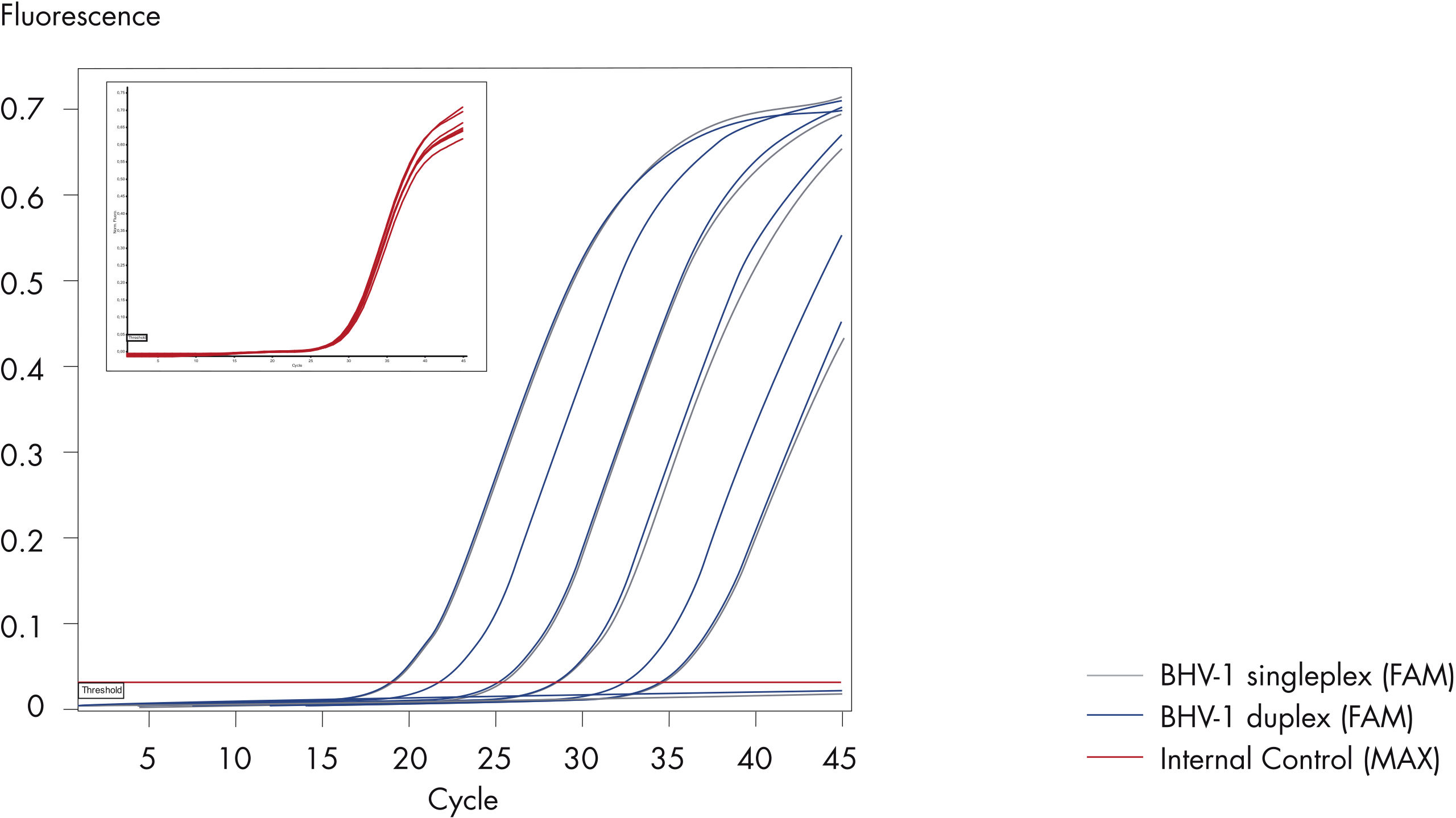
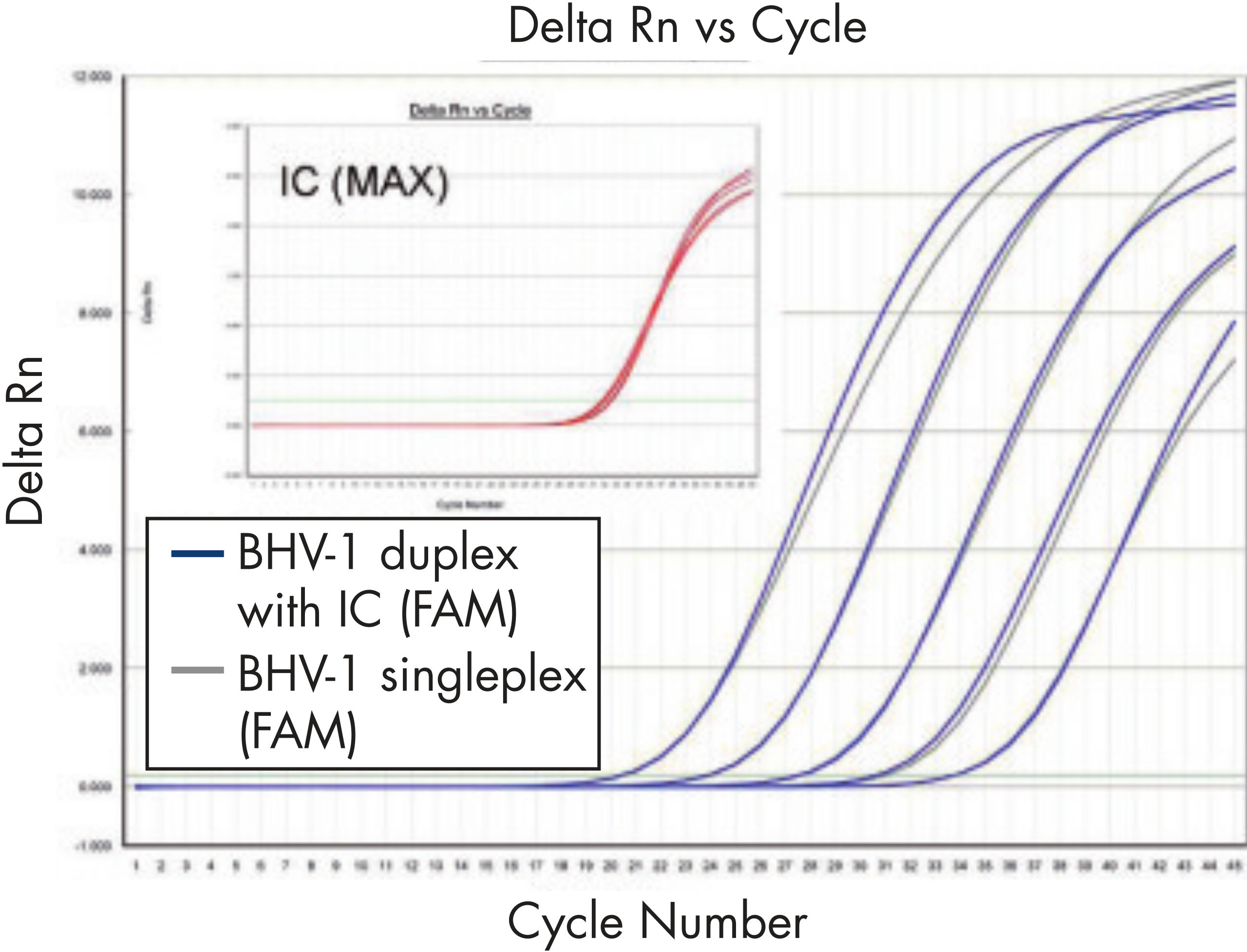
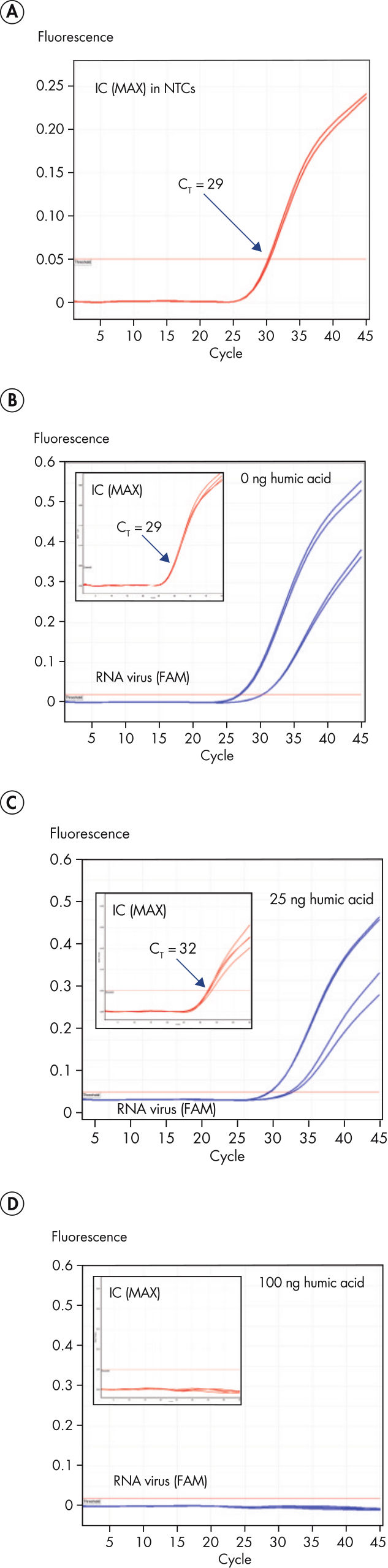
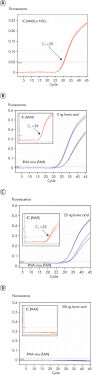
Les QuantiFast Pathogen +IC Kits permettent la détection simultanée de cibles d’ARN ou d’ADN viral et du contrôle interne fourni sur une large plage linéaire sans perte de sensibilité en cas de multiplexage (voir figures  Détection sensible du Norovirus sur le Rotor‑Gene Q et  Linéarité et précision élevées des détections simple et double). Le protocole a été développé pour réaliser des expériences de thermocyclage rapide sur la plupart des thermocycleurs avec une grande fiabilité (voir figures «  Détection sensible du BHV-1 sur le Rotor‑Gene Q » et «  Détection sensible du BHV-1 sur l’ABI 7500 »). L’amplification combinée de la cible pathogène et du contrôle interne à l’aide des QuantiFast Pathogen +IC Kits augmente la sécurité du processus de la procédure de détection des pathogènes en garantissant l’interprétation correcte des résultats négatifs (voir figure «  Interprétation correcte des résultats négatifs »).

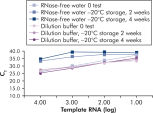
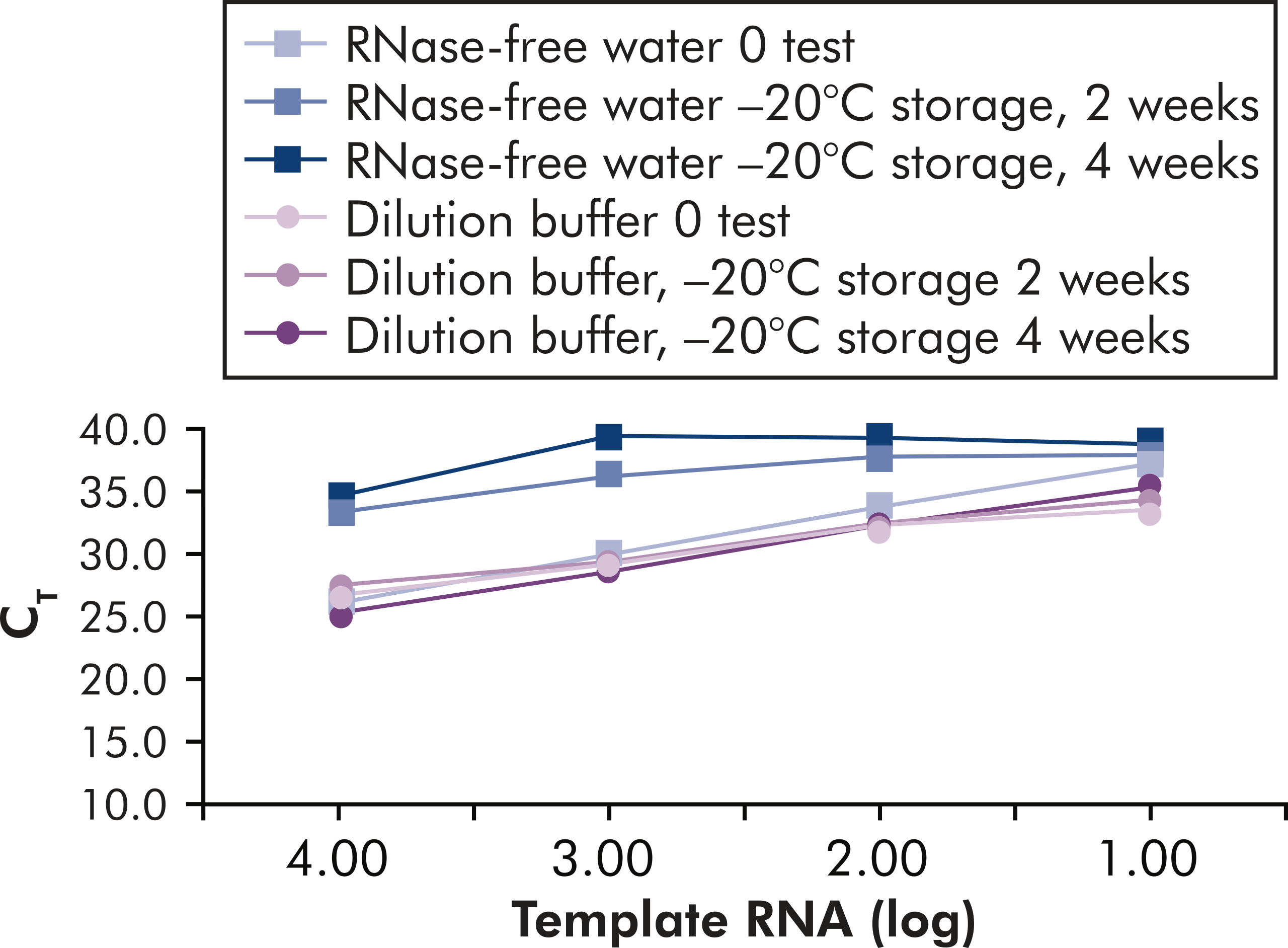
Le QuantiTect Nucleic Acid Dilution Buffer, fourni avec les kits, stabilise les étalons d’ARN et d’ADN pendant la dilution et la configuration de la réaction et empêche la perte d’acides nucléiques sur les surfaces en plastique, telles que les tubes ou les pointes de pipette. Il permet une dilution fiable des étalons utilisés pour quantifier les acides nucléiques viraux, offrant une large plage linéaire, des valeurs CT faibles à élevées. Le tampon assure un stockage plus long des étalons sans dégradation (voir figure «  Dilution et stockage fiables des étalons d’ARN »).

Principe

Afin de garantir la sécurité des processus grâce à l’interprétation correcte des résultats négatifs, chaque QuantiFast Pathogen _IC Kit contient des réactifs pour la détection multiplex en temps réel d’une cible pathogène définie par l’utilisateur avec le contrôle interne. L’amplification des gènes de contrôle et des gènes cibles dans la même réaction plutôt que dans des réactions séparées augmente la fiabilité de la quantification des gènes en minimisant les erreurs de manipulation.

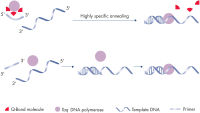
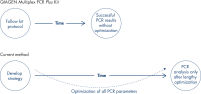
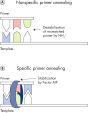
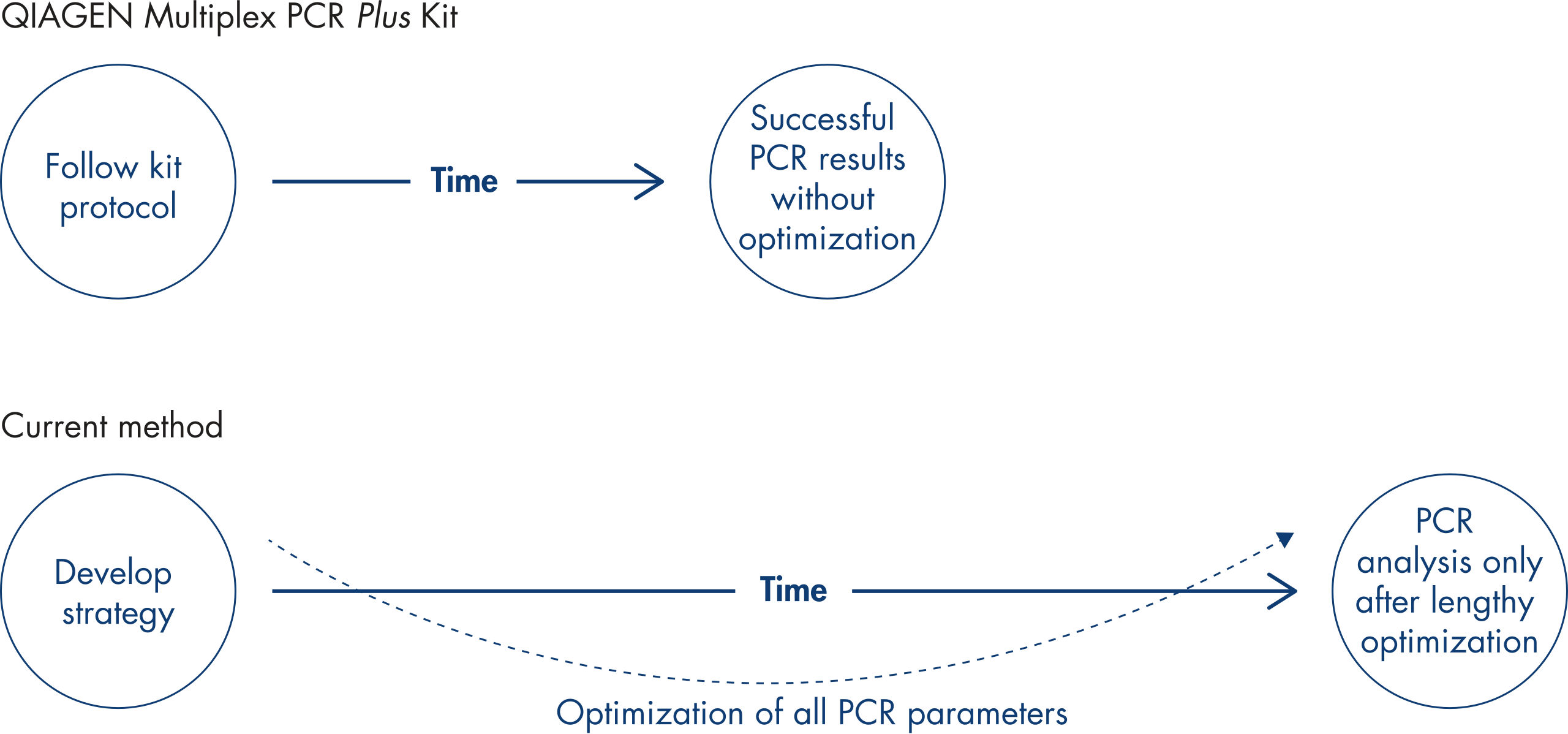
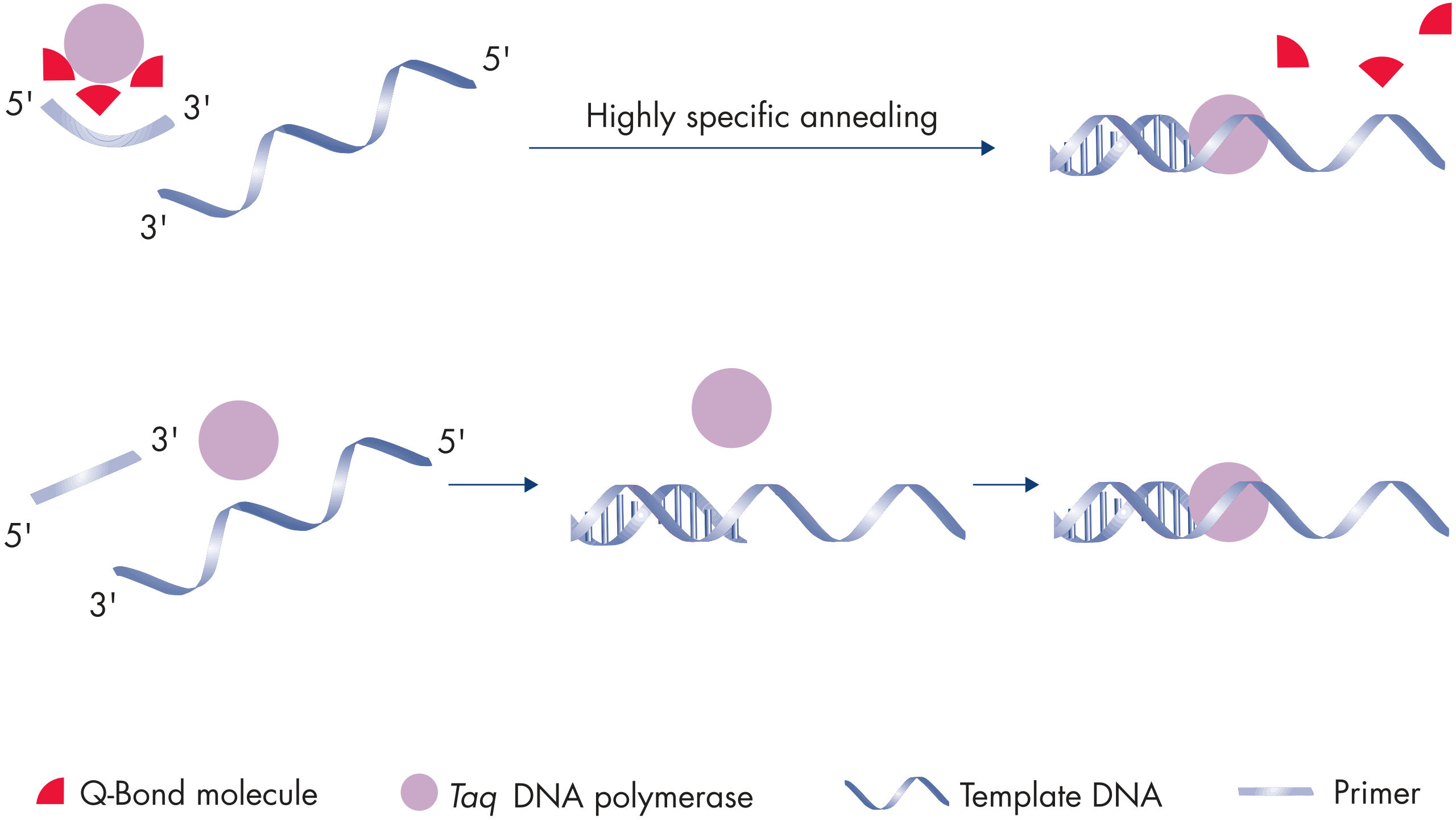
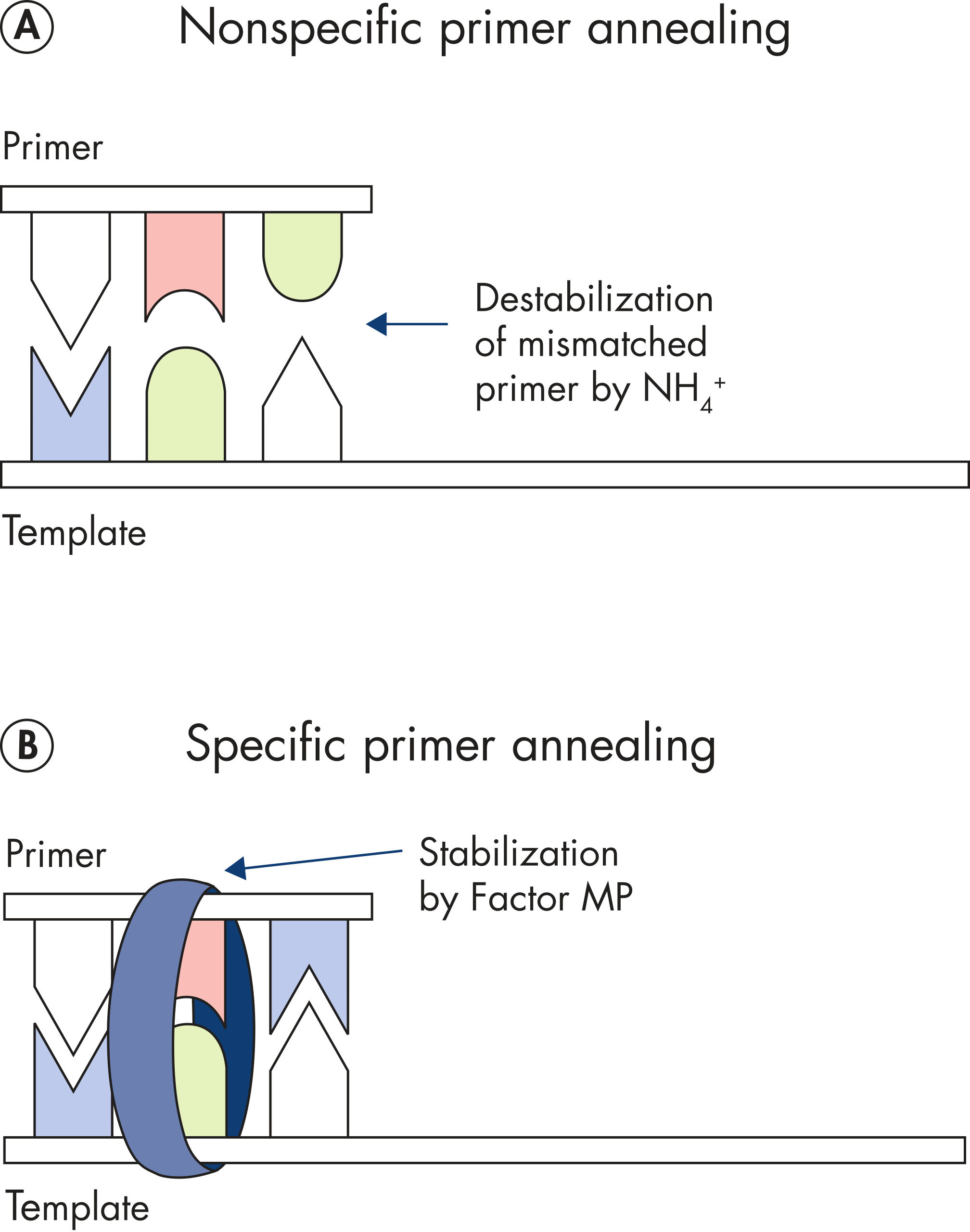
Les QuantiFast Pathogen +IC Kits permettent une détection sensible et rapide par PCR multiplex en temps réel ou par RT-PCR en une seule étape des acides nucléiques des pathogènes dès la première tentative (voir l’organigramme «  Kits multiplex QIAGEN »). Le mélange principal optimisé garantit que les produits PCR dans une réaction multiplex soient amplifiés avec la même efficacité et la même sensibilité que les produits PCR dans une réaction d’amplification simple correspondante. Le tampon PCR rapide spécialement développé contient le nouvel additif Q-Bond, qui réduit considérablement les temps de dénaturation, de renaturation et d’extension (voir figure «  Renaturation rapide de l’amorce »). Une combinaison équilibrée d’ions K+ et NH4+ ainsi que le Factor MP synthétique unique qui favorisent une renaturation stable et efficace des amorces et des sondes sur la matrice d’acide nucléique, ce qui permet une grande efficacité de la PCR (voir figure «  Tampon PCR unique »). En outre, la formulation unique de la Sensiscript Reverse Transcriptase garantit une transcription inverse très sensible de l’ARN viral, tandis que la HotStarTaqPlus DNA Polymerase assure un hot start rigoureux, empêchant la formation de produits non spécifiques.

Composant du QuantiFast Pathogen +IC Kit
Composant du kitCaractéristiquesAvantages
5x QuantiFast Pathogen PCR Master MixMélange principal concentréHautement concentré et optimisé pour une détection sensible des agents pathogènesPour augmenter la sensibilité du dosage, il est possible d’ajouter des volumes plus importants de matrice
HotStarTaq Plus DNA Polymerase5 min d’activation à 95 ºCRéglage des réactions qPCR à température ambiante
QuantiFast Pathogen BufferCombinaison équilibrée d’ions NH4+ et K+La renaturation spécifique des amorces garantit des résultats fiables de la PCR
Synthetic Factor MPAnalyse multiplexe fiable d’un maximum de 4 gènes dans le même tube
Additif unique Q-BondTemps d’exécution de la PCR plus rapides, permettant des résultats plus rapides et un plus grand nombre de réactions par jour
Test de contrôle interneMatrice de contrôle interneMatrice d’ADN de contrôle interne dans le QuantiFast Pathogen PCR +IC KitUn contrôle universel de l’amplification de l’ADN qui peut être utilisé avec différents dosages de pathogènes
ARN de contrôle interne dans le QuantiFast Pathogen RT-PCR +IC KitUn contrôle universel de l’amplification de l’ARN qui peut être utilisé avec différents dosages de pathogènes
Test de contrôle interneEnsemble d’amorces/sondes prémélangées (sonde TaqMan®) marquées au MAX (équivalent à HEX, VIC, etc.)N’interfère pas avec les amorces contre le pathogène-cible
Composants supplémentaires du kitQuantiFast Pathogen RT Mix*Contient une formulation unique de Sensiscript Reverse TranscriptaseOptimisé pour une détection très sensible de l’ARN pathogène
ROX Dye SolutionTube séparé de colorant de référence passif pour la normalisation des signaux fluorescents sur les systèmes de real-time PCR Applied Biosystems 7500. En option : Peut être utilisé sur les appareils Stratagene d’AgilentQuantification précise sur les thermocycleurs qui nécessitent le colorant ROX. N’interfère pas avec la PCR sur n’importe quel cycleur en temps réel
High-ROX Dye SolutionTube séparé de colorant de référence passif pour la normalisation des signaux fluorescents sur les systèmes de PCR en temps réel Applied Biosystems 7900 et StepOne
QuantiTect Nucleic Acid Dilution BufferFormule tampon exclusive pour la dilution et le stockage des étalons d’acides nucléiquesStabilise les étalons d’ARN et d’ADN pendant la dilution et la configuration de la réaction et empêche la perte d’acides nucléiques sur les surfaces en plastique, telles que les tubes ou les pointes de pipette

Procédure

Les QuantiFast Pathogen +IC Kits offrent une procédure simple pour la détection d’un pathogène défini par l’utilisateur et du contrôle interne. Ils contiennent un master mix prêt à l’emploi pour la détection en temps réel de l’ARN viral (RT-PCR en une étape) ou de l’ADN viral, bactérien et fongique (PCR). Il n’est pas nécessaire d’optimiser les conditions de réaction et de thermocyclage. Il suffit de mélanger le master mix fourni avec le dosage de l’agent pathogène (amorces et sonde) et l'Internal Control Assay ainsi que l'Internal Control DNA ou RNA Sinon, si l'Internal Control a été ajouté à la procédure de purification de l’échantillon, ajouter du RNase-free water à la place de l'Internal Control DNA or RNA au mélange réactionnel. Ajoutez ensuite votre échantillon d’ADN ou d’ARN et démarrez la réaction sur n’importe quel thermocycleur. Le manuel du kit contient des protocoles optimisés pour l’utilisation des sondes TaqMan® sur un grand nombre de thermocycleurs. Il contient également des recommandations pour la sélection des combinaisons de colorants.

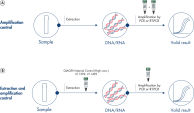
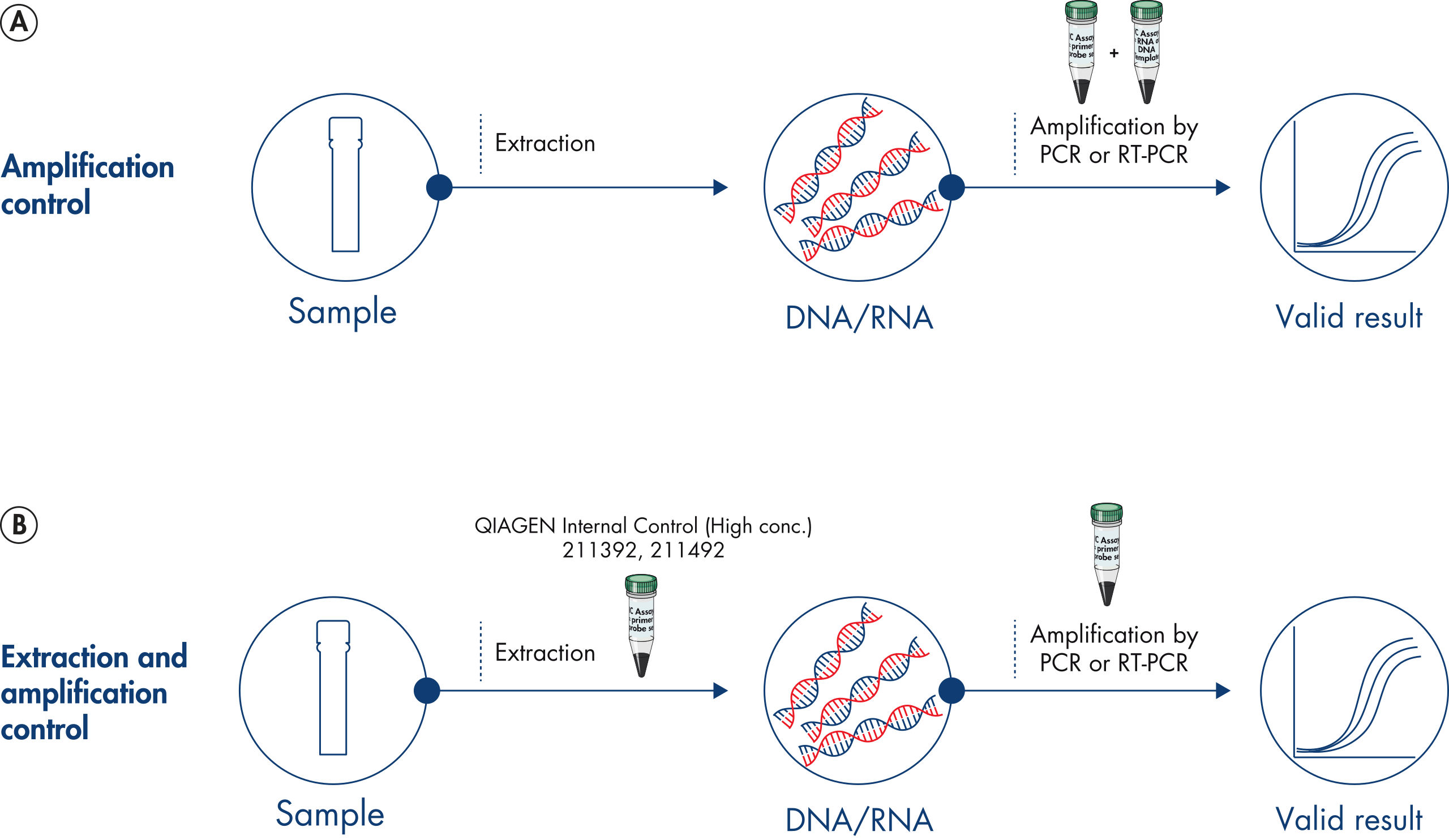
Chaque QuantiFast Pathogen +IC Kit comprend l'Internal Control Assay et l'Internal Control DNA ou RNA à utiliser comme contrôle d’amplification par ajout direct au mélange réactionnel. Par ailleurs, l’IC peut être ajouté à la procédure de purification afin de contrôler à la fois le processus de purification et l’amplification. Pour l’ajout du l'Internal Control à la procédure de purification, il est possible de commander séparément l'Internal Control DNA or RNA (High conc.) (voir figure «  Contrôle interne QIAGEN »).

Applications

Les QuantiFast Pathogen +IC Kits permettent une PCR en temps réel sensible ou une RT-PCR en une étape au moyen de sondes spécifiques de séquence pour la détection de l’ADN et/ou de l’ARN du pathogène, y compris un contrôle interne. Les kits peuvent être utilisés sur un grand nombre de thermocycleurs en temps réel, notamment les thermocycleurs de QIAGEN, Applied Biosystems, Bio-Rad, Roche (à l’exception des thermocycleurs capillaires) et Agilent.
Données et illustrations utiles

Spécifications

CaractéristiquesSpécifications
ApplicationsDétection des pathogènes : PCR en temps réel de l’ADN viral, bactérien ou fongique (QuantiFast Pathogen PCR +IC Kit) ou RT-PCR en une étape pour la détection de l’ARN viral (QuantiFast Pathogen RT-PCR +IC Kit)
Sample/target typeQuantiFast Pathogen PCR +IC Kit : ADN viral, bactérien ou fongique ; QuantiFast Pathogen RT-PCR +IC Kit : ARN viral
Single or multiplexDuplex
Reaction typePCR en temps réel ou RT-PCR en une étape incluant un contrôle interne (IC)
Real-time or endpointTemps réel
SYBR Green I or sequence-specific probesSondes spécifiques à une séquence
Thermal cyclerPour la plupart des thermocycleurs standards et rapides en temps réel compatibles avec la PCR/RT-PCR duplex, par exemple Rotor‑Gene Q ou les thermocycleurs d’Agilent, Applied Biosystems, BioRad, Roche
With or without ROXLe Master Mix est fourni sans colorant ROX, mais 2 solutions ROX distinctes sont incluses : High-ROX Dye Solution pour utilisation avec les thermocycleurs ABI sauf ABI 7500, ROX Dye Solution (ROX à faible concentration) pour utilisation avec ABI 7500 et autres fournisseurs

Ressources

Manuels de kit (5)
配列特異的なプローブを用いた高感度な1 ステップリアルタイムRT-PCR によるウイルスRNA およびインターナルコントロールの検出
配列特異的なプローブを用いた高感度リアルタイムPCR によるウイルス/バクテリアDNA およびインターナルコントロールの検出
Fiches de données de sécurité (2)
Download Safety Data Sheets for QIAGEN product components.
Brochures et guides (2)
Now with even more applications!
Safety Data Sheets (1)
Certificates of Analysis (1)

FAQ

What is the difference between QuantiTect Virus Kit and the new QuantiFast Pathogen +IC Kits?
The QuantiTect Virus Kit and the new QuantiFast Pathogen +IC Kits are based on similar reaction chemistry and show identical sensitivity but as a new feature, the QuantiFast Pathogen kits include an Internal Control template and the corresponding primer/probe set for duplex amplification of a user-defined pathogen target with the provided Internal Control. Additional new features are pack size, kit variants, ROX variants, and speed.
FAQ-2448
What are the labels of the probe which is used in the Internal Control Assay for detection of the IC?
In the QuantiFast Pathogen + IC kit, the probe is labeled with MAX-NHS ester (MAX) as the reporter dye which has a spectrum equivalent to HEX, JOE or VIC dyes. IowaBlack is used as the quencher dye. IowaBlack is a non-fluorescent quencher (dark quencher).
FAQ-2449
What is the nature of the Internal Control in the QuantiFast Pathogen + IC kit?
The DNA IC is a non-linearized plasmid. The RNA IC is an in vitro transcript. Both are naked nucleic acids. The size (base pair length) of both templates is sufficient to allow for efficient purification with standard methods for nucleic acid extraction.
FAQ-2450
Can the Internal Controls be ordered separately in the QuantiFast Pathogen + IC kit for use during purification?

Yes, the Internal Control RNA (High conc.) and Internal Control DNA (High conc.) templates are available under a separate catalog number. After reconstitution according to the description in the handbook, these IC templates have a 10x higher concentration than the Internal Control templates provided in the kits.   They are sufficiently concentrated to be spiked into the sample prep without replacing too much of the sample input volume.


**Please note that there is no assay (primer/probe set) for amplification of the IC included in these separate catalog numbers. The assay is only included in the QuantiFast Pathogen PCR +IC Kit and QuantiFast Pathogen RT-PCR +IC Kit.  The ICs cannot be used with the QuantiTect Virus kits because the assay (primer/probe set) for the detection of the IC is provided with the QuantiFast Pathogen Kits only.


FAQ-2451
How long does a QuantiFast Pathogen + IC run take on the Rotor-Gene Q?

Using the QuantiFast Pathogen + IC kits on the Rotor-Gene Q:


RT-PCR

 
40 cycles ~95 minutes
45 cycles ~100 minutes


PCR  
40 cycles ~75 minutes
45 cycles ~80 minutes

FAQ-2452
What is the detection limit for the QuantiFast Pathogen + IC kits?
The detection limit for the QuantiFast Pathogen RT-PCR and PCR kits is < 10 copies.
FAQ-2453
When using the QuantiFast Pathogen PCR +IC Kit or the QuantiFast Pathogen RT-PCR +IC Kit, what should the fluorescent label of the probe be for the customer-defined assay to detect the pathogen?
Typically, the target-specific probe should be labeled with FAM as the reporter dye and a non-fluorescent quencher (e.g., Dark Quencher, Black Hole Quencher [BHQ] or Iowa Black Quencher). Other reporter dyes than FAM, detected in a different detection channel than MAX, may also be suitable. It is not recommended to use fluorescent quenchers (e.g., TAMRA fluorescent dye). Due to their own native fluorescence, fluorescent quenchers contribute to an overall increase in background and reduce the signal-to-noise ratio.
FAQ-2594
Can the QuantiFast Pathogen PCR +IC Kit or the QuantiFast Pathogen RT-PCR +IC Kit be used with hybridization probes?

No, the QuantiFast Pathogen PCR +IC kits are designed for use with hydrolysis probes (also known as TaqMan® probes) only.

See trademarks

FAQ-2595
On which cyclers can the QuantiFast Pathogen PCR +IC Kit or the QuantiFast Pathogen RT-PCR +IC Kit be used?
The QuantiFast Pathogen PCR + RT-PCR +IC Kits can be used on all leading block cycler platforms, but not on capillary systems (e.g., LightCycler 2.0).
FAQ-2596
When performing the Internal Control assay for the QuantiFast Pathogen PCR +IC Kit and the QuantiFast Pathogen RT-PCR +IC Kit, what channel or filter can be used to detect MAX?
MAX can be detected using the same channels or filters as for HEX, JOE, or VIC.
FAQ-2597
Are the Internal Controls used in the QuantiFast Pathogen PCR +IC Kit and the QuantiFast Pathogen RT-PCR +IC Kit homologous to a known target?
No, the Internal Controls used in the QuantiFast Pathogen PCR +IC Kit and the QuantiFast Pathogen RT-PCR +IC Kit are an artificial sequence that is not present in biological sample material.
FAQ-2598
How many times can the Internal Controls used in the QuantiFast Pathogen PCR +IC Kit and the QuantiFast Pathogen RT-PCR +IC Kit be freeze-thawed?
The Internal Control templates can be freeze-thawed for up to 6 times without decrease in performance. However, great care should be taken to avoid inadvertently introducing RNAses/DNAses into the Internal Control template solutions. In general, in order to avoid repeated freeze-thaw cycles, we recommend preparing aliquots of the Internal Control templates.
FAQ-2599
What is the difference between adding the Internal Control (IC) template used in the QuantiFast Pathogen PCR +IC Kit and the QuantiFast Pathogen RT-PCR +IC Kit to the amplification reaction versus adding the IC template at the extraction step?
When the IC is added to the amplification reaction mix, the IC signal confirms that PCR amplification has been successful. When it is added at the extraction step to the lysis buffer or lysate, the IC signal confirms that nucleic acid purification and PCR amplification have been successful.
FAQ-2600
For the QuantiFast Pathogen RT-PCR +IC kit, does the Internal Control also control for the reverse transcription reaction?
Yes, the Internal Control RNA will only give the expected signal when both the reverse transcription and the PCR reactions have been successful.
FAQ-2601
Can the Internal Control DNA or RNA be added directly to the sample?
No, the Internal Control template DNA or RNA must be added to the lysis buffer or to the lysate in order to prevent the loss of Internal Control template thorough matrix effects.
FAQ-2602
Why do the Internal Control templates for extraction (Internal Control DNA or RNA [High conc.]) have a 10x higher concentration than the IC templates provided with the QuantiFast Pathogen PCR +IC Kit and the QuantiFast Pathogen RT-PCR +IC Kit?

After reconstitution according to handbook instructions, the Internal Control (IC) templates provided with the kits have a ready-to-use concentration for direct use as an amplification control in PCR or RT-PCR. For each 25 µl reaction, 2.5 µl of the IC are added, resulting in an expected CT value of approximately 29-30.

In order to achieve the same CT value when using the IC as an extraction control, more IC template has to be spiked in before extraction. The exact amount depends mainly on the elution volume. For each 1 µl of elution volume, 0.1 µl of the IC High conc. should be added to each of the extraction samples. This should result in a CT value in the PCR or RT-PCR reactions of approximately 29-30.


Examples: For 100 µl of elution volume, 10 µl of the IC, per sample, should be added to the lysis buffer or lysate. For 50 µl of elution volume, 5 µl of the IC, per sample, should be added to the lysis buffer or lysate.

FAQ-2603
Does the amount of Internal Control to be spiked into the lysis buffer or lysate depend on the elution volume only?

Principally, yes. However, additional factors influencing the CT are:

1. Extraction efficiency, which depends on extraction method and sample material.

2. Volume of the eluate used for PCR.

Examples: Use of the Internal Control according to handbook instructions (0.1µl per 1µl elution volume) for two different workflows.

  • Workflow 1: High extraction efficiency: use of 5 µl of the eluate for PCR results in a CT value of 29-30.
  • Workflow 2: High extraction efficiency: use of 10 µl of the eluate for PCR results in a CT of 28-29.

Depending on the workflow, the amount of Internal Control to be added to the extraction might have to be adjusted to more than 0.1 µl per 1 µl elution volume, or to less than 0.1 µl per 1 µl elution volume, in order to achieve a CT value within the expected range.

Running the Internal Control DNA/RNA provided with the QuantiFast Pathogen +IC Kit in a separate reaction can serve as a reference for adjusting the amount of Internal Control DNA/RNA (High conc.) to be added to the extraction.

FAQ-2604
Do the QuantiFast Pathogen PCR +IC Kit and the QuantiFast Pathogen RT-PCR +IC Kit contain ROX in the master mix?
The QuantiFast Pathogen PCR +IC Kit and the QuantiFast Pathogen RT-PCR +IC Kit are supplied with master mixes that do not contain ROX. Instead, 2 different ROX concentrations are supplied in separate tubes. “High-ROX Dye Solution” is suitable for use with all ABI cyclers except ABI 7500, and “ROX Dye Solution” is suitable for use with ABI 7500 and, optionally, instruments from Stratagene (Agilent). Recommendations are provided in the handbook.
FAQ-2605
Which DNA/RNA extraction kits were tested in combination with the QuantiFast Pathogen PCR +IC Kit and the QuantiFast Pathogen RT-PCR +IC Kit?
FAQ-2606
During data analysis, how should the threshold be set in the Yellow channel on the Rotor-Gene Q cycler to analyze the Internal Control from the QuantiFast Pathogen PCR +IC Kit or the QuantiFast Pathogen RT-PCR +IC Kit
On the Rotor-Gene Q, setting the threshold in the Yellow channel to an absolute value of 0.05 will give satisfactory results in most cases.
FAQ-2607
What should the Rotor-Gene Q cycler settings be for a duplex reaction with the pathogen assay (FAM) and the Internal Control assay (MAX), when using the QuantiFast Pathogen PCR +IC Kit or the QuantiFast Pathogen RT-PCR +IC Kit?
Please follow the instructions in the handbook. Briefly, use gain optimization “Before First Acquisition” for the pathogen assay (FAM) in the Green channel, and use a fixed gain of 9 for the Internal Control Assay (MAX) in the Yellow channel.
FAQ-2608
What should the cycler set-up be for a duplex reaction with the pathogen assay (FAM) and the Internal Control assay (MAX) on Mx instruments from Stratagene (Agilent), when using the QuantiFast Pathogen PCR +IC Kit or the QuantiFast Pathogen RT-PCR +IC Kit?
In the “Filter Gain Settings” dialog box, set the filter gain to a value of 4 for both the FAM/SYBR Green and HEX/JOE/VIC filters. See the Mx instrument/software manual for details.
FAQ-2609
What should the cycler set-up be for a duplex reaction with the pathogen assay (FAM) and the Internal Control assay (MAX) on ABI instruments, when using the QuantiFast Pathogen PCR +IC Kit or the QuantiFast Pathogen RT-PCR +IC Kit?
No calibration for MAX is needed if the instrument is calibrated for VIC. Use the FAM/SYBR Green filter for the pathogen assay and the VIC/JOE filter for the IC assay. To detect the Internal Control (MAX) in the VIC/JOE filter, create a new detector (e.g., “MAX/IowaBlack”). Assign “VIC” as the reporter dye and “None” for the quencher dye.
FAQ-2610
What is the threshold cycle or Ct value?
The Ct or threshold cycle value is the cycle number at which the fluorescence generated within a reaction crosses the fluorescence threshold, a fluorescent signal significantly above the background fluorescence. At the threshold cycle, a detectable amount of amplicon product has been generated during the early exponential phase of the reaction. The threshold cycle is inversely proportional to the original relative expression level of the gene of interest.
FAQ-2682
Why do replicates in real-time PCR have different plateau heights?

Replicates in real-time PCR may have different plateau heights due to differences in the reaction kinetics for each sample. Even though replicates start out with identical template amounts, the rate at which reagents are being depleted, and the point when exponential accumulation of PCR product stops and becomes linear, differ between replicates. This will result in different plateau heights, the stage where PCR reactions have come to a halt, and little or no additional PCR product is being amplified. You can find further information in Chapter 'Quantification of target amounts' of our Brochure "Critical Factors for Successful Real-Time PCR".


FAQ-539
Why does my realtime PCR assay quality decrease over time?
Make sure that template, primers, probes, and amplification reagents are stored correctly and avoid multiple freeze–thaw cycles for oligonucleotides and template. Check the performance of your real-time instrument as some instruments require the halogen lamp to be frequently replaced. Lasers must also be replaced occasionally.
FAQ-589