
✓ Traitement automatique des commandes en ligne 24 h/24 7 j/7
✓ Assistance technique et produits pertinente et professionnelle
✓ Commande (ou réapprovisionnement) rapide et fiable
Blood & Cell Culture DNA Mini Kit (25)
N° de réf. / ID. 13323
25 QIAGEN Genomic-tip 20/G, QIAGEN Protease, tampons
KitTampon
Blood & Cell Culture DNA Kit
Genomic DNA Buffer Set
Type de colonne
20/G
100/G
500/G
Les Blood & Cell Culture DNA Kits sont destinés aux applications de biologie moléculaire. Ces produits ne sont pas conçus pour le diagnostic, la prévention ou le traitement des maladies.
✓ Traitement automatique des commandes en ligne 24 h/24 7 j/7
✓ Assistance technique et produits pertinente et professionnelle
✓ Commande (ou réapprovisionnement) rapide et fiable
Caractéristiques
- Isolement fiable d’ADN de poids moléculaire élevé jusqu’à 150 kb en taille
- Pas d’extraction au phénol ou au chloroforme
- Traitement pratique en parallèle de plusieurs échantillons
Détails produit
Les Blood & Cell Culture DNA Kits fournissent un écoulement par gravité, des embouts et des tampons échangeurs d’anions pour un isolement efficace de l’ADN génomique pour une large gamme d’échantillons biologiques. La taille de l’ADN purifié peut monter jusqu’à 150 kb, avec une taille moyenne de 50 à 100 kb.
L’achat du Genomic DNA Buffer Set (n° de réf. 19060) est requis pour les échantillons de levures et de bactéries.
Performances
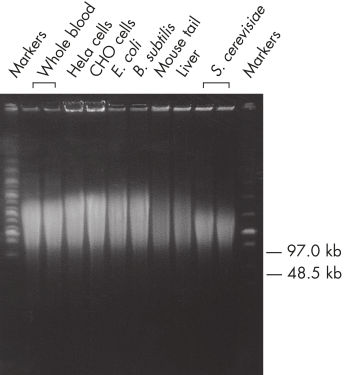
La procédure QIAGEN Genomic-tip est très délicate, et le cisaillement de l’ADN qui en résulte est négligeable. La taille de l’ADN purifié avec les QIAGEN Genomic-tips peut monter jusqu’à 150 kb avec une longueur moyenne de 50 à 100 kb (voir la figure « ADN génomique jusqu’à 150 kb »). L’ADN ne présente aucun contaminant tel que de l’ARN, des protéines ou des métabolites, et possède des ratios A260/A280 entre 1,7 et 1,9.
La taille exceptionnelle de l’ADN obtenu le rend particulièrement adapté à la préparation de bibliothèques de haute qualité pour le séquençage à haut débit (NGS) sur d’autres plateformes et est recommandée par plusieurs installations centrales.
Principe
Les QIAGEN Genomic-tips, inclus dans les Blood & Cell Culture DNA Kits, utilisent technologie unique d’échange d’anions de QIAGEN pour purifier l’ADN de poids moléculaire élevé à partir d’une grande variété d’échantillons biologiques sans nécessiter de phénol ou de chloroforme. Les tampons de lyse sont optimisés pour différents types d’échantillons et assurent une dénaturation immédiate des protéines, telles que les nucléases, les histones et les protéines de liaison à l’ADN ainsi que des particules virales potentiellement infectieuses. Grâce au pH et aux conditions de faible salinité garantis par le tampon, l’ADN se lie à la résine QIAGEN dans la colonne. Dans le même temps, d’autres composants cellulaires, tels que les protéines, les glucides et les métabolites s’écoulent. L’ADN purifié est élué dans un tampon à haute salinité. Les Genomic-tips fonctionnent par écoulement par gravité et peuvent donc être laissés sans surveillance sans qu’ils ne s’assèchent. Cela réduit au minimum la durée de manipulation et rend la procédure idéale pour un traitement simultané de plusieurs échantillons.
Procédure
Les échantillons sont d’abord lysés (les échantillons de tissus sont mécaniquement désagrégés) et les protéines simultanément dénaturées dans le tampon de lyse approprié (voir le schéma « Procédure QIAGEN Genomic-tip »). La QIAGEN Protease ou Proteinase K est ensuite ajoutée et, après un temps d’incubation approprié, les lysats sont chargés sur le QIAGEN Genomic-tip. L’ADN se lie à la colonne pendant que les autres composants cellulaires s’écoulent. À la suite d’une étape de lavage pour éliminer tout contaminant résiduel, l’ADN pur de poids moléculaire élevé est élué et précipité avec de l’isopropanol. La durée complète de manipulation pour la procédure est de seulement 30 minutes pour le sang et les cellules de culture.
Les Blood & Cell Culture DNA Kits sont des kits prêts à l’emploi contenant tous les composants nécessaires pour la purification d’ADN de poids moléculaire élevé à partir de sang et de cellules de culture.
Applications
L’ADN purifié à l’aide des Blood & Cell Culture DNA Kits est adapté pour les applications suivantes :
- Séquençage Sanger et séquençage à haut débit
- Séquençage à lecture longue
- Analyse par RFLP
- Analyse de ciblage de gène
- Criblage d’animaux transgéniques
- Études de profilage génétique
- Amplification par PCR
| Fonctionnalités | Blood & Cell Culture DNA Mini Kit | Blood & Cell Culture DNA Midi Kit | Blood & Cell Culture DNA Maxi Kit |
|---|---|---|---|
| Applications | PCR, RFLP, transfert, dépistage | PCR, RFLP, transfert, dépistage | PCR, RFLP, transfert, dépistage |
| Volume d’élution | 0,1 à 2 ml | 0,1 à 2 ml | 0,1 à 2 ml |
| Format | Genomic-tip | Genomic-tip | Genomic-tip |
| Type d’échantillon principal | Sang, cellules | Sang, cellules | Sang, cellules |
| Traitement | Manuel | Manuel | Manuel |
| Purification de l’ARN total, du miARN, de l’ARNm poly A+, de l’ADN ou des protéines | ADN | ADN | ADN |
| Quantité d’échantillon | 1 ml/5 x 106 | 5 ml/2 x 107 | 20 ml/1 x 108 |
| Technologie | Technologie d’échange d’anions | Technologie d’échange d’anions | Technologie d’échange d’anions |
| Rendement | 15 à 20 µg | 80 à 100 µg | 350 à 400 µg |
Données et illustrations utiles
ADN génomique jusqu’à 150 kb.
Électrophorèse sur gel en champ pulsé d’ADN (2 µg) purifié à l’aide des QIAGEN Genomic-tips. M : marqueurs.
Ressources
Protocoles de démarrage rapide (1)
Fiches de données de sécurité (2)
Protocoles élaborés par l’utilisateur (2)
Manuels de kit (1)
Safety Data Sheets (1)
Certificates of Analysis (1)
Publications
Lack of telomerase RNA gene hTERC expression in alternative lengthening of telomeres cells is associated with methylation of the hTERC promoter.
Cancer Res; 2001; 61 (1):27-32 2001 Jan 1 PMID:11196173
GATA-3 is an important transcription factor for regulating human NKG2A gene expression.
J Immunol; 2005; 174 (4):2152-9 2005 Feb 15 PMID:15699146
FAQ
How do I safely inactivate biohazardous flow-through material?
Does the Epitect Bisulfite Kit also work on DNA extracted from plants?
What is the size of genomic DNA that is obtained with QIAGEN Genomic-tips?
Do you have a protocol for the purification of DNA from fruit flies?
What is the composition of Buffer G2?
What is the composition of Buffer B1?
What is the composition of Buffer B2?
How do I perform a DNA precipitation to concentrate my sample?
What do you recommend for the cleanup of genomic DNA (gDNA)?
What can be used as an alternative to the A260 measurement for quantification of small amounts of RNA and DNA?
Do you have a protocol for the isolation of genomic DNA from frozen clotted blood?
Do you have a protocol for isolation of genomic DNA from insects?
Do you have a protocol for the isolation of genomic DNA from fungi?