
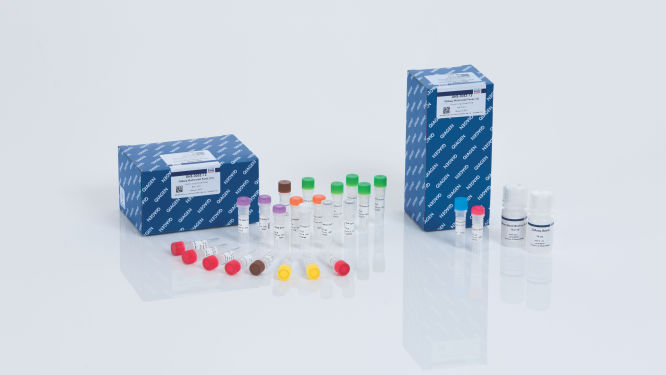
QIAseq Multimodal HC Panel (12)
Cat no. / ID. 333942
QIAseq Multimodal HC Panel (12) contains ALL reagents (except indices) sufficient to process 12 samples for multimodal (DNA and RNA) sequencing; fixed high content panel for a total of 24 reactions
Browse product options to see pricing
PanelIndex
Panel
Index
For number of samples
12
96
| Popular Products | GeneGlobe ID |
|---|---|
| QIAseq Multimodal Human Pan Cancer Panel | UHS-5000Z |
Features
- QIAseq enrichment technology is the basis for Multimodal's uniform and complete coverage of targets, including complex genes like CEPBA, and confident detection of known and novel fusions
- Pre-optimized protocol to go from total nucleic acid extraction to preparation of UMI-containing, unique dual-indexed, NGS-ready libraries using a single-day workflow to enhance sensitivity, improve error correction and reduce index hopping
- Pre-configured automation-compatible workflow solution with secondary analysis and variant interpretation for rapid onboarding, faster turnaround time and improved scalability
Product Details
QIAseq Multimodal Panels have been developed for consolidated targeted DNA and RNA enrichment and analyses. Unlike other available approaches, QIAseq Multimodal Panels do not require 2 separate workflows for DNA and RNA analysis – saving time and conserving samples that are of limited availability.
Principle
Recent advances in NGS chemistries, platforms, and bioinformatics pipelines are enabling users to efficiently interrogate biological samples for changes in DNA and RNA. Other available approaches, however, require the use of 2 separate workflows to prepare libraries from separate DNA and RNA isolates. Limitations of such approaches include:
- Large amounts of sample material required for generating sufficient amounts of input DNA and RNA for multiple workflows
- Added complexity of deriving integrated insights from results of different technical approaches, each with its own innate bias
- Inefficient use of resources
- Long turn-around times
To overcome the limitations associated with current approaches, QIAseq Multimodal Panels start with total nucleic acids (or DNA + RNA) and prepares UDI-containing, Illumina-compatible targeted DNA and RNA libraries using a single-day, consolidated workflow. In addition, QIAseq Multimodal Panels have been designed for use with low-yield and poor-quality biological samples.
Procedure
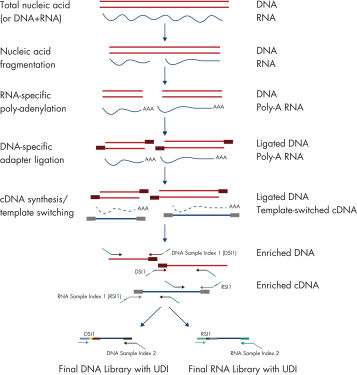
Workflow of the QIAseq Multimodal Panels
The QIAseq Multimodal Panel workflow can be used to prepare sequencing-ready libraries in a single day. The library insert size is approximately 150 bp, making the QIAseq Multimodal Panels highly compatible with low-quality samples, such as FFPE samples.
Robust detection of DNA and RNA biomarkers
QIAseq Multimodal Panels can be used to reliably detect DNA and RNA biomarkers using a consolidated workflow from total nucleic acids. The ability of QIAseq Multimodal Panels to simultaneously detect DNA and RNA biomarkers has been benchmarked against two separate workflows (namely, QIAseq Targeted DNA Panels and QIAseq RNA Fusion XP Panels).
Applications
QIAseq Multimodal Panels can be used to interrogate different types of biomarkers using a consolidated workflow from total nucleic acids, which can be isolated using dedicated sample isolation protocols that have been developed specifically for the QIAseq Multimodal Panels.
From DNA:
- Single nucleotide variants (SNVs)
- Insertions and Deletions (InDels)
- Copy number variants (CNVs)
- TMB score
- MSI status
From RNA:
- Fusions
- Exon skipping events
- Gene expression levels
Supporting data and figures
Workflow
The QIAseq Multimodal HT Panel workflow
Resources
Brochures & Guides (4)
Kit Handbooks & Protocols (2)
Software-related downloads (7)
Validation & Technical Documentation (1)
Safety Data Sheets (1)
Certificates of Analysis (1)
Publications
Single-nucleotide polymorphism profiling by multimodal-targeted next-generation sequencing in methotrexate-resistant and -sensitive human osteosarcoma cell lines.
Front Pharmacol; 2023; 14:1294873 2023 Nov 22 PMID:38074116
CANTRK: A Canadian Ring Study to Optimize Detection of NTRK Gene Fusions by Next-Generation RNA Sequencing.
J Mol Diagn; 2022; 25 (3):168-174 2022 Dec 28 PMID:36586421
Harmonization of tumor mutation burden testing with comprehensive genomic profiling assays: an IQN Path initiative.
J Immunother Cancer; 2024; 12 (2) 2024 Feb 2 PMID:38309725
Comprehensive biomarker diagnostics of unfavorable cancer of unknown primary to identify patients eligible for precision medical therapies.
Eur J Cancer; 2024; 200:113540 2024 Jan 26 PMID:38316065
All-in-one bimodal DNA and RNA next-generation sequencing panel for integrative diagnosis of glioma.
Pathol Res Pract; 2024; 263:155598 2024 Sep 28 PMID:39357189