
✓ Procesamiento automático sin interrupción de pedidos en línea
✓ Servicio técnico y para productos experto y profesional
✓ Realización y repetición de pedidos rápidas y fiables
Blood & Cell Culture DNA Mini Kit (25)
N.º de cat. / ID. 13323
25 QIAGEN Genomic-tip 20/G, QIAGEN Protease y Buffers
KitSolución tampón
Blood & Cell Culture DNA Kit
Genomic DNA Buffer Set
Tipo de columna
20/G
100/G
500/G
Blood & Cell Culture DNA Kits están concebidos para su uso en aplicaciones de biología molecular. Estos productos no están concebidos para el diagnóstico, la prevención ni el tratamiento de enfermedades.
✓ Procesamiento automático sin interrupción de pedidos en línea
✓ Servicio técnico y para productos experto y profesional
✓ Realización y repetición de pedidos rápidas y fiables
Características
- Aislamiento fiable de ADN de alto peso molecular de hasta 150 kb
- Sin extracciones con fenol o cloroformo
- Procesamiento cómodo y en paralelo de varias muestras
Detalles del producto
Los Blood & Cell Culture DNA Kits proporcionan tampones y puntas de intercambio aniónico de flujo por gravedad para el aislamiento eficaz de ADN genómico a partir de una amplia gama de muestras biológicas. El ADN purificado tiene un tamaño de 150 kb, con un tamaño medio de entre 50 y 100 kb.
Es necesario adquirir el Genomic DNA Buffer Set (número de catálogo 19060) para las muestras de levaduras y bacterias.
Rendimiento
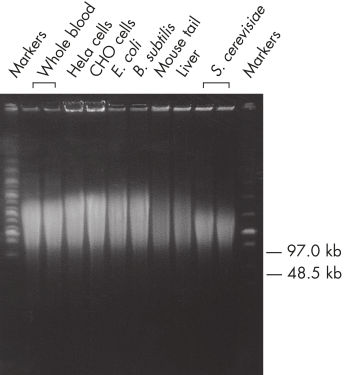
El procedimiento con QIAGEN Genomic-tip es muy suave, por lo que genera un ADN con el mínimo cizallamiento. El ADN purificado con QIAGEN Genomic-tips tiene un tamaño de 150 kb, con un tamaño medio de entre 50 y 100 kb (consulte la figura “ADN genómico de hasta 150 kb”). El ADN no contiene ningún tipo de contaminante, como ARN, proteínas o metabolitos, y ofrece una relación A260/A280 de entre 1,7 y 1,9.
El tamaño excepcionalmente grande del ADN obtenido lo hace especialmente adecuado para preparar genotecas de alta calidad para la secuenciación de última generación (NGS) en distintas plataformas y está recomendado por varias instalaciones centrales.
Principio
Las QIAGEN Genomic-tips, que se incluyen en los Blood & Cell Culture DNA Kits, utilizan una tecnología de intercambio aniónico exclusiva de QIAGEN para purificar el ADN de alto peso molecular desde una amplia gama de muestras biológicas sin aplicar fenol ni cloroformo. Los tampones de lisis están optimizados para distintos tipos de muestras y proporcionan una desnaturalización inmediata de proteínas, como nucleasas, histonas y proteínas de unión al ADN, así como partículas víricas potencialmente infecciosas. En las condiciones de pH y baja salinidad que proporciona el tampón, el ADN se une a la resina de QIAGEN en la columna. Al mismo tiempo, otros constituyentes celulares, como proteínas, carbohidratos y metabolitos, fluyen libremente. El ADN purificado se eluye en un tampón de salinidad alta. Las puntas genómicas funcionan por efecto de la gravedad. Además, no necesitan supervisión y no se secan. Esto reduce el tiempo de manipulación al mínimo y hace que el procedimiento sea idóneo para procesar varias muestras en paralelo.
Procedimiento
En primer lugar, las muestras se lisan (se aplica disrupción mecánica a las muestras de tejido) y las proteínas se desnaturalizan simultáneamente en el tampón de lisis adecuado (consulte el gráfico de flujo “Procedimiento con las QIAGEN Genomic-tips”). A continuación, se añade QIAGEN Protease o Proteinase K y, tras un periodo de incubación adecuado, los lisados se cargan en QIAGEN Genomic-tip. El ADN se une a la columna mientras que otros constituyentes celulares fluyen libremente. A continuación, se lleva a cabo un paso de lavado para eliminar cualquier contaminante que haya quedado. Después, el ADN puro de alto peso molecular se eluye y precipita con isopropanol. El tiempo de manipulación para el procedimiento completo es de solo 30 minutos para sangre y células cultivadas.
Los Blood & Cell Culture DNA Kits son kits listos para usarse que contienen todos los componentes necesarios para la purificación de ADN de alto peso molecular de sangre y células cultivadas.
Aplicaciones
El ADN purificado con Blood & Cell Culture DNA Kits es idóneo para su uso en las siguientes aplicaciones:
- Secuenciación de Sanger y secuenciación de última generación
- Secuenciación de lectura larga
- Análisis de RFLP
- Análisis genético dirigido
- Cribado de animales transgénicos
- Estudios de identificación del ADN
- Amplificación por PCR
| Características | Blood & Cell Culture DNA Mini Kit | Blood & Cell Culture DNA Midi Kit | Blood & Cell Culture DNA Maxi Kit |
|---|---|---|---|
| Aplicaciones | PCR, RFLP, blotting, cribado | PCR, RFLP, blotting, cribado | PCR, RFLP, blotting, cribado |
| Volumen de elución | 0,1-2 ml | 0,1-2 ml | 0,1-2 ml |
| Formato | Punta genómica | Punta genómica | Punta genómica |
| Tipo de muestra principal | Sangre, células | Sangre, células | Sangre, células |
| Procesamiento | Manual | Manual | Manual |
| Purificación de ARN total, miARN, ARNm poli A+, ADN o proteína | ADN | ADN | ADN |
| Cantidad de muestra | 1 ml/5 × 106 | 5 ml/2 × 107 | 20 ml/1 × 108 |
| Tecnología | Tecnología de intercambio aniónico | Tecnología de intercambio aniónico | Tecnología de intercambio aniónico |
| Rendimiento | 15-20 µg | 80-100 µg | 350-400 µg |
Datos y cifras de respaldo
ADN genómico de hasta 150 kb.
Electroforesis en gel de campo pulsado (PFGE) de ADN (2 µg) purificado con QIAGEN Genomic-tips. M: marcadores.

Recursos
Protocolos de inicio rápido (1)
Hojas de datos sobre seguridad (2)
Protocolos desarrollados por el usuario (2)
Manuales de uso de kits (1)
Safety Data Sheets (1)
Certificates of Analysis (1)
Publicaciones
Lack of telomerase RNA gene hTERC expression in alternative lengthening of telomeres cells is associated with methylation of the hTERC promoter.
Cancer Res; 2001; 61 (1):27-32 2001 Jan 1 PMID:11196173
GATA-3 is an important transcription factor for regulating human NKG2A gene expression.
J Immunol; 2005; 174 (4):2152-9 2005 Feb 15 PMID:15699146
Preguntas frecuentes
How do I safely inactivate biohazardous flow-through material?
Does the Epitect Bisulfite Kit also work on DNA extracted from plants?
What is the size of genomic DNA that is obtained with QIAGEN Genomic-tips?
Do you have a protocol for the purification of DNA from fruit flies?
What is the composition of Buffer G2?
What is the composition of Buffer B1?
What is the composition of Buffer B2?
How do I perform a DNA precipitation to concentrate my sample?
What do you recommend for the cleanup of genomic DNA (gDNA)?
What can be used as an alternative to the A260 measurement for quantification of small amounts of RNA and DNA?
Do you have a protocol for the isolation of genomic DNA from frozen clotted blood?
Do you have a protocol for isolation of genomic DNA from insects?
Do you have a protocol for the isolation of genomic DNA from fungi?