HiSpeed Plasmid Kits

Zur ultraschnellen Aufreinigung von bis zu 750 µg transfektionsfähiger Plasmid- oder Cosmid-DNA

S_1376_DNA_PLS0763

✓ Automatische Verarbeitung von Online-Bestellungen 24/7

✓ Sachkundiger und professioneller technischer und Produkt-Support

✓ Schnelle und zuverlässige (Nach-)Bestellung

HiSpeed Plasmid Midi Kit (25)

Kat.-Nr. / ID.   12643

25 HiSpeed Midi Tips, 25 QIAfilter Midi Cartridges, 25 QIAprecipitator Midi Module plus Spritzen, Reagenzien, Puffer.
Kartuschentyp
Midi
Maxi
HiSpeed Plasmid Kits sind für molekularbiologische Anwendungen vorgesehen. Diese Produkte sind nicht zur Diagnose, Prävention oder Behandlung einer Erkrankung vorgesehen.

✓ Automatische Verarbeitung von Online-Bestellungen 24/7

✓ Sachkundiger und professioneller technischer und Produkt-Support

✓ Schnelle und zuverlässige (Nach-)Bestellung

Eigenschaften

  • Präparationsdauer unter 60 Minuten
  • Lysatbereinigung und Isopropanolausfällung ohne Zentrifugation
  • Kein Risiko des Verlusts von DNA-Pellets beim Ausfällen
  • Ausbeute von bis zu 750 µg Plasmid-DNA mit hoher Kopienzahl
  • LyseBlue für optimale Lyse und maximale DNA-Ausbeute
  • Plasmidpräparation im großen Maßstab ohne Vakuumverteiler

Angaben zum Produkt

HiSpeed Plasmid Kits ermöglichen eine schnelle, auf Anionenaustausch basierende Plasmid-DNA-Präparation in großem Maßstab ohne Zentrifugation. Die aufgereinigte DNA entspricht der durch zweimalige CsCl-Gradientenzentrifugation gewonnenen DNA und eignet sich für transfektionsfähige Anwendungen.

Leistung

HiSpeed Plasmid Kits enthalten QIAfilter Cartridges, HiSpeed Tips und QIAprecipitator Module für die schnelle Plasmidpräparation im großen Maßstab ohne Vakuumverteiler. Die QIAfilter und QIAprecipitator Module im Spritzenformat ersetzen die Zentrifugationsschritte im klassischen Anionenaustauschverfahren und beschleunigen und vereinfachen die Plasmidaufreinigung. Aus 150 µl – 250 ml bzw. 50 µl – 150 ml Kulturmedium können bis zu 750 µg (Maxi) bzw. 200 µg (Midi) Plasmid-DNA mit hoher Kopienzahl bereinigt werden (das Kulturvolumen hängt von der Plasmid-Kopienzahl, der Größe des Inserts, dem Wirtsstamm und dem Kulturmedium ab). Der Aufbau der HiSpeed Tips ermöglicht eine sehr hohe Durchflussrate, so dass die DNA-Bindung, das Waschen und die Elutionsschritte für die Plasmidaufreinigung schneller erfolgen können.

Das innovative Anionenaustauscherharz der HiSpeed Tips wurde ausschließlich für die Aufreinigung von Nukleinsäuren entwickelt. Seine hervorragenden Trenneigenschaften führen zu einer DNA-Reinheit, die der durch zwei aufeinanderfolgende Durchgänge der CsCl-Gradientenzentrifugation erzielten Reinheit gleichwertig oder überlegen ist.

Prinzip

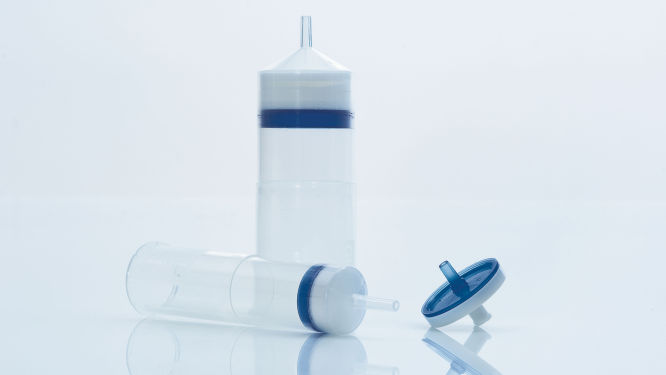
QIAfilter Cartridges (siehe Abbildung „ QIAfilter Cartridge“) sind spezielle Filtereinheiten, die den Zentrifugationsschritt nach der alkalischen Lyse von Bakterienzellen ersetzen sollen. QIAfilter Cartridges entfernen SDS-Niederschlag vollständig und bereinigen Bakterienlysate in einem Bruchteil der für die Zentrifugation benötigten Zeit. Die vorverpackten HiSpeed Tips arbeiten nach dem Schwerkraftprinzip und trocknen nie aus, was den Zeitaufwand für die manuelle Plasmidpräparation minimiert.
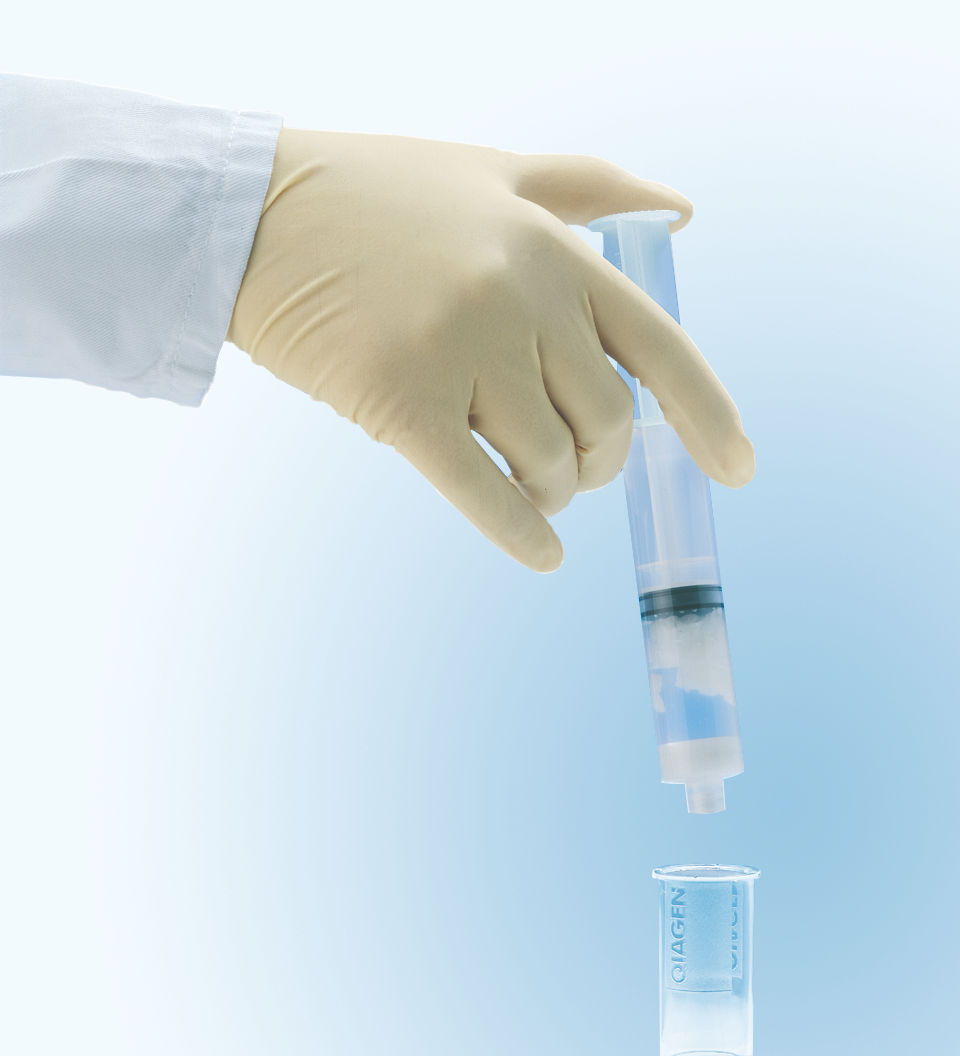
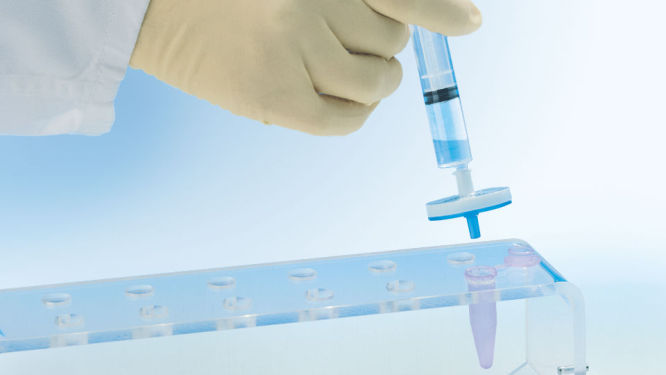
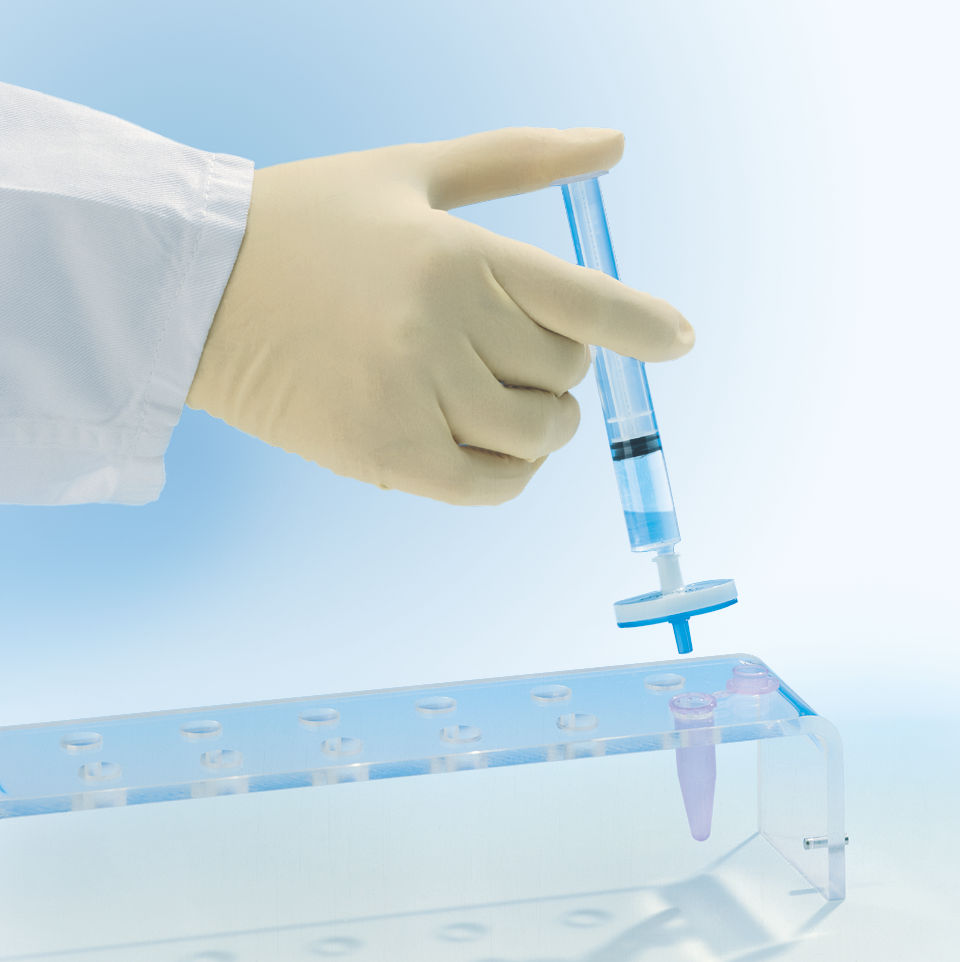
Das neuartige QIAprecipitator Modul (siehe Abbildung „ QIAprecipitator Modul“) ersetzt den Zentrifugationsschritt, der traditionell zum Auffangen der mit Isopropanol ausgefällten DNA nach der Aufreinigung dient. Das QIAprecipitator Modul scheidet die ausgefällte DNA ab, während das Isopropanol-Puffergemisch durch das Modul strömt. Die DNA wird dann einfach aus dem QIAprecipitator in ein Mikrozentrifugenröhrchen mit TE-Puffer oder Wasser eluiert. Dieses spezielle Modul eliminiert auch das Risiko des Pelletverlustes, zu dem es beim Abgießen des Überstandes nach der Zentrifugation kommen kann.

Spezifikationen
Merkmale HiSpeed Plasmid Midi Kit HiSpeed Plasmid Maxi Kit
Anwendungen Transfektion, Klonierung, Sequenzierung, Gen-Silencing Transfektion, Klonierung, Sequenzierung, Gen-Silencing
Kulturvolumen/Ausgangsmaterial 50 µl – 150 ml Kulturvolumen 150 µl – 250 ml Kulturvolumen
Plasmidtyp Cosmid-DNA mit hohem Kopienanteil Cosmid-DNA mit hohem Kopienanteil
Verfahren Manuell (Filtration) Manuell (Filtration)
Probe pro Lauf 1 Probe pro Lauf 1 Probe pro Lauf
Technologie Anionenaustausch-Technologie Anionenaustausch-Technologie
Dauer pro Lauf 45 min 60 min
Ausbeute <200 µg <750 µg

Verfahren

Neutralisierte Bakterienlysate werden in der QIAfilter Cartridge inkubiert und in Sekundenschnelle durch Filtration bereinigt. Das Filtrat wird für die Aufreinigung der Plasmid-DNA auf ein HiSpeed Tip aufgebracht (siehe Flussdiagramm „QIAGEN Plasmid Kit-Verfahren“). Die eluierte DNA wird mit Isopropanol versetzt und mit der mitgelieferten Spritze auf das QIAprecipitator Modul aufgetragen. Die konzentrierte und entsalzte DNA wird dann aus dem QIAprecipitator direkt in ein Mikrozentrifugenröhrchen mit TE-Puffer oder Wasser eluiert.

Anwendungen

Mit HiSpeed Plasmid Kits aufgereinigte DNA liefert hervorragende Ergebnisse bei allen Anwendungen, von der Klonierung und Sequenzierung bis zur Transfektion und dem plasmidvermittelten Gen-Silencing.

Ergänzende Daten und Abbildungen

Ressourcen

Kurzprotokolle (2)
Sicherheitsdatenblätter (1)
Download Safety Data Sheets for QIAGEN product components.
Safety Data Sheets (1)
Certificates of Analysis (1)

Publikationen

Characterization of Helicobacter pylori lytic transglycosylases Slt and MltD.
Chaput C; Labigne A; Boneca IG;
J Bacteriol; 2006; 189 (2):422-9 2006 Nov 3 PMID:17085576
Identification of a lipase-linked cell membrane receptor for pigment epithelium-derived factor.
Notari L; Baladron V; Aroca-Aguilar JD; Balko N; Heredia R; Meyer C; Notario PM; Saravanamuthu S; Nueda ML; Sanchez-Sanchez F; Escribano J; Laborda J; Becerra SP;
J Biol Chem; 2006; 281 (49):38022-37 2006 Oct 10 PMID:17032652
Role of parathyroid hormone in the downregulation of liver cytochrome P450 in chronic renal failure.
Michaud J; Naud J; Chouinard J; Désy F; Leblond FA; Desbiens K; Bonnardeaux A; Pichette V;
J Am Soc Nephrol; 2006; 17 (11):3041-8 2006 Oct 4 PMID:17021269
A rapid functional assay for the human trace amine-associated receptor 1 based on the mobilization of internal calcium.
Navarro HA; Gilmour BP; Lewin AH;
J Biomol Screen; 2006; 11 (6):688-93 2006 Jul 10 PMID:16831861
Engineering of a xylose metabolic pathway in Corynebacterium glutamicum.
Kawaguchi H; Vertès AA; Okino S; Inui M; Yukawa H;
Appl Environ Microbiol; 2006; 72 (5):3418-28 2006 May PMID:16672486

FAQ

Where can I find a protocol for cleanup of already purified plasmid DNA?

When using the silica-based QIAprep Spin Miniprep Kit, a protocol is contained in the QIAprep Miniprep Handbook, in Appendix C: Special Applications. The protocol is called: 'Purification of plasmid DNA prepared by other methods'.

For our anion-exchange based Plasmid Purification Kits, a protocol can be accessed online at our Plasmid Resource Center, and is called 'Re-Purification of Plasmid DNA Prepared by Methods other than QIAGEN Tips'.


FAQ-1031
I am seeing a precipitate after adding LyseBlue reagent to Buffer P1. What should I do about that?

A precipitate forming upon adding LyseBlue reagent to Buffer P1 is a normal observation. This precipitate will completely dissolve after addition of Buffer P2. Please be sure to shake Buffer P1 vigorously before use to completely resuspend LyseBlue particles.

FAQ-1045
What are the additional plasmid bands I see on my gel?

Open circular plasmid, resulting from single strand nicks, usually migrates slower in agarose gels and forms (faint) bands above the supercoiled plasmid DNA band. Sometimes an additional band of denatured supercoiled DNA migrates just below the supercoiled form. This form may result from prolonged alkaline lysis with Buffer P2 and is resistant to restriction digestion.

For a detailed description on how to run and interpret an analytical gel, please see Appendix A in the QIAGEN Plasmid Purification Handbook: "Agarose Gel Analysis of the Purification Procedure", or visit this link.

FAQ-1059
How can I prevent clogging of QIAfilter cartridges?
It is important to completely mix and lyse bacterial cells with plasmid Buffers P1 and P2. Incomplete mixing results in sticky or slimy areas of lysate, which will clog the filter matrix. It is recommended to completely resuspend cells in Buffer P1 and vigorously mix after addition of Buffer P2. Also mixing after Buffer P3 addition needs to be complete to allow fluffy precipitation of cell debris, which will float up. If the white debris does not float, dislodge it from the QIAfilter barrel wall (e.g. using a sterile pipette tip). Otherwise it will collect on the filter matrix and can lead to clogging. Use of LyseBlue reagent will help to achieve proper mixing results.
FAQ-1060
How can I increase DNA concentration using QIAprecipitators of the HiSpeed Plasmid Kits?
Use 500 µl instead of 1 ml of Buffer TE for elution of plasmid DNA from the QIAprecipitator of the HiSpeed Plasmid Kits. If low copy plasmids are used, the lysates of two QIAfilter Cartridges can be filtered into one equilibrated HiSpeed Tip. HiSpeed Maxi Kits will result in higher DNA concentration than HiSpeed Midi Kits, because the QIAprecipitators in both kits (Midi- and Maxi Module) use the same elution volume.
FAQ-1061
How can I improve the performance of the HiSpeed QIAprecipitator module?

When using the QIAprecipitator module of the HiSpeed Plasmid Midi- or Maxi Kits, make sure to dry the membrane by pressing air through the QIAprecipitator at least twice. Dry the outlet nozzle of the QIAprecipitator with absorbent paper. This will prevent carry-over of alcohol into the eluate and enable optimal performance of the extracted DNA downstream.

Do not load eluate from from several columns on the QIAprecipitator, and be sure that the correct precipitator size is used for the corresponding HiSpeed Tip. Do not replace the isopropanol with ethanol for precipitation, since the use of ethanol will lead to a finer precipitate that can clog the module.

To prevent breakage and leakage of the module it is important to avoid excessive force, bending, or twisting while attaching the QIAprecipitator to the syringe. Do not stress the inlet by resting one edge of the QIAprecipitator on a hard surface (e.g., the edge of a sink) and depressing the syringe plunger. Always apply gentle, even, pressure perpendicularly to the QIAprecipitator.

FAQ-144
What is the RNase A concentration and composition of Buffer P1?

The composition of Buffer P1 is:

  • 50 mM Tris·Cl, pH 8.0
  • 10 mM EDTA
  • 100 µg/ml RNase A

After RNase A addition, the buffer should be stored at 2–8°C.

Buffer P1 is the resuspension buffer used in a variety of QIAGEN kits for plasmid DNA purification. Details on buffer preparation and storage are presented in Appendix B of the QIAGEN Plasmid Purification Handbook.

FAQ-198
Can I use water for elution from the QIAprecipitator of the HiSpeed Plasmid Kits?

Yes, when eluting DNA from the QIAprecipitator Modules of the HiSpeed Plasmid Kits, water or buffers commonly used to dissolve DNA (e.g., Tris) may be employed.

Note: Store DNA at -20°C when eluted with water as DNA may degrade in the absence of buffering and chelating agents.

FAQ-306
What is the lowest elution volume that can be used with QIAprecipitator Midi and Maxi Modules?

The lowest elution volume that should be used for both the QIAprecipitator Midi and the Maxi Module provided in the HiSpeed Plasmid Kits is 500 ul. The official elution volume for both modules is 1 ml. If a higher DNA concentration is desired and a reduction in yield of up to 10% is acceptable, the elution volume can be reduced. Elution volumes smaller than 500 ul will lead to incomplete wetting of the QIAprecipitator membrane and further reduced DNA yields.

FAQ-307
Are the QIAprecipitator Midi and Maxi Modules of the HiSpeed Plasmid Kits interchangeable?
No, the QIAprecipitator Midi and Maxi modules of the HiSpeed Plasmid Midi- and Maxi Kits are not interchangeable. Each module has been designed for different capacities and recoveries.
FAQ-308
Can Buffers N3 and P3 be used interchangeably?
No. Although both Buffers N3 of the QIAprep Spin Miniprep and P3 of the QIAGEN Plasmid Kits perform the neutralization step in an alkaline lysis procedure, they are completely different. Buffer N3 contains a proprietary formula that sets up binding conditions for the QIAprep Miniprep column's silica-gel-membrane. Buffer P3 sets up binding conditions for QIAGEN anion-exchange columns. Our website explains QIAGEN's nucleic acid purification technologies in more detail.
FAQ-310
Can I use ethanol instead of isopropanol for DNA precipitation when using HiSpeed Plasmid Kits?

No. Ethanol is not recommended when using the QIAprecipitator module of the HiSpeed Plasmid Kits for DNA precipitation. The finer precipitates formed with ethanol are likely to clog the QIAprecipitator.

FAQ-354
Can I eliminate RNase A from buffer P1 for my plasmid preparation to obtain RNase-free DNA for in-vitro transcription?
No, RNase A should not be omitted from buffer P1. It is required to prevent RNA contamination of the purified plasmid DNA. RNase A will not interfere with downstream in-vitro transcription experiments, since it will be efficiently removed during the plasmid purification procedures using QIAGEN Plasmid Kits.
FAQ-366
What is the composition of buffer QBT?

Buffer QBT is the equilibration buffer used in QIAGEN Plasmid Kits for plasmid purification and in QIAGEN Blood & Cell culture kits.

The composition of Buffer QBT is:

  • 750mM NaCl • 50 mM MOPS, pH 7.0
  • 15% isopropanol (v/v)
  • 0.15 % Triton® X-100 (v/v)

To make 1 liter of solution, dissolve 43.83 g NaCl, 10.46 g MOPS (free acid) in 800 ml distilled water. Adjust the pH to 7.0 with NaOH. Add 150 ml pure isopropanol and 15 ml 10% Triton X-100 solution (v/v). Adjust the volume to 1 liter with distilled water. Store at 15–25°C

FAQ-411
What is the composition of buffer QC?

Buffer QC is the wash buffer used in QIAGEN Plasmid Kits for plasmid purification and in QIAGEN Blood & Cell Culture kits.

The composition of Buffer QC is:

  • 1.0 M NaCl
  • 50 mM MOPS, pH 7.0
  • 15% isopropanol (v/v)


To make 1 liter of solution, dissolve 58.44 g NaCl, 10.46 g MOPS (free acid) in 800 ml distilled water. Adjust the pH to 7.0 with NaOH. Add 150 ml pure isopropanol. Adjust the volume to 1 liter with distilled water. Store at 15–25°C.

FAQ-412
What is the composition of buffer QF?

Buffer QF is the elution buffer used in QIAGEN Plasmid Kits for plasmid purification and in QIAGEN Blood & Cell culture kits.

The composition of Buffer QF is:

  • 1.25 M NaCl
  • 50 mM Tris-Cl, pH 8.5
  • 15% isopropanol (v/v)


To make 1 liter of solution, dissolve 73.05 g NaCl and 6.06 g Tris base in 800 ml distilled water. Adjust the pH to 8.5 with HCl. Add 150 ml pure isopropanol. Adjust the volume to 1 liter with distilled water. Store at 15–25°C

FAQ-413
What is the composition of buffer STE?

The composition of Buffer STE is:

  • 100 mM NaCl
  • 10 mM Tris-Cl, pH 8.0
  • 1 mM EDTA

Buffer STE is a DNA resuspension and storage buffer used in QIAGEN Plasmid Kits for plasmid purification and in some plasmid supplementary protocols. Details on buffer preparation and storage are presented in Appendix B of the QIAGEN Plasmid Purification Handbook.

FAQ-415
What is the composition of buffer TE?

The composition of Buffer TE is:

  • 10 mM Tris·Cl, pH 8.0
  • 1 mM EDTA

Buffer TE is a commonly used DNA resuspension and storage buffer. It is supplied in QIAGEN's Endofree Plasmid Kits, and used for plasmid DNA resuspension in combination with other QIAGEN Plasmid Kits. Details on buffer preparation and storage are presented in Appendix B of the QIAGEN Plasmid Purification Handbook.

FAQ-416
What is the composition of buffer P3?

The composition of Buffer P3 is:

  • 3.0 M potassium acetate, pH 5.5

Buffer P3 is the neutralization buffer used in QIAGEN's anion-exchange based Kits for plasmid preparation. Details of buffer preparation and storage are presented in Appendix B of the QIAGEN Plasmid Purification Handbook.

FAQ-418
What can I do when the DNA pellet prepared with QIAGEN Plasmid Kits has been overdried?
Redissolve the DNA by warming the solution slightly, e.g. incubate it at 37°C, and allow more time for redissolving.
FAQ-572