
Need bulk, customized or optimized products for commercial purposes? We also offer support with logistics, compliance and more. Reach out to cooperate with QIAGEN Strategic Partnerships & OEM
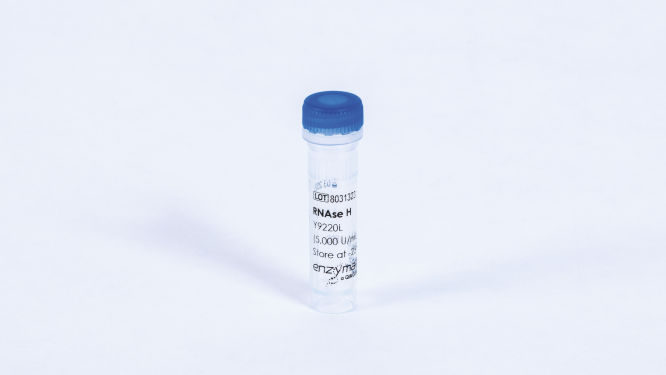
Thermostable RNase H (5000 U/mL)
Cat no. / ID. Y9250-5000-FIN
Thermostable RNase H (5000 U/mL)
The Thermostable RNase H (5000 U/mL) is intended for molecular biology applications. This product is not intended for the diagnosis, prevention, or treatment of a disease.
The Thermostable RNase H is intended for molecular biology applications. This product is not intended for the diagnosis, prevention, or treatment of a disease.
Need bulk, customized or optimized products for commercial purposes? We also offer support with logistics, compliance and more. Reach out to cooperate with QIAGEN Strategic Partnerships & OEM
Features
- Optimal activity above 65°C for high-stringency reactions with reduced nonspecific hybridization
- Improves specificity by enabling selective cleavage of RNA in RNA-DNA hybrids at elevated temperatures
- Suitable for rRNA depletion, cDNA synthesis and RNA amplification workflows
- Manufactured and quality tested for reliable molecular biology performance
- Available exclusively as a bulk reagent for commercial and large-scale molecular biology applications
Product Details
Thermostable RNase H (Ribonuclease H) is an engineered endoribonuclease that specifically hydrolyzes the RNA strand of RNA-DNA hybrids without degrading the complementary DNA strand. This enzyme will not degrade single or double-stranded DNA or RNA strands that are not hybridized to DNA. Unlike conventional RNase H enzymes that operate at moderate temperatures, this thermostable variant retains activity during elevated-temperature incubations, enabling improved hybridization specificity and more selective RNA removal. It is active over a broad range of temperatures ≥ 50ºC with optimal activity above 65ºC, and as high as 95ºC.
The ability to perform reactions above 65°C helps disrupt RNA secondary structures and minimizes nonspecific probe binding, resulting in greater consistency and selectivity in demanding workflows.
Thermostable RNase H is available exclusively in bulk quantities for commercial-scale supply. To request a sample or discuss your application requirements, please contact our Customization Team.
Supplied in:
50 mM Tris-HCl, 100 mM NaCl, 1 mM dithiothreitol, 0.1 mM EDTA, stabilizer, 50% glycerol, pH 7.5 @ 25ºC:
For workflows that do not require elevated incubation temperatures, standard RNase H provides selective degradation of RNA in RNA-DNA hybrids with reliable performance and ease of use.
Performance
Thermostable RNase H is quality tested for enzyme activity, purity and consistent performance in molecular biology applications.
- Storage temperature: -25ºC to -15ºC
- Molecular weight: 18.7 kDa
| Test | Amount tested | Specification |
|---|---|---|
| Purity | n/a | >99% |
| Single-stranded exonuclease | 500 U | <5.0% Released |
| Double-stranded exonuclease | 500 U | <1.0% Released |
| Double-stranded endonuclease | 500 U | No conversion |
| E. coli DNA contamination | 500 U | < 10 copies |
| Non-specific RNase | 500 U | No detectable non-specific RNase |
One unit is defined as the amount of enzyme that will hydrolyze 1 nmol of RNA from an 3H-labeled DNA:RNA hybrid molecule into acid-soluble material in 20 minutes at 50°C.
Principle
Thermostable RNase H is a non-specific endoribonuclease that hydrolyzes phosphodiester bonds within the RNA strand of RNA-DNA hybrids while leaving the DNA strand unaffected. The enzyme requires divalent metal ions for catalysis and functions optimally at elevated temperatures, making it particularly valuable in workflows where higher hybridization stringency improves target specificity.
Operating at higher temperatures helps denature stable RNA secondary structures and reduces unintended hybridization events, enabling more selective cleavage of intended RNA targets while preserving non-target transcripts. These characteristics make Thermostable RNase H particularly useful in next-generation sequencing library preparation, transcriptomics workflows and nucleic acid amplification technologies.
Procedure
Thermostable RNase H specifically degrades the RNA strand in an RNA/DNA duplex while leaving the DNA strands and any single-stranded RNA molecules intact.
For the reaction buffer, we recommend 10X RNase H Buffer (B9920), which provides final concentrations of 50 mM Tris-HCl (pH 8.3), 75 mM KCl, 3 mM MgCl2, and 10 mM DTT. The optimal enzyme amount, RNA/DNA input, and reaction temperature may vary depending on the specific sequences and application and should be determined empirically for best results. As a starting point, the reaction can be assembled as follows:
| Component | Quantity for 50 µl reaction |
|---|---|
| RNA/DNA Duplex | 1 µg to 2.5 µg |
| 10X RNase H Buffer (B9220) | 5 µl (1X) |
| Thermostable RNase H (5000 U/ml) | 0.5 µl to 5 µl (2.5 U to 25 U) |
| Nuclease-Free Water | Bring to 50 µl |
Incubate at 50°C for 10 to 20 min. Depending on the application, the optimal reaction temperature may be higher, up to or above 65°C.
Applications
Thermostable RNase H is designed for workflows that benefit from selective RNA degradation under high-stringency conditions.
- rRNA depletion for RNA sequencing: High-temperature incubation improves probe specificity by reducing secondary structure and nonspecific hybridization, enabling efficient and selective depletion of ribosomal RNA.
- Poly(A) tail removal: Removes poly(A) tails from mRNA molecules hybridized to oligo(dT), facilitating downstream molecular biology applications.
- Second-strand cDNA synthesis: Efficiently removes RNA templates following first-strand synthesis while preserving the complementary DNA strand.
- RNA isothermal amplification and NASBA: Supports nucleic acid sequence-based amplification (NASBA) and related isothermal amplification methods requiring controlled degradation of RNA within RNA hybrids.